
When a big storm finally rolls out of San Jose, the quiet that follows is often unsettling. Homeowners step outside to see what the wind and rain have left behind. That first look—a massive oak branch dangling over the driveway or a heritage redwood suddenly leaning—is what kicks off a very specific, and very urgent, search.
This guide explains why that post-storm “arborist near me” search is so critical for South Bay residents. We’ll cover the immediate dangers, the hidden risks unique to our local climate, and what a professional sees that you can’t.
The Critical Search After The Storm Hits
It’s a pattern we see after every major weather event, from Diablo winds to atmospheric rivers. San Jose residents grab their phones and type in “arborist near me.” This isn’t just about tidying up a messy yard; it’s a critical first step in managing serious risk. The chaos a storm leaves behind creates immediate dangers that only a trained professional can safely handle.
After just one series of winter storms, PG&E crews had to remove 13,263 storm-damaged trees across their service area. On a single day, the City of San Jose fielded 219 calls for downed trees, forcing city crews into round-the-clock mode. This is the reality of living with large, beautiful trees in our unique microclimates.
On top of the immediate safety issues, homeowners are often thrown into the confusing world of insurance. Getting expert advice on understanding fallen tree insurance claims can be a lifesaver.
The decision to bring in a professional arborist boils down to a few core concerns:
- Safety and Risk Assessment: A homeowner might see a broken branch, but an arborist sees invisible stress fractures, a compromised root system, and other limbs that could fail without warning.
- Property Protection: It’s about preventing that leaning pine from becoming an unwanted skylight in your living room or crushing your car.
- Liability Concerns: If your tree is threatening a neighbor’s property, the liability clock is ticking. Addressing that risk proactively is essential.
In a crisis, it’s tempting to hire the first person who answers the phone. Our guide on what to look for before hiring a tree service in San Jose can help you find a qualified, licensed tree removal contractor.
Immediate Post-Storm Tree Hazards Checklist
After the storm passes and it’s safe to go outside, use this checklist to perform a quick visual inspection from a safe distance. Never approach a tree that is near a downed power line or appears unstable.
| Hazard Type | What to Look For | Immediate Action |
|---|---|---|
| Broken/Hanging Limbs | Large branches cracked but still attached, often called “widow-makers.” | Stay far away from the area underneath. Call an arborist for emergency removal. |
| Leaning Trees | The entire tree is tilting at a new, noticeable angle. Look for heaving soil at the base. | Evacuate the area in the potential fall path. This is an emergency situation. |
| Split Trunks | A deep crack running vertically down the main trunk, especially where large limbs meet. | This is a sign of imminent failure. Cordon off the area and call immediately. |
| Root Plate Damage | Exposed roots, or soil and turf that looks like it has been lifted up around the base. | A major sign of instability. The tree could topple with the next gust of wind. |
| Utility Line Contact | Any tree limb touching or entangled with power lines, phone, or cable wires. | Assume the line is live. Contact your utility company (PG&E) and an arborist. |
This checklist isn’t a substitute for a professional assessment, but it helps you spot the most urgent dangers so you know when to make that emergency call.
Uncovering the Invisible Dangers in Your Yard
After a big storm blows through, it’s easy to focus on the obvious—a snapped branch on the lawn or a pile of leaves by the curb. But the real reason so many San Jose homeowners search for an arborist near me after every storm is for the dangers you can’t see. The most serious threats are often hidden, lurking just beneath the soil or deep within the tree’s trunk.
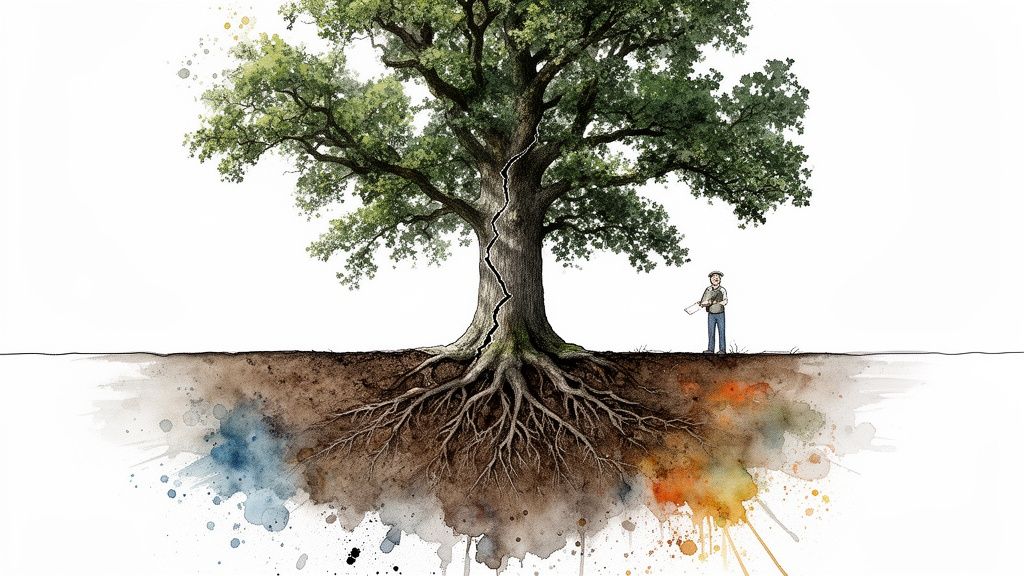
A mature tree is like a car that’s been in a fender-bender. The paint might just be scratched, but underneath, the frame could be bent, making it unsafe to drive. A tree is the same after being thrashed by high winds and drenching rain. It might look fine, but its core stability could be compromised.
The Problem Beneath Your Feet: San Jose Clay Soil
Here in San Jose, our infamous clay soil is a big part of the problem. After an atmospheric river drops inches of rain, that same dense soil turns into a slick, unstable mess. Once waterlogged, the soil loses its grip on the tree’s root system.
Suddenly, a massive, top-heavy tree is essentially standing in a bowl of pudding. The next gust of wind could send it toppling, even days after the sky has cleared. This is a huge concern in neighborhoods with mature canopies, like Willow Glen, Almaden, and Cambrian.
A tree that looks perfectly healthy from your porch can have a completely compromised root system underground. A soil-saturation and root-zone assessment is the only way to reveal the true level of risk.
Subtle Signs of Serious Trouble
While you can’t see what’s happening underground, a trained arborist knows exactly what to look for above ground. They can spot the subtle clues that a tree’s structure has been weakened and is at risk of failing.
A professional inspection involves looking for things like:
- Hairline Cracks: These tiny fissures on the trunk or major limbs are stress fractures, weak points waiting for the right pressure to give way.
- Minor Ground Heaving: A slight mound or lift in the soil around the base is a dead giveaway the root plate is shifting and losing its anchor.
- Canopy Imbalance: If one side of the tree lost a lot of branches, its weight is no longer evenly distributed, putting enormous strain on the trunk and remaining limbs.
Catching these signs is exactly why getting a professional opinion is so important. A certified arborist doesn’t just glance at a broken branch; they perform a full diagnostic check.
How San Jose’s Unique Climate Turns Our Trees Into Hazards
The rush to find an arborist after a storm in San Jose isn’t just about the wind. It’s a direct consequence of the South Bay’s punishing climate cycle: long, parched droughts followed by sudden, intense downpours. This cycle creates the perfect conditions for catastrophic tree failure.
Our dense clay soil acts like a dry sponge. After months without rain, the ground becomes almost like concrete, leaving tree roots dehydrated and brittle.
The Drought-to-Deluge Whiplash Effect
Then, an atmospheric river hits, unloading a staggering amount of water onto this baked, compacted ground. The deluge doesn’t just rehydrate the soil—it completely oversaturates it. The firm earth that once anchored a tree’s root system turns into a soupy, unstable mess.
This rapid transition from drought stress to soil saturation puts our iconic local trees in serious jeopardy.
- Valley Oaks & Coast Live Oaks: Found all over San Jose, from Willow Glen to Cambrian, their massive canopies and shallow root systems make them extremely vulnerable when the soil gives way.
- Redwoods: These giants have shallow root plates that simply weren’t designed to hold their incredible height steady in liquefied clay soil, making them a huge fall risk after heavy rains.
This environmental whiplash is the number one reason San Jose homeowners are frantically searching for an arborist near me after every storm. They’re seeing the direct results of our region’s extreme weather firsthand.
Hillside Homeowners Face Double the Danger
If you live in a hillside community like the Los Gatos foothills or parts of Almaden, the danger is compounded. The steep terrain increases runoff, washing away soil from the root base. It also creates a wind-tunneling effect, where gusts slam into trees with greater force, targeting trees already weakened by saturated soil.
The climate is shifting, and these storms are only getting more intense. Projections show that by 2050, the amount of rain we get during the heaviest downpours will rise significantly. To understand how this affects local trade professionals, take a look at our guide on how San Jose’s storm seasons are reshaping contractor demand.
On top of that, about 42% of buildings in San Jose are already at risk of flooding (Source: ClimateCheck), a risk directly tied to the same soil saturation that destabilizes our trees. After a storm, a professional assessment from an arborist who understands our local conditions is the only way to get a clear picture of the threats you’re facing. You can explore more about San Jose’s climate risks on ClimateCheck.com.
What a Certified Arborist Sees That You Can’t
After a big storm, you can spot the obvious damage—a big branch on the lawn or a torn limb. But when a certified arborist shows up, they are looking at your trees on a completely different level. Their job is to find what’s about to break.
A professional arborist conducts a systematic Tree Risk Assessment, analyzing the tree as a whole system. It’s this deep understanding that separates a true expert from someone who just cuts wood.
The Professional Diagnostic Process
An arborist is trained to spot the subtle, almost invisible clues of instability that a storm can leave behind. They start at the top and work their way right down into the soil.
Here’s a glimpse of what’s on their checklist:
- Root Collar Stability: They inspect the base of the trunk for tiny signs of ground heaving or soil pulling away, which are red flags that the root system has lost its grip in our waterlogged clay soil.
- Canopy Weight Distribution: When a tree loses a major limb, its entire center of gravity shifts. An arborist can pinpoint which remaining branches are now under dangerous stress.
- Invisible Stress Fractures: Powerful winds can create hairline cracks in major limbs, especially where they connect to the trunk. These are ticking time bombs that only a trained eye can spot.
- Internal Decay: A storm can tear away protective bark, creating an open wound. Professionals use advanced methods for decay detection to assess rot deep inside the trunk.
This process connects the dots. The graphic below shows how our unique drought-and-deluge cycle here in the South Bay sets the stage for tree failure.
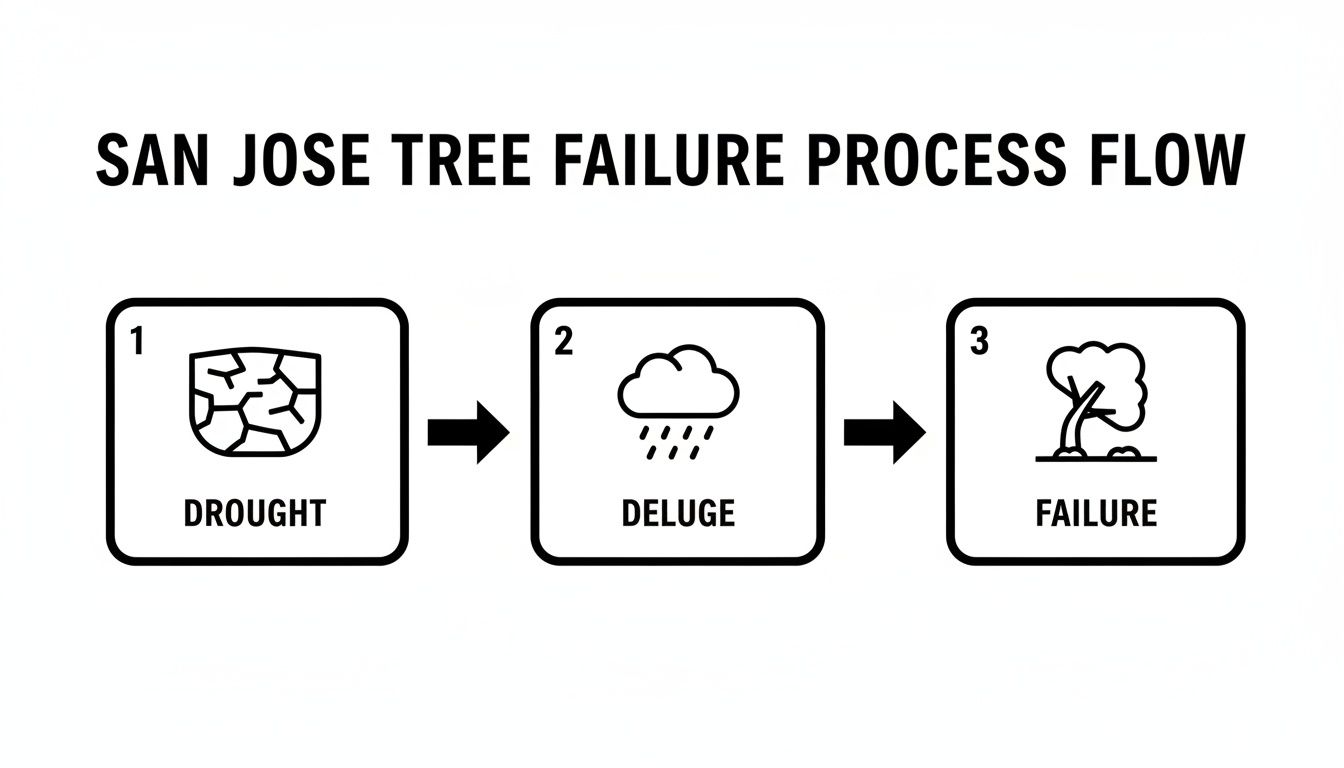
As you can see, years of drought weaken the root system, and then a sudden, intense rainy season saturates the soil until it’s like mud. The already-stressed roots simply can’t hold on anymore.
DIY Check vs Professional Arborist Inspection
| Assessment Factor | Homeowner Check (Visible Signs) | Certified Arborist Analysis (Technical) |
|---|---|---|
| Leaning | Obvious tilting of the entire tree. | Measures the degree of lean and identifies soil heaving at the root base. |
| Branches | Large broken or hanging limbs. | Detects hairline stress fractures and weak branch unions (“codominant stems”). |
| Trunk | Visible cracks, large cavities, or missing bark. | Assesses for internal decay, fungi presence, and structural integrity. |
| Roots | Exposed or severed roots from uprooting. | Checks the entire root collar for signs of instability and compromised anchoring. |
| Overall Health | Dead leaves or discolored foliage. | Evaluates canopy density, new growth patterns, and signs of pest infestation or disease. |
Ultimately, a homeowner’s check is a good first step, but an arborist’s inspection is a comprehensive safety and health diagnosis for your property’s biggest assets.
Bringing in a licensed and insured professional isn’t just about getting the work done right; it’s a critical move to protect yourself from liability. An official assessment from a qualified arborist provides the expert documentation you need for insurance claims and guarantees the job is handled safely.
Your Guide to Storm-Proofing Your Trees Before the Season
The best way to handle storm damage is to prevent it from happening in the first place. Proactive tree care puts you in the driver’s seat. Think of it as preventative medicine for your yard—a smart way to keep your property safe and your trees standing tall.
Getting your trees ready for San Jose’s storm season is one of the wisest investments you can make as a homeowner. It all begins with a professional pre-season inspection to spot hidden weaknesses before the first atmospheric river rolls in.
Taking Proactive Steps for a Safer Yard
A certified arborist can map out a custom plan to get your trees ready for high winds and drenching rain. Proper trimming is key to a tree’s health and structure, making it far more resistant to gusty conditions. You can check out some essential methods for trimming limbs on trees to better protect your yard.
A solid storm-proofing plan often involves a few key tactics:
- Strategic Canopy Thinning: An expert will selectively remove limbs to reduce the tree’s density. This lets wind flow through the canopy instead of pushing against it like a giant sail, drastically cutting the risk of the tree toppling over.
- Addressing Soil Compaction: Our South Bay clay soil can get packed down. An arborist can treat the soil to improve drainage, so it’s less likely to turn into a soupy mess that can’t hold onto roots during a heavy downpour.
- Cabling and Bracing: For a beautiful old oak or redwood with heavy limbs or a weak V-shaped trunk, installing steel cables or braces can give it the structural support it needs to weather the storm. This technique can be the difference between saving a beloved tree and losing it.
Proactive care is always cheaper than emergency removal. When you find and fix risks before the storms arrive, you’re protecting your home and keeping your mature trees healthy for years to come.
Taking these steps ahead of time moves you from being a potential storm victim to a prepared homeowner. You can learn more about how to prevent tree damage before the next big storm in San Jose in our detailed guide.
Your South Bay Partner in Storm Recovery & Preparedness
The storms we get here in San Jose, from gusty winter winds to sudden downpours, can leave behind obvious and hidden dangers. The single most important call you can make for your family’s safety is to a licensed, local arborist who understands our regional challenges.
While proactive care is the best defense, nature is unpredictable. When a storm does hit, you need a team that knows the South Bay landscape. For our neighbors in San Jose, Almaden, Willow Glen, Campbell, and Los Gatos, we’re here to help you navigate the aftermath with emergency response and expert assessments. We also provide a full range of professional arborist services to build resilience in your trees long before the next storm.
You can trust San Jose Tree Service & Landscaping (CSLB #985639, BBB Accredited) to bring that local expertise to your property. Contact us today for a consultation or emergency service.
Frequently Asked Questions (FAQs)
My tree is leaning after the storm. Should I be worried?
Yes, a leaning tree is an emergency. It indicates root failure and is an immediate fall risk, so you should call for an emergency assessment without delay.
Will my insurance policy cover storm-related tree removal?
Most policies cover removal if the tree has fallen on a covered structure, like your house or garage. A detailed report from a certified arborist is often required for a smooth claims process.
Is it okay to clean up small branches myself after a storm?
Yes, clearing small debris from walkways is fine. However, never touch large branches, especially those still hanging in the tree, as they can be unstable and extremely dangerous.
How do I know if my tree is truly safe after a storm?
The only way to know for sure is with a professional risk assessment. A certified arborist can spot hidden dangers like hairline fractures and root plate damage that are invisible to the untrained eye.
Why is it important to hire a licensed and insured arborist?
A valid license (like our CSLB #985639) proves competency, and proper insurance protects you from all liability if an accident occurs on your property. It’s your guarantee of working with a safe, accountable professional.