
Direct Answer: Have an arborist assess your mature trees before any design work begins. Root zones decide where hardscape, trenching, and grading can go, and that shapes the entire plan.
You have been thinking about redoing the yard for a couple of years. Maybe the lawn is tired, the drainage pools against the patio every January, or the irrigation is a patchwork of repairs. So you start sketching, start pricing, and plan to break ground in 2027.
Here is where I would push back on the usual order of operations. Most people hire a designer first and only bring in a tree person if something needs to come out. On an older property in Willow Glen, Almaden Valley, Saratoga or Los Gatos, that is backwards.
The mature trees are the most valuable and least replaceable thing on your lot. Their root zones decide where you can trench, grade, pour, and plant. Settle that first and the design gets better. Skip it and you can lose a 60-year-old tree to a project meant to make the yard nicer.
Why the Arborist Assessment Comes Before the Drawing
A mature tree keeps most of its feeder roots in the top 12 to 18 inches of soil, spread out well past the edge of the canopy. Nothing about that is visible when you are standing in the yard with a tape measure.
A common way to figure the protected area is 12 times the trunk diameter, or the dripline plus about five feet, whichever is wider. On a 30-inch oak that is roughly a 30-foot radius. That circle usually covers a lot of the ground a renovation wants to use.
The damage that kills trees during construction is rarely dramatic. It is quiet and slow:
- Grade changes. Adding six inches of soil or base rock over roots cuts off oxygen.
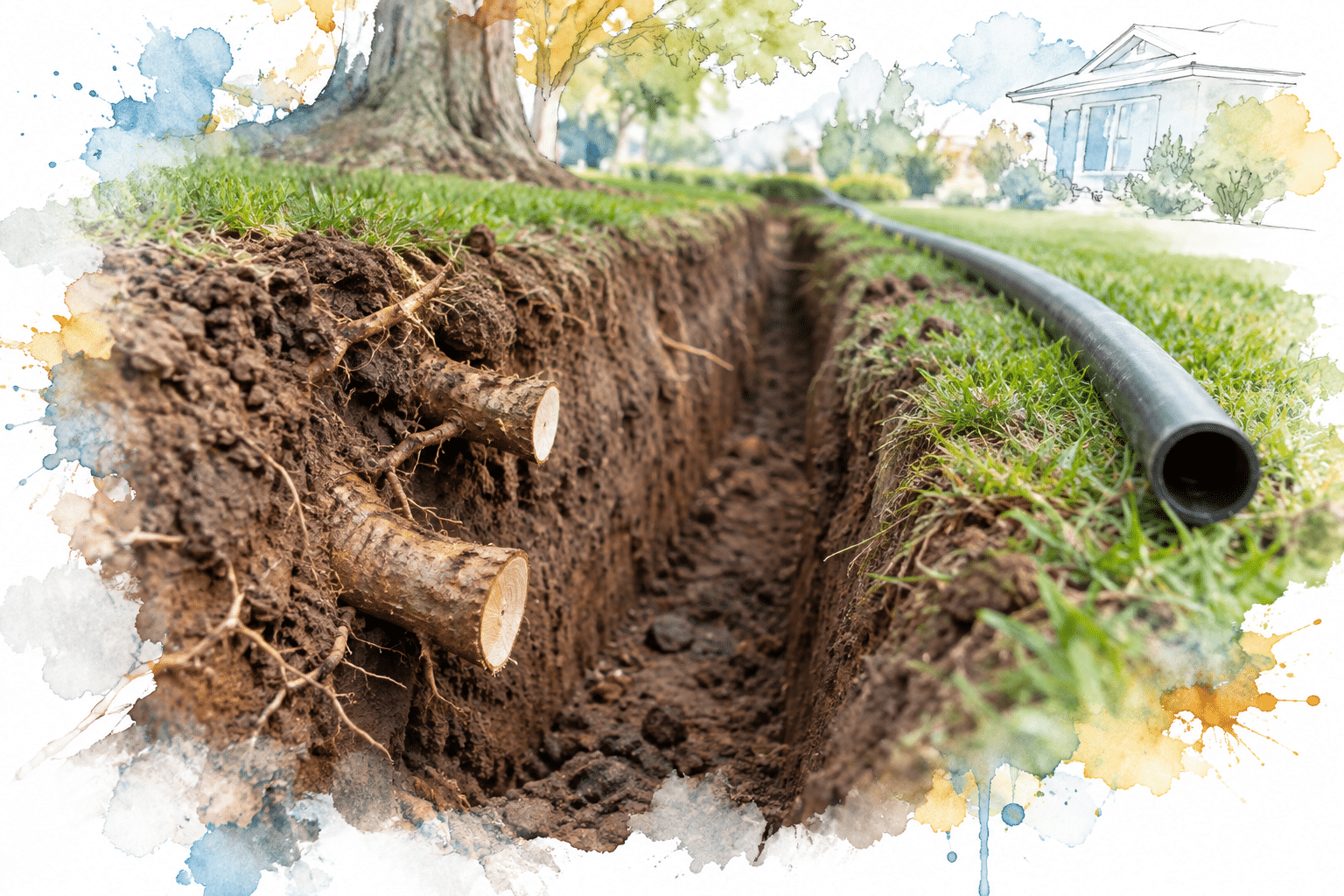
- Trenching. One straight run for a drain line or irrigation main can sever several structural roots at once.
- Compaction. Repeated equipment passes squeeze clay soil tight enough that roots cannot push through it.
- Footings. Post holes and pier locations placed by convenience instead of by root map.
The hard part is the delay. A tree that lost 30 percent of its root system in spring can look fine through the next two summers. The thinning canopy and dieback show up in year three to five, when nobody connects it to the patio anymore.
That is why every plan we work on gets reviewed by a Board-Certified Master Arborist before anything is drawn in ink. If your city requires formal oversight during the build, that falls under project arborist construction monitoring.
What a Root Zone Actually Does to Your Plan
People hear “protected root zone” and assume it means the whole idea is dead. It almost never does. It means the plan changes shape.
Here is the kind of adjustment I would recommend on a typical project:
- Patios near a mature tree. Build on grade over a permeable base instead of excavating down. You keep the usable space and the roots keep their soil.
- Drainage runs. Route the line around the root zone, or air-excavate and tunnel under large roots instead of cutting through them.
- Raised beds under a canopy. Keep soil off the trunk flare entirely. Piling planting mix against bark invites collar rot.
- Equipment access. Pick one route, protect it with plywood or mulch, and keep everything else off the root zone.
The same thinking applies to the house. Homeowners ask us constantly whether a big tree near the foundation is a problem, and the honest answer is usually more nuanced than they expect. We walked through that in detail in tree roots and your foundation.
The point of the early assessment is not to add restrictions. It is to know which trees are worth designing around, which have real structural issues to address first, and which spots on the lot are genuinely open.
The Ground You Are Actually Building On
Most of the valley floor, from Willow Glen out through Campbell, sits on clay-heavy soil. Clay holds water, drains slowly, and compacts hard. It is the single biggest reason new landscapes underperform here.
So drainage gets solved before planting, not after. That means grading, surface collection where water pools, and French drains or subsurface systems where it cannot shed on its own. A yard that looks beautiful in September and floods in February was designed in the wrong order.
Irrigation is the other piece people get wrong, and it is usually a zoning mistake. New drought-tolerant plantings want infrequent deep water. An established oak or redwood wants almost nothing in summer near the trunk. Putting both on the same valve slowly stresses one of them.
What I would plan for on a 2027 install:
- Separate valves for trees, shrubs, and any remaining turf area
- Drip or low-volume emitters placed out toward the dripline, not at the trunk
- Summer heat protection for first-year plantings, which lose more plants to a July heat run than to anything else
- Soil work before planting, because amending around a finished landscape is nearly impossible
Water-use rules are tightening too. The state’s Model Water Efficient Landscape Ordinance sets requirements that many renovation permits are measured against, and there are separate changes coming for decorative turf. We covered what that means locally in the 2027 nonfunctional turf rule.
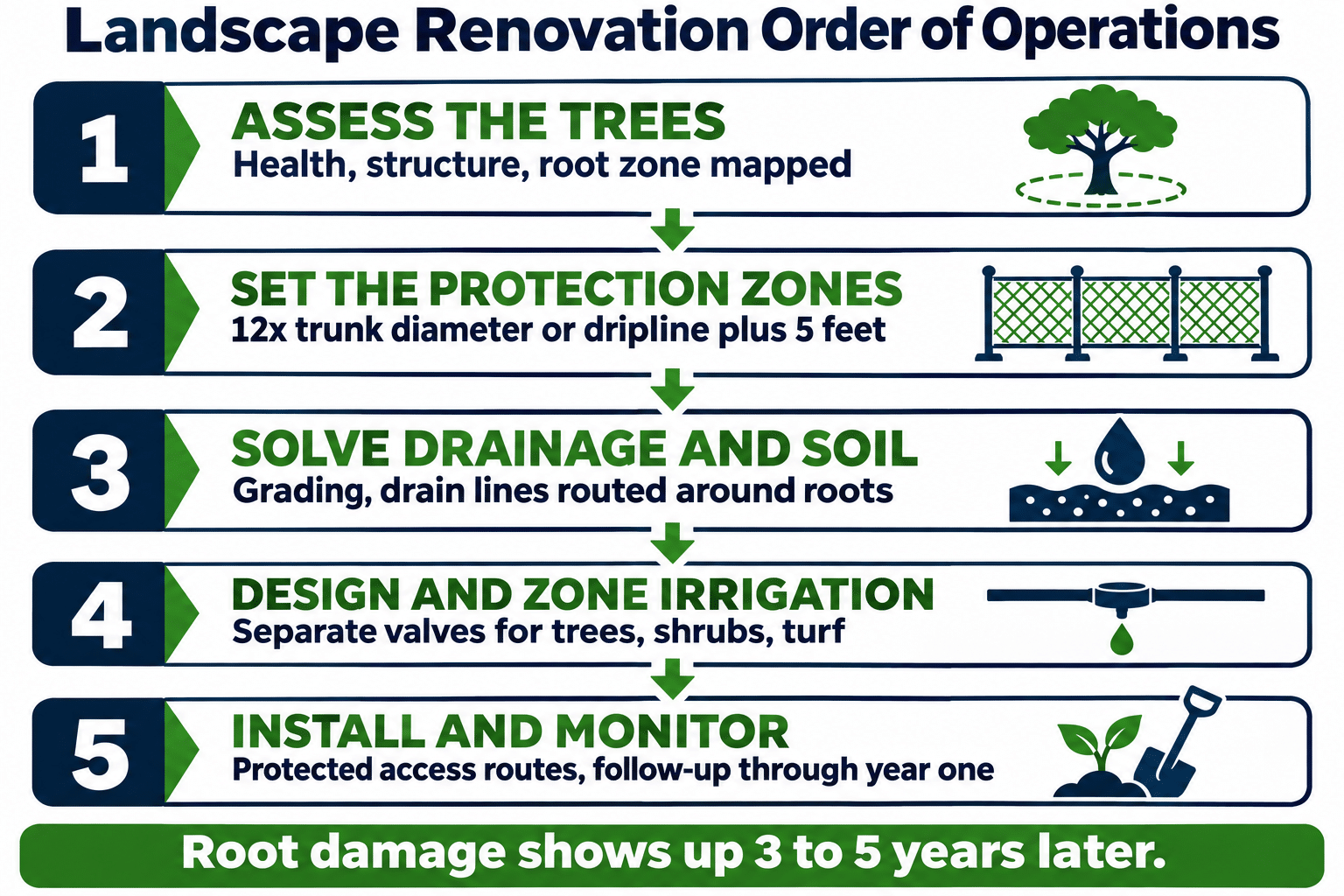
The Order That Keeps Mature Trees Alive
This is the sequence I would follow on any renovation where established trees are staying in the ground.
Timing a 2027 Install Backward From the Season
Installation season is the fixed point. Everything else works backward from it. Here is a rough shape for a 2027 project of moderate size.
| Window | What Happens | Why Then |
|---|---|---|
| Now through early spring 2027 | Tree assessment, root zone mapping, design concepts | Deciduous trees are bare and structure is easy to read |
| Spring 2027 | Final plan, irrigation design, permits if trees are involved | City review takes time and should not sit in the critical path |
| Summer 2027 | Hardscape, drainage, grading | Dry ground, and oak pruning falls in the July to October window |
| Fall into early winter 2027 | Planting and irrigation startup | Roots establish in cool soil before the first dry summer |
| Year one after install | Seasonal adjustment and follow-up | Watering needs change sharply between the first and second year |
One Team Beats Four Trades With Four Opinions
The most expensive problems I see on renovations are not design problems. They are handoff problems.
The hardscape crew trenches where the irrigation tech would not have. The planting crew adds four inches of soil over a root flare because nobody told them not to. Each trade did its own work correctly and the tree still paid for it.
On our projects, the designer, the plant specialist, the certified irrigation technician, and the ICPI-certified hardscapers are all on the same team, with the arborist reviewing anything that touches a tree. You get one point of contact and one plan everyone is working from.
That shows up in how people talk about the finished work. One longtime customer put it simply: they are “very careful not to damage any of the landscaping in the areas they work.” Another wrote that the crew “came back after the project was complete” to help sort out irrigation. If you want to see how this plays out on a real property, here is a 1980s San Jose front yard rebuilt as a low-maintenance landscape.
And one more scheduling note worth saying plainly: if a tree on your plan is ordinance size, removal or major work may need city approval first. Permits are slow. Start them early, not the week before the crew arrives. Here is what triggers a permit in San Jose.
Frequently Asked Questions About Planning a 2027 Landscape Renovation
Can I send photos first instead of scheduling a visit?
Yes, and a lot of people start that way. Photo quotes and on-site estimates are both free. Photos work well for straightforward scope. For a full renovation with mature trees in play, an on-site walk is going to give you a far more useful answer.
What is the $250 arborist assessment and do I need one for a renovation?
The Level 1 Arborist Assessment is $250 and it is a formal tree diagnosis, not an estimate. You need it when the health, structure, or survivability of a specific tree is the actual question. If you just want to know what the project costs, the estimate is free. We broke the difference down in when a tree visit is free and when it comes with a fee.
How much does a full landscape renovation cost around San Jose?
There is no honest flat answer, because the drivers vary so much from lot to lot. What moves the number most is square footage, how much hardscape and concrete is involved, whether drainage needs real grading work, how far the irrigation has to be rebuilt, and plant sizes at install. Scope the design first, then get a firm quote against that plan.
Is it too early to start planning a 2027 project?
No. For a project you want installed in fall 2027, starting the assessment and design now is about right. Winter is the easiest time to read tree structure, and it leaves room for permits without compressing the build.
Do I have to take out the tree if it is in the way of the design?
Usually not. Removal is the last call, not the first one. Most of the time the plan can shift around the root zone, and a mature canopy adds more to an established street than almost anything you could build in its place.
Thinking Through a 2027 Project?
If you are working on plans for a renovation in San Jose, Willow Glen, Almaden Valley, Los Gatos, Saratoga or Campbell, the winter months are a good time to have the trees looked at while their structure is easy to read. San Jose Tree & Landcare handles design, installation, irrigation and tree care under one roof, with every plan reviewed by a Board-Certified Master Arborist. You can reach us at (408) 422-1313 or at sanjosetree.com when you are ready to talk it through.