
Direct Answer: No. AB 1572 bans potable water on nonfunctional turf at public, commercial and HOA common-area properties on a staged schedule starting January 1, 2027. Private single-family yards are not covered.
I keep getting asked some version of the same question this year: is the state going to make me tear out my lawn in 2027? Usually the person asking lives in Willow Glen or Almaden Valley, has a lawn their kids grew up on, and heard something secondhand that stuck.
Here is the short version before anything else. AB 1572 does not apply to private single-family yards. Your grass is not on the list, in 2027 or after.
What the law does cover is nonfunctional turf at public, commercial and HOA properties, and it arrives in stages, not all at once. Below I will lay out the real dates, explain the one definition everyone trips over, and then get to the part almost nobody is talking about locally: what happens to the mature trees that have been quietly living off that lawn irrigation for thirty years.
What the California Nonfunctional Turf Ban Actually Says About 2027
AB 1572 bans the use of drinking water to irrigate nonfunctional turf. It does not ban grass, and it does not ban watering your yard.
The rollout is phased by property type. The City of San Jose’s own water efficiency page lays out the same schedule the state does:
- January 1, 2027 for properties owned by local governments and public agencies
- January 1, 2028 for commercial, industrial and institutional properties
- January 1, 2029 for HOA common areas, mobile home parks and retirement communities
- A later date for public properties located in disadvantaged communities
The confusion I hear locally comes from summaries that compress all of this into one January 2027 deadline for businesses and HOAs. That is not what the law says.
If you sit on an HOA board in Campbell, your common-area date is 2029, not 2027. If you own a small office park in Santa Clara, yours is 2028. That difference is two to three budget cycles, which is a very different planning problem than the one most people think they have.
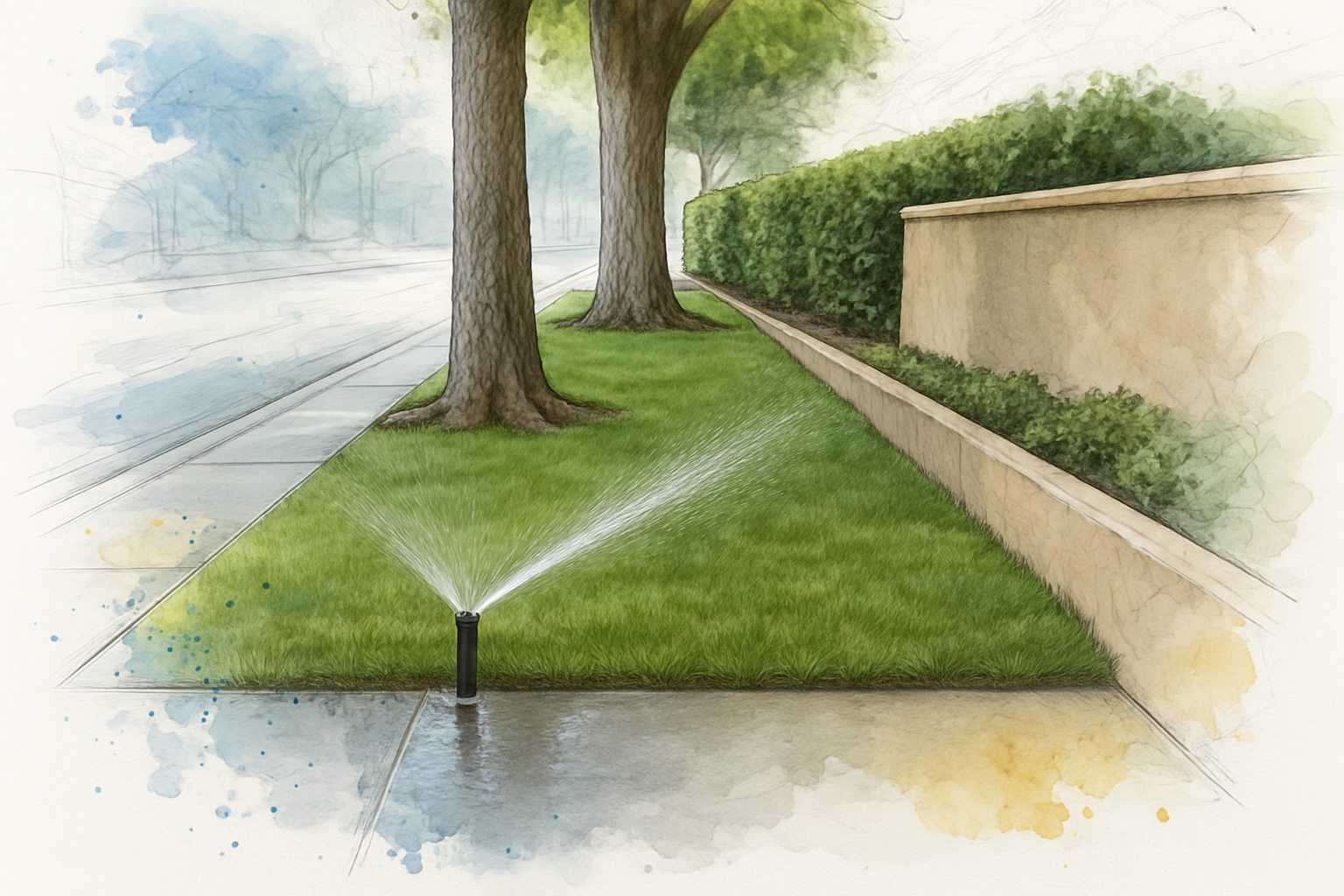
Functional or Nonfunctional? The Test Is Simpler Than People Expect
The date is only half the confusion. The other half is that almost nobody can tell you which patch of grass on their property counts.
The working test used across California water agency materials is plain: if the only person who ever walks on that grass is the person mowing it, it is probably nonfunctional. Decorative entry strips, medians, the green band nobody sits on. That is the target.
Turf that gets treated differently includes:
- Sports fields and recreation areas where the grass is actually used
- Picnic and gathering spaces that serve a community function
- Turf irrigated with recycled water rather than drinking water
- Areas where potable water is needed to keep trees and other perennial plants alive
There is also a reporting piece. Covered properties above 5,000 square feet of irrigated turf are expected to self-certify to the State Water Resources Control Board on a three-year cycle.
So for a board member or a property owner, the order of questions is short:
1. Is my property type covered, and what is my date?
2. Is this specific patch of grass functional or decorative?
3. Do I have a certification obligation based on square footage?
Answer those three and most of the anxiety goes away. About one in ten calls we took in August came from someone facing a city or regulatory requirement nobody had explained to them, and the fix is almost always just getting the sequence straight.
Who Is Covered, and When
Here is the phase-in at a glance, with what it means in practice for South Bay properties.
| Property type | Potable irrigation of nonfunctional turf ends | What this looks like locally |
|---|---|---|
| Private single-family yards | Not covered | Your own front and back lawn is outside the law entirely |
| Local government and public agency property | January 1, 2027 | City medians, civic grounds, decorative strips at public buildings |
| Commercial, industrial, institutional | January 1, 2028 | Office parks, retail centers, campuses in San Jose and Santa Clara |
| HOA common areas, mobile home parks, retirement communities | January 1, 2029 | Shared entry lawns, clubhouse surrounds, greenbelt strips |
| Public property in disadvantaged communities | Later phase | Extended timeline set by the state |
The Trees Standing in That Lawn Are the Real Risk
This is the part that worries me more than any deadline. On South Bay properties, a mature tree sitting in or next to turf has often spent twenty or thirty years drinking from that lawn irrigation.
When the spray heads go off, the tree loses its water source. Nobody decided to stop watering the tree. It just happens as a side effect of a turf decision.
I see the two concerns arrive together all the time. One homeowner wrote in asking about replacing part of the backyard lawn with native and drought-tolerant plants, and in the same message asked about a walnut with a dead branch. Another asked for an assessment of the plants, the trees and the irrigation as one project rather than three.
That instinct is correct. The law itself leaves room for using potable water where it is needed to keep trees and perennial plantings alive, so a turf conversion done properly keeps a dedicated water source at the root zone instead of cutting it off.
The damage from getting this wrong is slow and easy to miss:
- Thinning canopy and small, pale leaves in the first full summer
- Early leaf drop before fall
- Dieback starting at the branch tips and working inward
- Fine root loss that shows up as decline two or three years later
Oaks are especially worth a careful look before anything changes, because their watering needs run opposite to a lawn’s. If you have one, it is worth learning how to read what your oak is telling you before you touch the irrigation around it. Know what the tree has been living on before you change it.
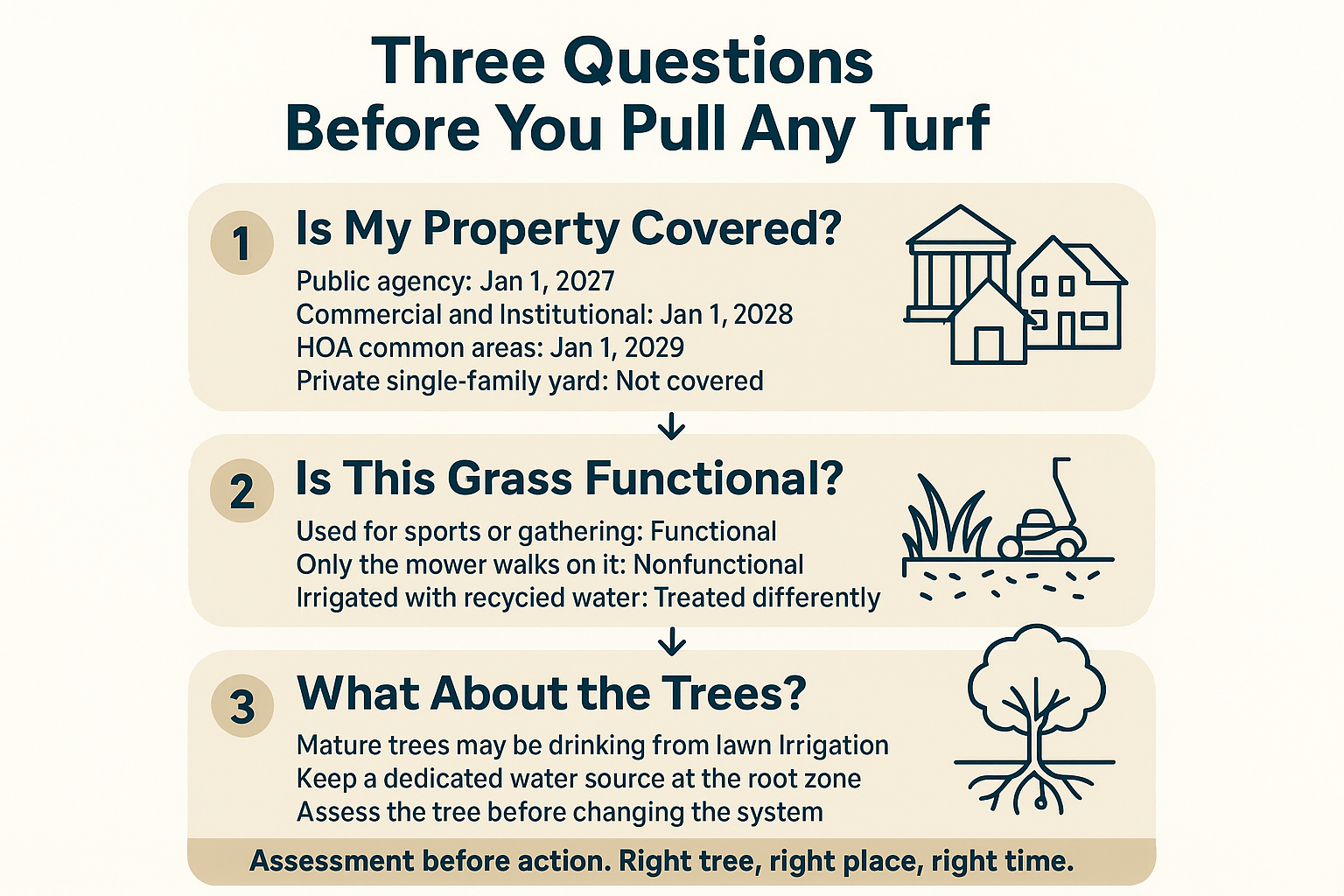
Three Questions Before You Pull Any Turf
This walks through the decision in the order it actually matters, from property type to the trees standing in the grass.
Treat a Turf Conversion as an Irrigation Project First
Most lawn replacement projects in San Jose succeed or fail on irrigation and soil, not on plant selection. The pretty part is the easy part.
Our soils here are clay-heavy. Clay holds water at the surface, sheds it where the ground is compacted, and punishes a system that was designed to throw spray evenly across open grass. That same system almost never delivers deep, slow water to a tree root zone on a separate schedule.
So the honest answer for a lot of properties is not a full tear-out. It is re-zoning:
- Separate established trees onto their own zone with longer, less frequent cycles
- Put new shrubs and perennials on drip with their own schedule
- Keep the turf that genuinely gets used and water it as turf
- Check grading and runoff before anything new goes in the ground
This comes up constantly in our request forms. One homeowner wanted existing drip lines split into more hydrozones because growing trees had been grouped with small potted plants. Another had a dozen browning Italian cypress and asked about the sprinkler system in the same breath, which is usually the right instinct since brown patches in a cypress screen often trace back to water delivery.
Keeping some lawn is often allowed and sometimes sensible. The goal is matching water to what is planted, not stripping the yard bare.
A Realistic Order of Operations
The properties that come through this well are the ones planning in the wet months instead of scrambling in spring.
Winter is the planning season in Santa Clara County. Soil is workable, new plant material establishes with natural rainfall behind it, and installers are far less booked than they are in March, when local landscaping interest peaks.
A sequence that works:
- November through January: assess trees and irrigation, confirm your date and turf status
- Winter: apply for any rebate and get the pre-inspection done
- Late winter into early spring: remove turf, rebuild zones, plant
- First summer: monitor tree response, adjust run times
One thing worth flagging on rebates: local lawn conversion programs require approval and a pre-inspection before any work starts. Pull the turf first and you can disqualify yourself before you begin. We have covered how the Valley Water lawn conversion rebate works and where people get disqualified and what the conversion really involves in detail, so I will leave it at that here.
Why This Is Really a Two-License Job
There is a structural reason these projects get messy. Removing turf, rebuilding irrigation zones and grading for drainage falls under a C-27 landscaping license. Judging how much root loss and water change a thirty-year-old tree can absorb is arborist work.
Most companies hold one of those and subcontract the other, and the gap between them is where trees get hurt.
We carry CSLB license #985639 with both the C-61/D-49 tree service and C-27 landscaping classifications, have been BBB accredited since 2013, and hold a 4.96 average across 70 Google reviews. Our owner is a Board-Certified Master Arborist, which is why the tree conversation happens before the irrigation plan, not after.
What that looks like on a finished job, in a customer’s own words: “They also connected all the irrigation for the new plants to our existing system and put down 10 cubic yards of Gorilla mulch.” One scope, one crew, one plan.
If you are unsure whether your situation calls for a quick look or a full arborist evaluation, it helps to understand when a tree visit is free and when it comes with a fee before you call anyone.
Frequently Asked Questions About the 2027 Turf Rule in San Jose
Does AB 1572 mean I have to remove my front lawn in San Jose?
No. Private single-family yards are not covered by the law. You can keep your lawn and keep watering it. Plenty of homeowners are converting anyway for water cost and rebate reasons, but that is a choice, not a requirement.
I’m on an HOA board in Campbell. What is my actual deadline?
January 1, 2029 for HOA common areas. The 2027 date applies to local government and public agency properties, and 2028 applies to commercial, industrial and institutional sites. If your board has been told it needs to act by 2027, that summary is wrong.
How do I know if a patch of grass counts as nonfunctional?
Ask who walks on it. If the only foot traffic is the mower, it is probably nonfunctional. Grass used for sports, recreation or gathering is treated as functional, and turf irrigated with recycled water is handled differently.
Will my trees die if the lawn sprinklers get shut off?
They can decline, and it usually takes a year or two to show. A mature tree in turf has often built its root system around that irrigation. The law allows potable water where it is needed to keep trees and perennials alive, so the right approach is a dedicated zone at the root zone, not a blanket shutoff. Assess the tree before changing the system.
What does a turf conversion cost in San Jose?
It varies more than most people expect. The drivers are square footage, how much of the existing irrigation can be reused versus rebuilt, grading and drainage work, soil prep in clay, and whether mature trees need their own zone. A small decorative strip and a 2,000 square foot backyard are not in the same conversation. Get a site-specific quote rather than working from a number you read somewhere.
Planning a lawn change around trees you want to keep?
If you are weighing a turf conversion in San Jose, Willow Glen, Almaden Valley, Los Gatos or Campbell, the useful first step is understanding what your trees have been living on before anything gets dug up. Our arborist and landscape teams work the same project together, so the irrigation plan and the tree assessment are one conversation. We are reachable at (408) 422-1313 or sanjosetreemaintenance.com whenever you want to talk it through.
