
Direct Answer: Most birch dieback in San Jose comes from heat and water stress, with borers arriving after. Age matters too: birches here often decline within about 20 years of planting.
You planted a row of birches years ago. They all went in the same week, in the same soil, on the same valve. And now two of them are thinning at the top while the rest still look fine.
That exact situation comes through our form more than you would think. One homeowner in Willow Glen wrote in this summer about five birches, two clearly in distress, and asked a fair question: what is causing it, and how do I protect the other three? Another homeowner with three river birches wanted an assessment before the rainy season hit.
What I want to do here is walk you through how I actually think about a declining birch before anyone touches a saw. Proper assessment before action. There are three honest explanations for most birch dieback in San Jose, and only one of them ends with a removal conversation.
When Birches Fail One at a Time, That Pattern Is Information
A row or cluster of birches that declines one tree at a time is telling you something useful. Same planting date, same soil, same irrigation, different outcome. So the difference is almost always local to that one tree.
Here is what I look for when the group is uneven:
- The end tree in a row often sits closer to hot pavement, a south-facing wall, or the edge of the drip line where coverage drops off
- A clogged or buried emitter on one tree while the others still run fine
- Grade changes where runoff pools at one end and drains away from the other, which matters a lot in San Jose’s heavy clay
- Trunk damage from a string trimmer, a stake left on too long, or a mower that nicked the root collar years ago
- Different sun exposure as a neighboring tree or structure grew and shifted the shade
I have seen two birches twelve feet apart with completely different soil moisture at eighteen inches down. Clay does that.
The first job is finding out why that one tree ran out of road first. Not scheduling the removal. Because whatever is pushing the failing tree is usually already working on the ones that still look fine.
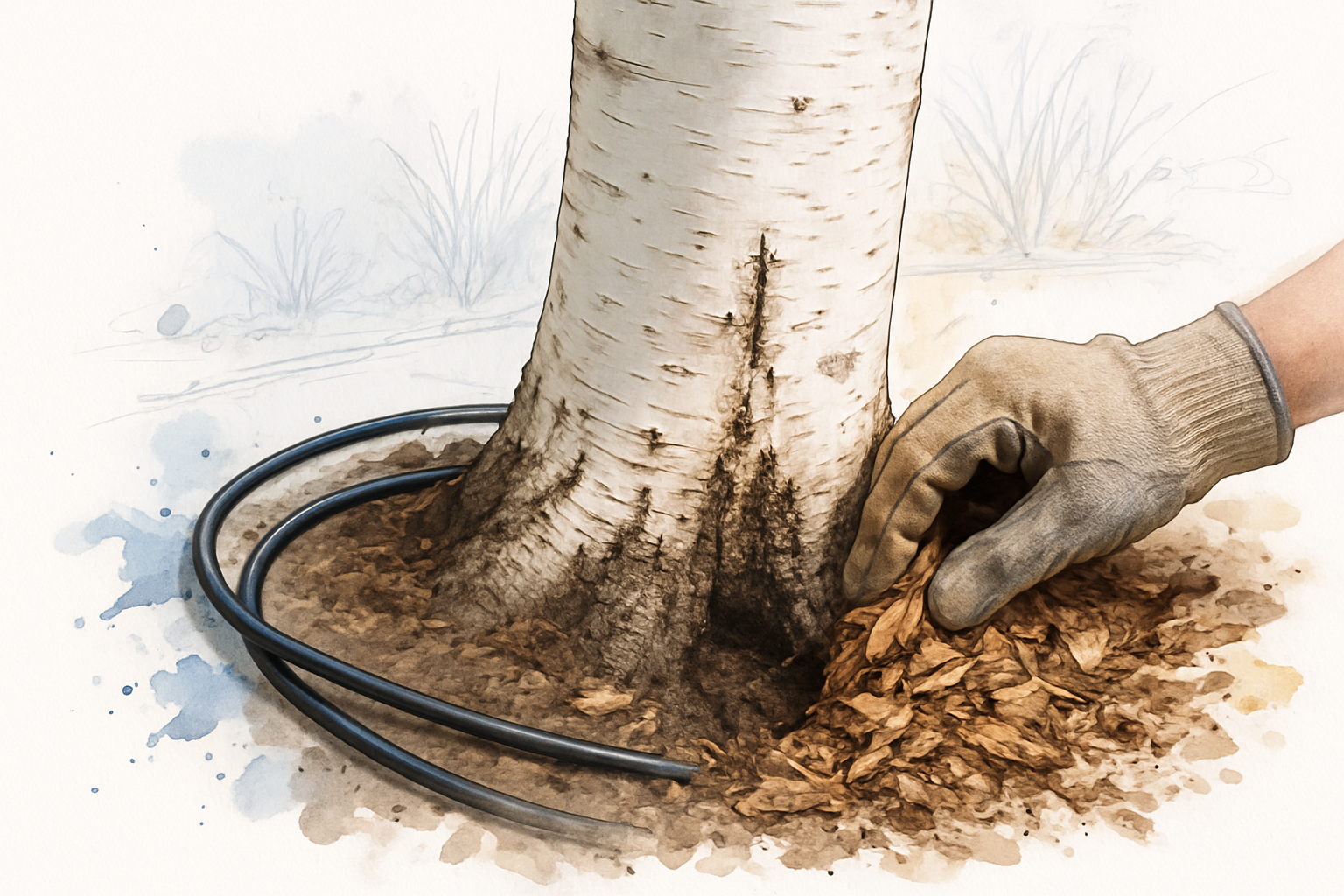
The Hard Part First: Birch Is a Short-Lived Tree Here
This is the piece most homeowners have never been told, and it changes the whole conversation.
Birches are native to cool, moist climates. In regions with hot, dry summers, University of California IPM notes that birches are relatively short lived and commonly decline and die within about twenty years of planting. UC also flags them as brittle and prone to wind damage, which lines up with what we see in South Bay winter storms.
Silicon Valley gives a birch a long, dry summer and dense clay that holds water badly at depth. That is a tough assignment for a tree built for riverbanks in cooler country.
Birch dieback reads top down and tip inward. The highest branches thin first, leaves get small and pale, and the outer twigs go bare while the lower canopy still looks green. If that is what you are seeing, age belongs on the list of suspects.
So try to date your tree:
- Check remodel or landscape permit records if the birches went in with a yard renovation
- Ask a longtime neighbor when the block’s landscaping was redone
- Look at old listing photos from when you bought the house
- Compare against the neighborhood’s build era, since a lot of Almaden Valley and Campbell yards were planted in waves
If the tree is pushing twenty years and thinning from the top, it is probably not a mystery disease. Right tree, right place, right time is the honest frame, and it is not a verdict on anything you did wrong.
Small Holes and Sawdust: The Borer Question
This is where people panic, and I understand why. You see pinholes, fine sawdust, or weeping sap on the lower trunk and the conclusion feels obvious: a bug showed up and killed the tree.
It is usually the other way around. Stress comes first, insects follow. UC IPM is clear that drought stress leads to borer attack, and that birches, poplars, and willows carry a built-in susceptibility to clearwing moth even when they are watered adequately.
That distinction matters for your wallet. Once a tree is genuinely infested, the realistic options narrow to improving the tree’s vigor, pruning out infested limbs, or removal. There is no spray that undoes years of root-zone stress.
Before I would recommend any product, here is what I am looking at on site:
- Root collar, uncovered and checked for buried flare, decay, or old mechanical wounds
- Bark condition on the lower trunk and scaffold limbs, including exit holes, frass, and sap weeping
- Canopy density and where the thinning starts, since top-down tells a different story than scattered branch death
- Irrigation pattern, meaning how often the zone runs, for how long, and how far the water actually spreads
- Soil moisture at depth, not just whether the surface looks damp
One homeowner told us they had paid a company to spray a screen of trees for three years with no improvement. That is what a spray schedule chosen before a diagnosis looks like. Treating the cause is what changes the outcome, and if you want more on how symptoms get confused with each other, these are the pest and disease questions San Jose homeowners keep asking.
Reading the Symptoms on Your Own Birch
None of this replaces an on-site look, but it will help you describe what you are seeing more accurately.
| What you see | What it often points to | What I check next |
|---|---|---|
| Top of the crown thinning, branch tips bare | Age-related decline or deep root-zone drought | Tree age, soil moisture at 12-18 inches, irrigation run time |
| Pinholes or fine sawdust on lower trunk | Borers that arrived after the tree was already stressed | Root collar condition, extent of infested wood, overall vigor |
| Leaves small, pale, dropping early in July or August | Heat and water stress, common in clay soils | Valve layout, emitter count, mulch depth and coverage |
| One tree failing in a row of healthy ones | A localized cause, not a spreading disease | Grade, sun exposure, emitter function, trunk wounds |
| Dead branches scattered through the canopy, not top down | Possible dieback from a different cause than age | Branch dissection, bark inspection, decay testing if warranted |
Why Your Valve Layout Matters More Than Any Spray
Most struggling birches I see in San Jose are on an irrigation setup built for something else entirely. This breaks down the difference.
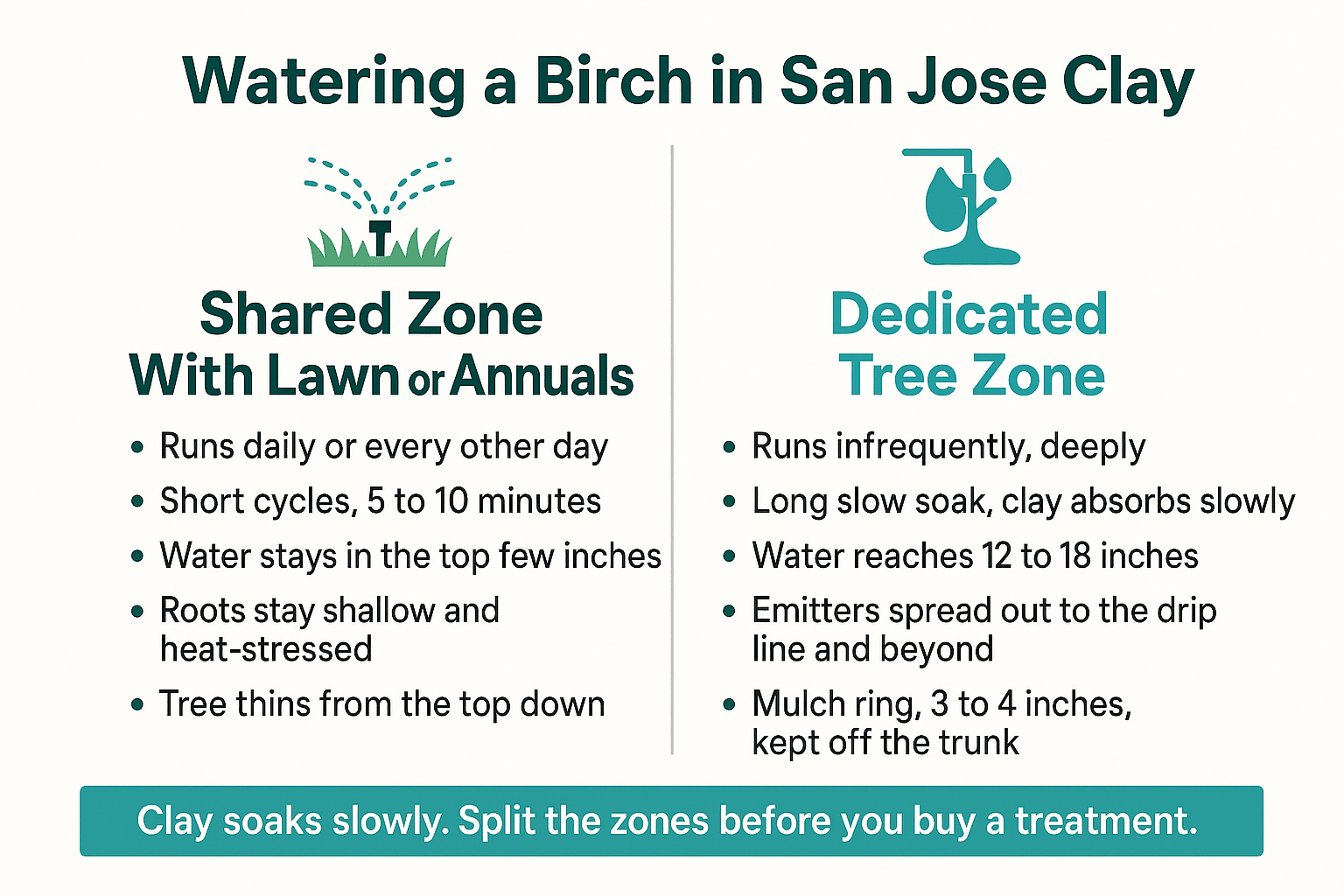
Water Delivery Is Usually the Lever, Not Chemistry
If I could fix one thing on most declining birches in San Jose, it would be how the water arrives.
A birch sharing a valve with lawn or annual flowers gets frequent shallow water. That schedule is right for the lawn and wrong for the tree. The birch wants an infrequent, deep, wide soak that reaches well past the trunk.
And our clay changes the math. Clay accepts water slowly, so a long slow application soaks in while a fast one runs off across the surface and disappears.
Go look at your valve layout this weekend. Here is what to check:
- Are the trees on their own zone? One homeowner who had rebuilt their landscape asked us to split existing drip lines into more zones because young trees were grouped with small potted plants. That instinct was correct.
- How many emitters feed the tree, and where are they? Two emitters at the trunk do almost nothing for a mature canopy. Roots run out past the drip line.
- How long does the zone run? Short daily cycles train roots to stay shallow.
- Is there mulch? Three to four inches over the root zone, pulled back off the trunk, buys you real summer moisture.
This is also why tree work and irrigation work keep showing up in the same request. Plenty of homeowners ask for trimming and an irrigation repair in the same breath, and they are right to connect them.
The Three Real Outcomes for a Declining Birch
Once I have looked at the tree, the answer lands in one of three places. None of them is automatically removal.
1. The birch can be stabilized. The dieback is modest, the root collar is sound, and the problem is water delivery or a correctable stress. Fix the irrigation, mulch the root zone, prune out the dead wood, and give it a season to respond.
2. The birch can be kept with monitoring. Enough crown is gone that it will not come all the way back, but the tree is not a hazard where it stands. Structural pruning, deadwood removal, and a check each year before storm season. You get a few more years, honestly earned.
3. The birch has lost too much crown to carry. A tree that has given up most of its canopy is not coming back, and birch wood is brittle in wind. At that point the conversation shifts to replacement with a species suited to long dry summers.
Location decides a lot of this. A brittle birch leaning over a roofline in Willow Glen is a different conversation than the same tree at the back fence with nothing under it. If you are weighing that call, this walks through what to consider before removing a tree in San Jose, and a tree risk inspection before storm season covers what actually gets checked.
The goal is safety, health, and longevity, in that order.
Why the Sequence Matters on a Species Like Birch
Birch punishes a wrong sequence. Spray first, diagnose later, and you can burn two or three seasons on a tree that only had a handful left.
So every treatment program here runs as integrated pest management rather than a default spray schedule, with the diagnosis coming first and a licensed applicator handling anything that does get applied. One longtime customer put it this way in a review: “They’re super knowledgeable and never push work that doesn’t need to be done.” – Kathryn P.
If you are not ready to pay for an on-site visit yet, emailing photos for a free review is a reasonable first step. It will not catch everything a hands-on inspection catches, and here is an honest look at what a photo can and cannot tell an arborist.
Frequently Asked Questions About Birch Dieback in San Jose
My birch has bare branches at the top but green leaves below. Is it dying?
Maybe, but not necessarily this year. Top-down thinning is the classic birch decline pattern here, and it can come from age, deep root-zone drought, or borers that followed stress. What matters is how much of the crown is gone and whether the root collar is sound. A tree that has lost a quarter of its canopy is a very different situation from one that has lost most of it.
If one birch in my row is failing, will it spread to the others?
Usually it is not contagious in the way people fear. More often the whole group is under the same stress and one tree simply hit its limit first. That is actually useful news, because correcting the cause can protect the ones still holding on.
Can borers be treated, or is removal the only option once I see holes?
Once a birch is infested, the realistic choices narrow to improving the tree’s vigor, pruning out infested limbs, or removal. There is no product that reverses the underlying stress. That is why I want a diagnosis before anyone writes a treatment plan, not after.
What does an on-site arborist assessment cost, and is it worth it?
A paid arborist consultation in the South Bay typically runs a few hundred dollars depending on scope, and it buys you a master arborist on site, a verbal diagnosis, and specific recommendations you can act on. Costs vary by property and tree count, so call for an exact figure. This explains when a tree visit is free and when it carries a fee.
Should I replace a failed birch with another birch?
I would not, in most San Jose yards. If the first one struggled with heat and clay, the second one will too. There are species that handle long dry summers far better and will give you shade for decades instead of years.
Wondering What Is Actually Wrong With Your Birch?
If you have a birch thinning at the top in San Jose, Willow Glen, Almaden Valley, Los Gatos, or Campbell, we are available to take a look and tell you what we see. You can email photos for a free review first if you would rather start there, or reach us at (408) 422-1313 or sanjosetreemaintenance.com. No pressure either way, and no removal recommendation without a reason behind it.
