 Skip to content

Direct Answer: Tree roots rarely crack a foundation directly. In San Jose, damage usually comes from expansive clay soil shrinking as large trees pull moisture out during dry summers.
You noticed a crack. Maybe it runs across the driveway near the big oak, or a patio paver lifted an inch, or there is a hairline seam in the garage slab that was not there last summer. And the first thought almost every homeowner has is the same one: the tree is doing this.
I hear this call constantly from homeowners in Willow Glen, Almaden Valley, Cambrian, and out toward Los Gatos. Several callers each month describe a crack near a large tree and ask, almost apologetically, whether the tree can be saved instead of removed.
Most of the time, the answer is yes. Tree root damage to a foundation is real, but it is one of the most overstated risks in residential property care. Below I will walk through what roots actually do, what our clay soil actually does, and why a removal quote is the wrong first step.
What Roots Are Actually Doing Under Your Yard
Roots are not looking for your house. They are looking for two things: moisture and oxygen. Compacted soil under a concrete slab has almost none of either, which makes it one of the least attractive places for a root to grow.
Most of a tree’s absorbing roots live in the top 12 to 18 inches of soil, spreading well past the canopy line. They follow the path of least resistance and the highest water content. That means they grow toward:
- Leaking irrigation lines and cracked sprinkler risers
- French drains and downspout outlets
- Loose backfill around a trench or utility line
- Planting beds that get regular water
- Gaps under pavers where condensation collects
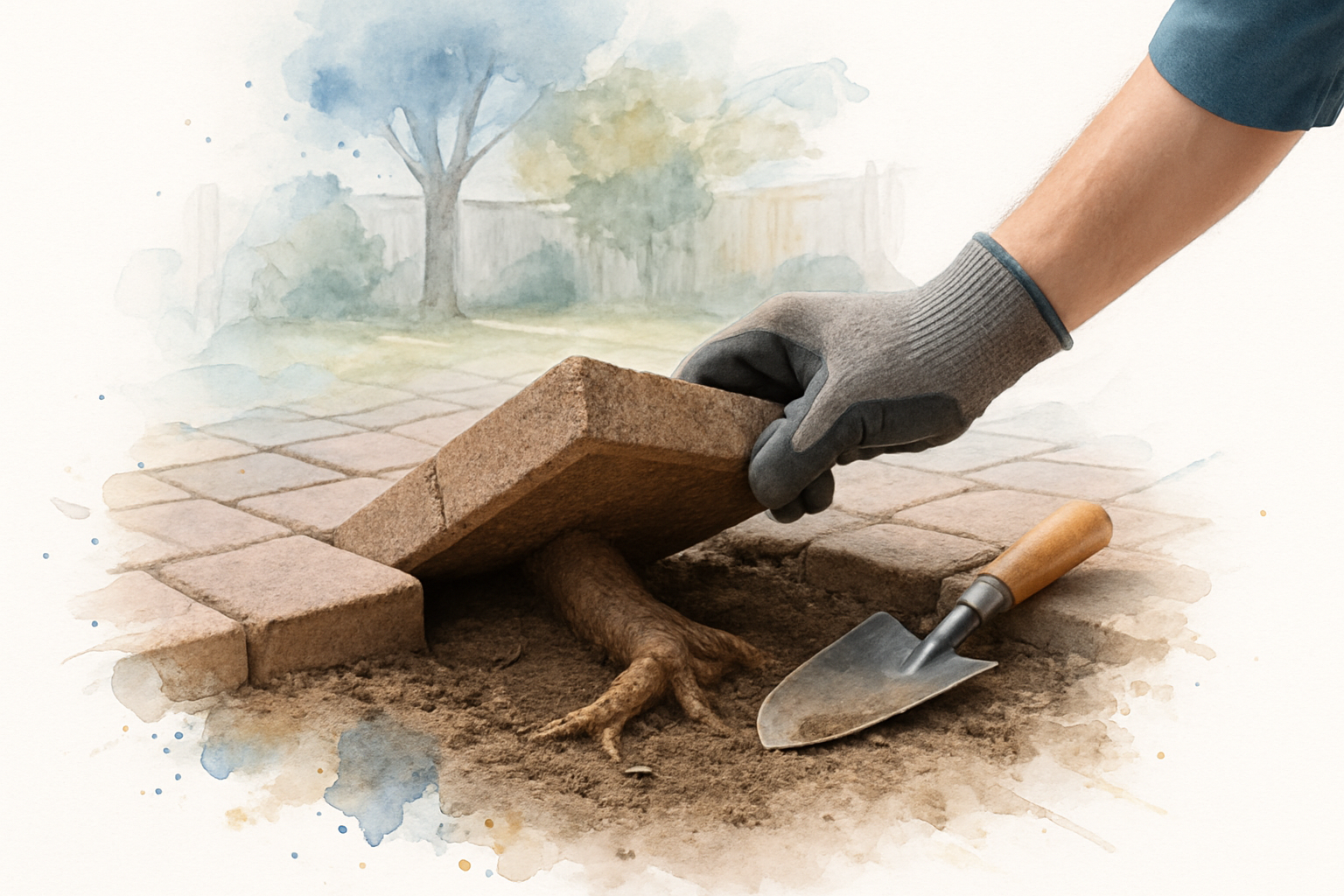
A root does not have the force to punch through a sound, properly poured foundation. What it can do is exploit an opening that already exists, then slowly widen it as the root thickens. That is why a lifted paver or a raised driveway seam is a surface problem, not proof that your foundation is in trouble.
One homeowner I worked with had two camphor trees and a patio where a single root had pushed up a few pavers. We removed that one root, reset the area, and the trees stayed. That is a far more typical outcome than people expect.
The Real Mechanism: Clay Soil, Not the Root Itself
Here is the part most homeowners never get explained to them. San Jose and the surrounding valley sit largely on expansive clay soil. Clay shrinks when it dries and swells when it gets wet, and it moves a lot more than sandy soil does.
Our weather makes that worse. We go roughly May through October with almost no rain, then get most of our water in a few concentrated winter storms. The soil under your house goes through a shrink and swell cycle every single year.
A large mature tree drinks a serious volume of water during a dry Silicon Valley summer. If that tree sits close to a slab, it can pull moisture out of one localized area of clay faster than the surrounding soil dries. That patch shrinks, and the slab above it settles slightly.
So the damage is real, but it is indirect. The root is not pushing. The clay is contracting. That distinction changes everything about how you manage it, because you can adjust soil moisture far more easily than you can undo a removal.
Reading the Signs: Cosmetic vs. Structural
Not every crack means the same thing. This is a general guide, not a diagnosis, but it helps you understand what you are actually looking at before anyone quotes you work.
| What You Are Seeing | Usually Points To | Reasonable First Step |
|---|---|---|
| Hairline crack in driveway or walkway near a tree | Surface root growth or normal concrete curing | Visual arborist assessment, no urgency |
| One or two lifted patio pavers | A single surface root under the base layer | Selective root pruning and paver reset |
| Stair-step cracking in stucco or masonry near a corner | Differential soil settlement | Structural evaluation plus soil moisture review |
| Doors and windows sticking seasonally, then normalizing | Clay shrink and swell cycle | Irrigation and drainage review before any tree work |
| Sewer line backups near a mature tree | Roots entering an already cracked pipe joint | Camera inspection of the line first |
| Slab crack that widens noticeably over one summer | Active localized settlement | Structural engineer, then arborist coordination |
Why Removing the Tree Can Make Things Worse
This is the part that surprises people. When you remove a large tree that has been drawing moisture out of clay soil for decades, that soil does not stay put. Over the following wet seasons it reabsorbs water and swells back upward.
That rebound can cause heave, which is upward movement, and heave is often harder on a slab than gradual settlement. So a homeowner pays for a removal, then watches new cracks appear the next winter and cannot understand why.
I am not saying removal is never the right call. Sometimes it clearly is. But it should be the conclusion of an assessment, not the opening move. In my experience the situation is far more often managed with:
- A root barrier installed between the tree and the structure
- Fixing irrigation leaks and rerouting water away from the foundation
- Adjusting watering so the clay near the slab stays at a more stable moisture level
- Correcting downspout and drainage runoff
- Crown reduction or thinning to lower the tree’s total water demand
A leaking valve or a broken head near a foundation does more quiet damage than most people realize. It is worth understanding how much water a broken sprinkler quietly wastes before you blame a 50-year-old tree for a crack.
And a mature tree in Willow Glen or Almaden Valley carries real property value. Removing one you did not need to remove is a permanent decision made from temporary worry.
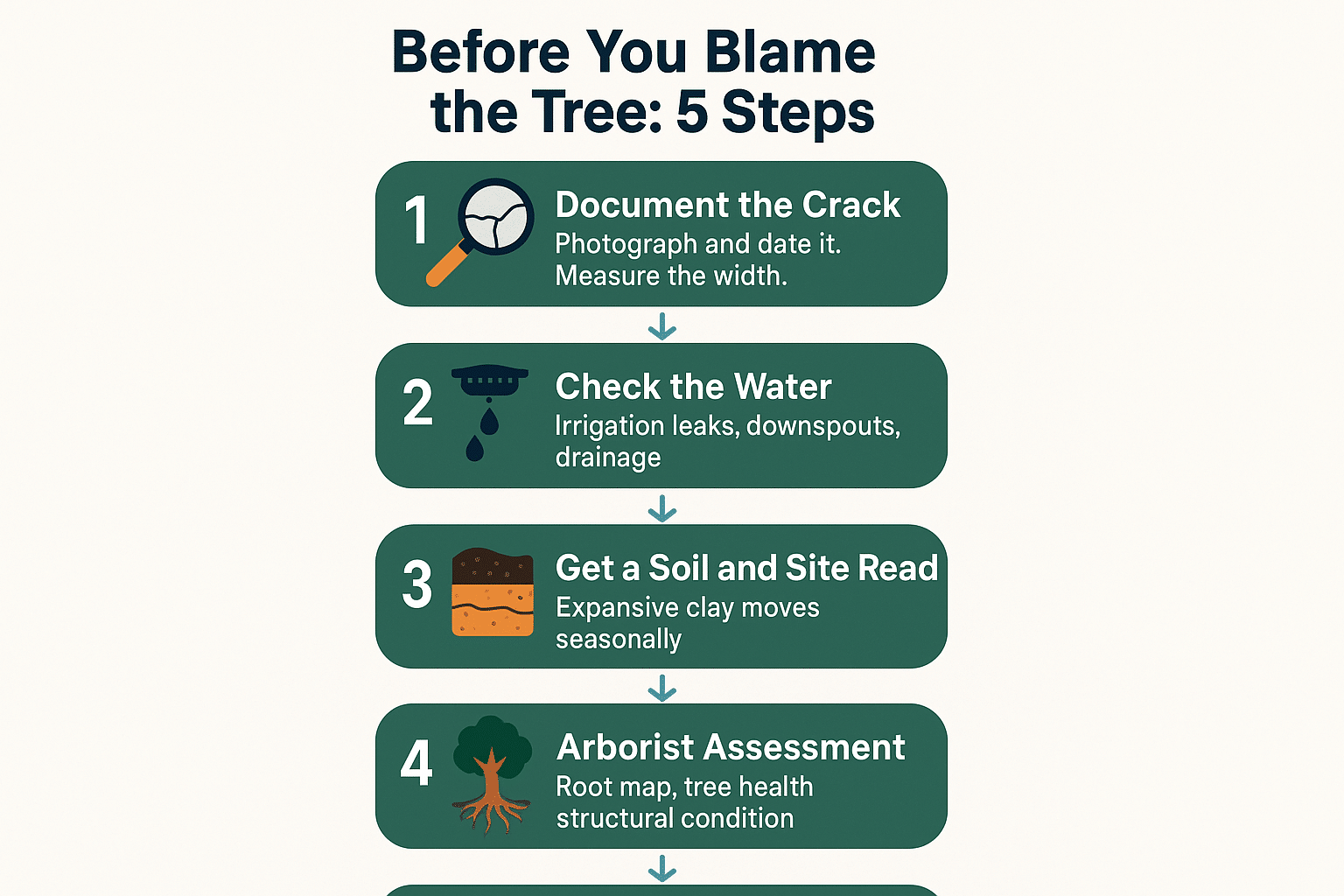
The Order of Operations Before Any Tree Comes Down
When a homeowner calls about a crack near a tree, this is the sequence I recommend they follow. It keeps a reversible problem from becoming an irreversible one.
Planning an Addition or ADU? Call an Arborist Before the Excavator
Pre-construction arborist consultations are one of the most underused tools available to San Jose homeowners, and they cost far less than fixing the problem afterward.
When you add an ADU, pour a new driveway, or extend a foundation, the excavation and grading work is what actually threatens the tree. Cutting through a major structural root on one side of a trunk can destabilize a tree that was perfectly sound the week before.
A consultation before the plans are locked lets you:
- Identify which trees sit inside the grading and excavation footprint
- Flag root protection zones the crew needs to stay out of
- Adjust the building footprint by a few feet while adjustment is still free
- Document tree condition before work starts, which matters if a dispute comes up later
- Sort out permit requirements before the contractor’s schedule depends on it
The International Society of Arboriculture publishes homeowner guidance on construction impacts, and the short version is that most construction-related tree failures trace back to root damage that nobody documented at the time.
If you are dealing with a lot split, the calculus gets more complicated, and what happens to your trees under SB9 is worth reading before you finalize anything.
The Permit Layer Most Homeowners Do Not Think About
Here is a scenario I have seen play out more than once. A general contractor or landscaper points at a tree near the foundation and says it has to go. The homeowner agrees, work gets scheduled, and nobody checks whether that tree is protected.
San Jose regulates trees by size and by species. A tree above the ordinance trunk size generally requires a removal permit, and a designated heritage tree carries stiffer protection. Penalties for unpermitted removal of a protected tree can run into the tens of thousands of dollars per tree, and street trees in the park strip fall under city jurisdiction even for pruning.
Several homeowners have contacted us specifically asking for a report they can submit to the city. That is a normal part of the process, not a sign that something is wrong.
Getting an arborist involved before anyone recommends removal gives you two things: an honest read on whether the tree is actually a threat, and a clear picture of what the city will require if it is. Details on the local process are covered in what San Jose requires before a tree comes down and in before you remove a tree in San Jose, read this first.
Proper assessment before action. That order saves money, and it saves trees that did not need to come down.
Frequently Asked Questions About Tree Roots and Foundations
How close is too close for a large tree to a foundation?
There is no single safe number, because it depends on species, mature size, soil type, and how much water the tree pulls. A general starting point people use is planting distance roughly equal to the tree’s mature canopy radius, but an existing tree that has coexisted with your slab for 40 years is a completely different conversation than a new planting. Right tree, right place, right time applies to what you plant next, not necessarily to what is already there.
Does a crack in my driveway mean my foundation is next?
Usually not. Driveways and patios sit on a thin base layer with no structural connection to your house foundation, so surface roots reach them easily and lift them long before anything reaches a slab. Different structure, different depth, different problem.
Will a root barrier actually work?
In the right situation, yes. A properly installed barrier redirects roots downward and away from a structure or hardscape. The key word is properly. Depth, placement, and how much of the root system you disturb during installation all matter, which is why it should be planned around the specific tree rather than trenched in on assumption.
Do I need a structural engineer or an arborist?
Often both, and in that order if the cracking is significant. A structural engineer tells you whether the movement is genuine settlement or cosmetic. An arborist tells you what role the tree is actually playing and what can be adjusted short of removal. Neither one should be guessing at the other’s job.
Can you tell me anything from photos before I pay for a site visit?
A lot of homeowners ask this, and photos are genuinely useful for a first read on tree health, canopy condition, and obvious warning signs. What photos cannot show is root architecture, soil moisture, or whether a crack is active. For a foundation question specifically, there is no substitute for someone standing on the property.
What does an on-site arborist consultation typically cost?
Consultation fees vary by scope and whether you need a written report for the city. Straightforward trimming and removal estimates and formal diagnostic consultations are usually priced differently, so it is worth asking what you need before booking. Call for current pricing rather than relying on a number you read somewhere.
Wondering whether that crack is really about the tree?
If you have a mature tree near a slab, a driveway, or a planned addition anywhere in San Jose, Los Gatos, Saratoga, or Campbell, an assessment will tell you far more than a guess will. Our team handles arborist consultations, diagnostics, and permit guidance across the South Bay, and we are reachable at (408) 422-1313 or at sanjosetreemaintenance.com. The goal is safety, health, and longevity, and that usually means keeping the tree, not losing it.
