
Direct Answer: An SB9 lot split often forces difficult decisions about existing trees. Grading, foundations, and setbacks frequently conflict with mature root zones, and San Jose’s tree protection ordinance still applies, even when SB9 approves the split.
California’s SB9 opened the door for many single-family homeowners to split their lot, add a second unit, or both. In San Jose and surrounding communities like Willow Glen and Almaden Valley, that opportunity is real, but the trees already living on those lots rarely figure into early planning conversations.
Most homeowners realize the tree situation when plans are already drawn. Suddenly there’s a mature oak or a row of liquidambars sitting exactly where a foundation, a setback, or a graded pad needs to go. That’s a harder problem to solve at that stage than it would have been three months earlier.
I’ve worked through enough of these projects to know that the tree question deserves attention early, before permits are filed, before demolition is scheduled, and well before anyone picks up a saw. Here’s what actually happens to trees when a lot gets split.
Why Lot Splits Create Tree Conflicts You Didn’t See Coming
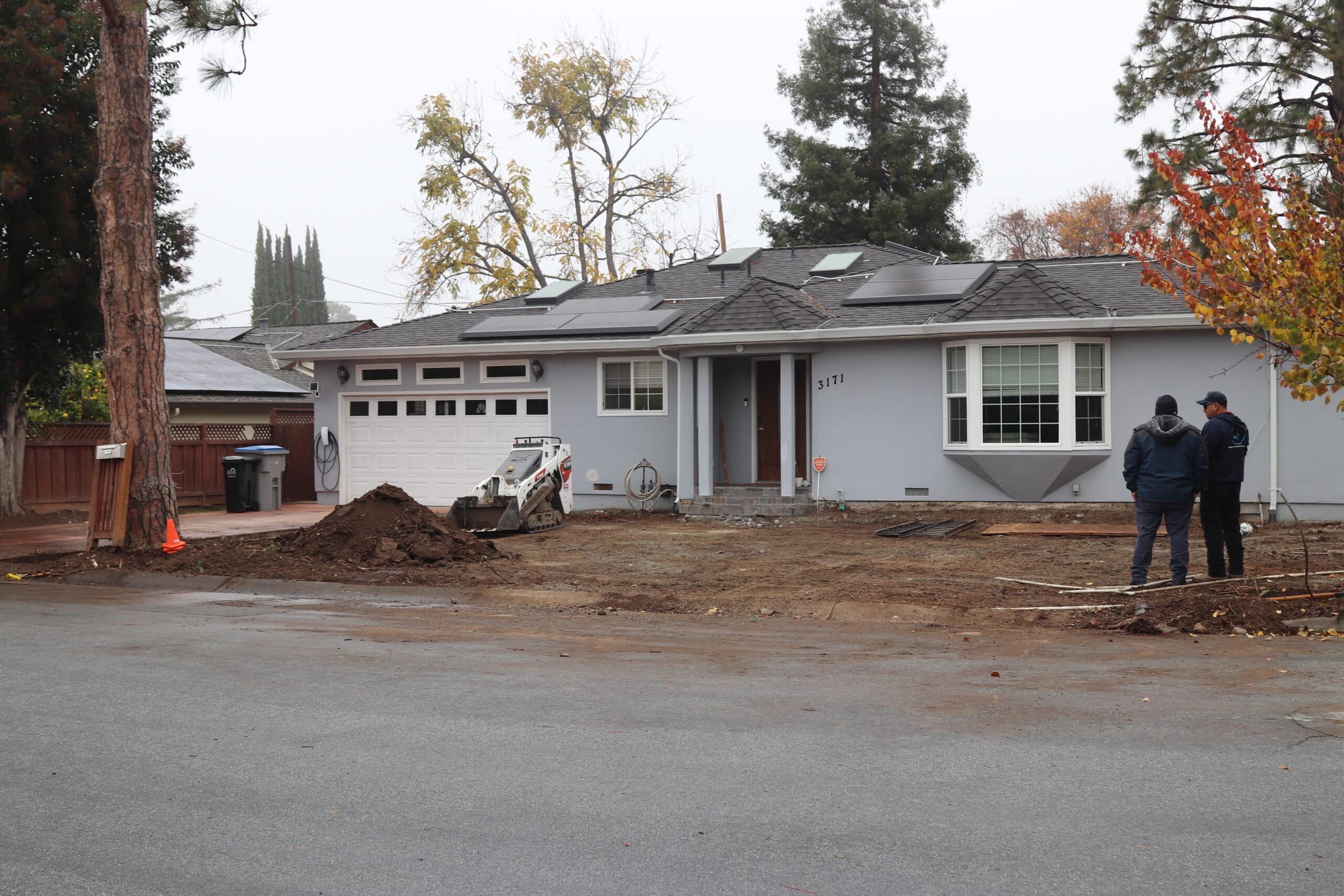
An SB9 lot split isn’t just a paperwork exercise. It creates a new property footprint, which usually means new construction, and new construction means grading, a new foundation, utility runs, and setbacks from every side of the new parcel.
Mature trees don’t fit neatly around those requirements. A tree’s canopy is easy to see, but the root system is the real problem. Structural roots on a large oak or sycamore can extend 1.5 to 3 times the canopy radius or more, often running directly under where a slab or a new driveway is planned.
Here’s what I see most often when a lot split hits tree territory:
- Grading work cuts into root zones before anyone realizes the damage is permanent
- New setback lines leave a tree with no buildable soil on one side, stressing or destabilizing it
- Foundation excavation severs anchor roots that were holding an older specimen upright
- Utility trenches for the new ADU or second unit run straight through the critical root zone
None of these are hypothetical. They happen on real lots in Willow Glen and Almaden Valley, and they happen because trees weren’t accounted for in the original site plan. How landscape design works when you have mature trees to protect explains this dynamic in more detail if you’re also thinking about what happens to the landscape after the split.
SB9 Approval Does Not Override San Jose’s Tree Permit Requirements
This is the piece that surprises homeowners the most. When the city approves your SB9 application, that approval covers the land use change. It does not automatically authorize removal of trees that fall under San Jose’s protected tree ordinance.
San Jose regulates removal of trees meeting certain size and species thresholds. A Coast Live Oak with a trunk diameter above a certain measurement, for example, requires a permit before removal regardless of what else is happening on the property. The same applies to heritage-designated specimens.
The practical sequence matters here:
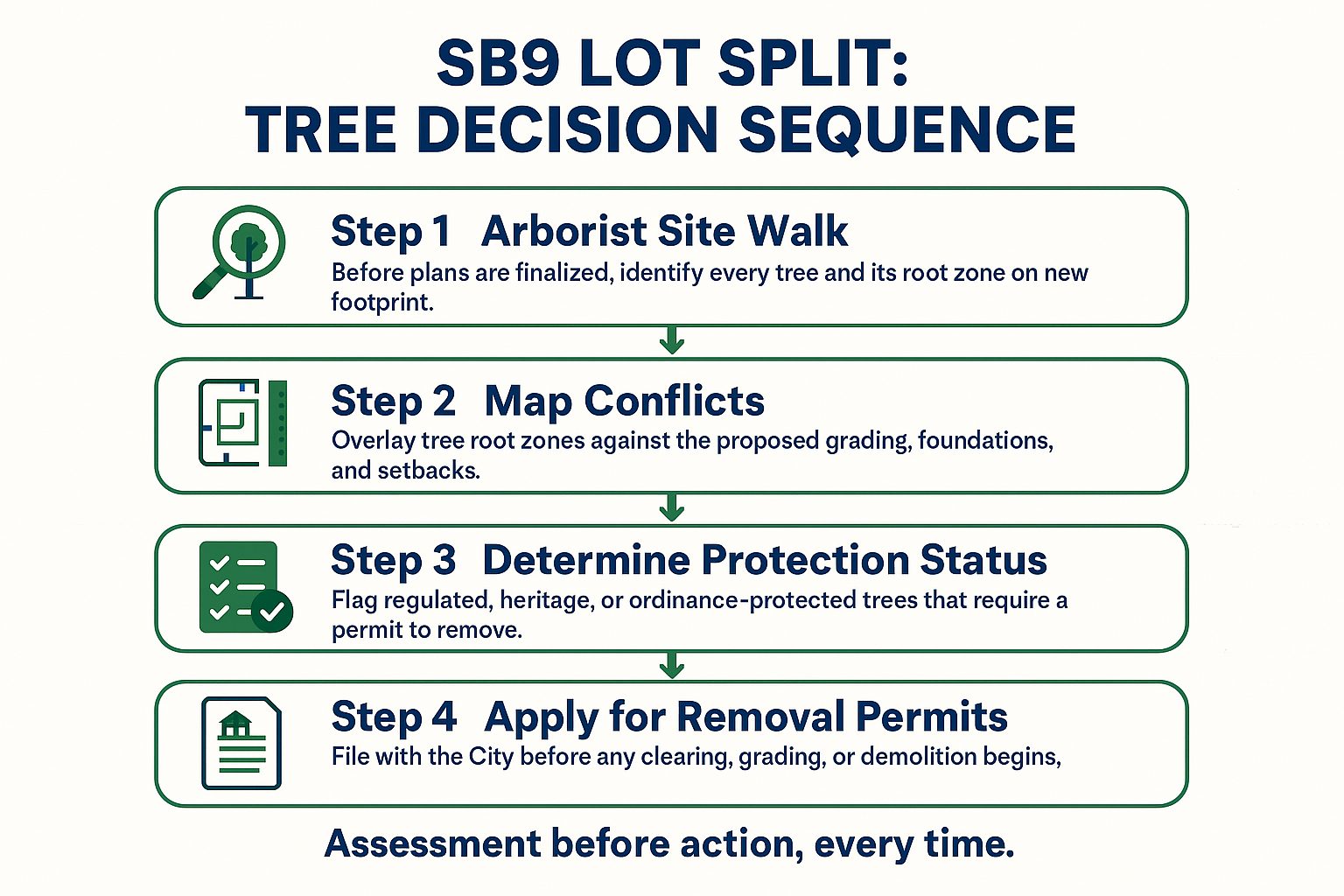
1. Identify which trees on the lot are regulated, this requires a site visit, not just a map
2. Determine which ones conflict with the new footprint based on actual grading and foundation plans
3. Apply for removal permits for any regulated trees before work begins, removal without one can carry real fines
4. Document condition and necessity, the City may require an arborist report explaining why removal is warranted
I’ve seen cases where a homeowner scheduled demolition and then discovered a protected tree in the removal path with no permit in hand. That stops the job. What San Jose requires before a tree comes down lays out the permit process in practical terms and is worth reading before any removal work is planned.
The City of San Jose’s Urban Forest Master Plan outlines the city’s framework for tree protection and removal permits if you want to go straight to the source.
The SB9 Tree Decision Sequence: What Comes First
This infographic walks through the correct order of steps when a lot split or new unit project involves existing trees.
Not Every Tree in the Build Path Has to Come Out
One thing I want to be direct about: removal is often the assumption, but it’s not always the answer.
I’ve walked SB9 project sites where the original plan called for removing four or five trees, and after a proper assessment, two of them could stay. One needed a crown reduction to clear the new structure’s roofline. Another had its root zone outside the actual construction impact area once we looked at the grading plans carefully.
This matters for a few reasons:
- Mature trees add documented value to residential properties, an arborist appraisal can capture that value if there’s a dispute or insurance question
- Trees that don’t need to go shouldn’t go, replanting a 40-year-old oak isn’t a substitute, and shade, privacy, and cooling benefits don’t come back quickly
- Some trees can be protected during construction with root zone fencing, adjusted excavation methods, and proper staging, but that planning has to happen before the crew shows up
If you just bought this property and are figuring out what you actually have, you just bought the house, now what do you do with the trees? is a good starting point. New homeowners evaluating an SB9 opportunity are a specific situation, and they deserve specific guidance, not a generic removal quote.
Before any removal is decided, it also helps to understand what the tree is actually worth, not just what it costs to cut it down. Before you remove a tree in San Jose, read this first covers the considerations most homeowners don’t think about until after.
Tree Situations Common in SB9 Projects: Remove vs. Preserve
Every tree situation is different and requires a real site assessment, but these general patterns come up often on South Bay lot split projects.
| Tree Situation | Typical Outcome | What Drives the Decision |
|---|---|---|
| Tree sits inside foundation or grading footprint | Removal likely required | Root zone cannot survive excavation; structural conflict is direct |
| Tree canopy overhangs new structure but roots are outside build zone | Crown reduction may preserve it | Root system intact; canopy can be trimmed back from roofline clearance |
| Heritage or protected tree in conflict with new footprint | Permit required before any action | City ordinance applies regardless of SB9 approval; arborist report usually needed |
| Tree on edge of new setback, roots partially in graded area | Assessment needed; outcome varies | Root zone mapping determines survivability; sometimes construction methods can adjust |
| Dead or severely declining tree in project path | Removal typically straightforward | Condition documentation may still be required for permit; removal framed as separate from SB9 |
What a Pre-Construction Arborist Assessment Actually Covers
When we walk an SB9 project site before construction begins, the goal isn’t to look for reasons to remove trees. It’s the opposite, to identify which trees can survive what’s planned, which ones are at genuine risk, and which ones are protected by ordinance and need a permit path before anything happens.
A pre-construction assessment typically covers:
- Species identification and size measurements, the foundation for any permit application
- Root zone mapping relative to the proposed grading and foundation plans
- Structural condition, decay detection, lean assessment, canopy balance
- Protection status under San Jose’s municipal code
- Preservation options where feasible, including construction exclusion zones
This isn’t a quick drive-by. It requires someone with actual credentials reviewing actual plans on the actual site. Robert Apolinar, our Board-Certified Master Arborist, has worked through this kind of pre-construction review on properties across San Jose, Los Gatos, and Campbell, and the arborist report that comes out of it is the document the City needs to see if removal permits are required.
If you’re unsure what a certified arborist actually brings to this kind of project that a general tree crew doesn’t, 6 things a Board-Certified Arborist does that a tree crew doesn’t is worth a few minutes.
Frequently Asked Questions About SB9 Lot Splits and Tree Removal
Does SB9 approval mean I can remove trees on my property without a separate permit?
No. SB9 approval covers the land use change, adding a unit or splitting the lot. It does not override San Jose’s tree ordinance. If a tree on your property meets the city’s size or species thresholds for protection, you still need a separate tree removal permit before it comes down.
How much does it cost to get a tree removal permit in San Jose?
Permit fees vary depending on the number of trees and the type of application, and the City’s fee schedule can change. More often, the real cost question isn’t the permit fee itself, it’s the arborist report required to support the application. That report involves an on-site evaluation, condition documentation, and written justification. For an accurate picture of what that costs for your specific situation, it’s worth a direct conversation with us.
Can I just trim a protected tree back instead of removing it to clear the build area?
Sometimes, yes, and that’s often the better outcome. If a tree’s canopy conflicts with a new structure but the root system isn’t in the graded footprint, a crown reduction can create the clearance needed without removing the tree. Whether that works depends on the specific species, the tree’s structural condition, and how much canopy work is actually required. A certified arborist assessment answers that question before you commit to either path.
What’s a critical root zone, and why does it matter for construction?
The critical root zone (CRZ) is the area around a tree’s trunk where the roots most important to its structural stability and water uptake live. For most trees, it extends outward well beyond the visible canopy edge. Grading, trenching, or compaction inside the CRZ can fatally stress a tree even if the trunk itself is untouched, which is why root zone mapping before any ground disturbance matters.
We just bought this house and are thinking about an SB9 project. Where do we even start with the trees?
Start with a site assessment before the architect draws anything. Knowing which trees are protected, where the root zones run, and which specimens are worth preserving gives the design team real constraints to work with from the beginning. It’s much easier to route a foundation around a protected oak before plans are finalized than to redesign after permits are filed.
What happens to stumps after tree removal on a construction site?
Stumps left in place can interfere with grading, create underground decay issues, and sometimes trigger regrowth. On an SB9 project site, stump removal is almost always part of the plan, but the method (grinding vs. full extraction) depends on how close the stump is to the new foundation. Why old stumps keep causing problems after the tree is gone covers this well if you want more detail.
Want a Clearer Picture of What Your Lot’s Trees Can Support?
If you’re planning an SB9 project in San Jose, Los Gatos, Campbell, or the surrounding South Bay communities, we offer a free photo-based evaluation as a first step, send us photos of the trees in question and we’ll give you initial guidance before any site visit is needed. For more complex situations, a full on-site assessment with Robert Apolinar covers everything from permit requirements to preservation options. Reach us at (408) 422-1313 or visit sanjosetreemaintenance.com to get started.
