 Skip to content

Direct Answer: A board-certified arborist diagnoses tree health, makes preservation decisions, and produces legal documentation. A labor crew executes cuts — but they can’t tell you whether the tree actually needed them.
We get calls regularly from homeowners who’ve already had work done — and something felt wrong afterward. The tree was topped instead of pruned. A healthy oak was removed when it didn’t need to be. The crew left, the yard looked neat, and two years later there’s a stub rotting at the crown or a root problem nobody mentioned.
Not long ago, a caller reached out specifically because a previous contractor had done poor work on her trees and she needed someone she could trust. She didn’t want more labor. She wanted an actual assessment. That’s a conversation we have more than most people realize.
The difference between a labor crew and a board-certified arborist isn’t just credentials — it’s a completely different set of questions they’re trained to ask. This list walks through six specific things an arborist does that a tree crew simply isn’t equipped to do.
1. Diagnose What’s Actually Wrong — Instead of Assuming
A tree crew looks at a tree and sees work to be done. A certified arborist looks at the same tree and asks why it looks the way it does.
That’s not a small distinction. A tree with yellowing leaves might have a nutrient deficiency, a watering problem, a fungal infection, or root compaction from nearby hardscape. Each of those has a different fix — and the wrong fix can make things worse.
When I walk a property, I’m reading the whole picture:
- Leaf color, shape, and drop patterns
- Bark texture and any signs of cankers or oozing
- Root zone condition and soil compaction
- Branch structure and where dieback is occurring
- The tree’s history, species, and age relative to its site
A crew that skips this step and goes straight to cutting isn’t doing anything wrong by their own standard — they were hired to trim. But trimming without diagnosis is like taking medication before knowing the diagnosis. It might be fine. Or it might accelerate the problem.
If you’re unsure whether a tree issue calls for a crew or an arborist, this breakdown on when a tree problem requires an arborist — not just a trimmer is a good place to start.
2. Recommend Preservation Before Removal
One of the things I hear most often from new customers is some version of: “I was expecting to be told to remove everything.” That expectation is understandable — some contractors default to removal because it’s faster, cleaner to quote, and harder for the homeowner to argue against.
A board-certified arborist is trained in exactly the opposite direction. The goal is safety, health, and longevity — not the quickest path to a stump.
One reviewer put it plainly after we assessed three trees she was concerned about: we recommended removing only one. She had come in prepared for a hard sell and left with a plan that kept two healthy trees standing.
Preservation options that a crew won’t typically discuss include:
- Cabling and bracing to support structurally compromised limbs
- Crown reduction to reduce wind load without destroying the tree’s form
- Targeted deadwood removal to reduce failure risk while keeping the canopy intact
- Deep root fertilization or soil aeration when the issue is below the surface
Removal is sometimes the right answer. But it should come at the end of an honest assessment — not as the default opening offer.
3. Practice Structural Pruning — Not Topping
Topping — cutting a tree back to large stubs regardless of where natural branch unions are — is one of the most damaging things that can happen to a mature tree. It triggers weak, fast-growing epicormic shoots, creates large open wounds that invite decay, and often shortens the tree’s life significantly.
And yet it still happens regularly, partly because it looks dramatic and thorough to a homeowner who just wanted the tree “cut back.”
A board-certified arborist follows ISA pruning standards — which means every cut is made at a natural branch union or collar, for a specific reason, with the tree’s long-term structure in mind. The goal is to reduce risk and improve form without creating new problems.
Structural pruning is particularly important for:
- Young trees being trained for a healthy mature form
- Mature oaks and eucalyptus in Willow Glen and Almaden Valley, where large limbs over structures carry real failure risk
- Post-storm recovery, where cuts need to account for the tree’s ability to compartmentalize and heal
If you’re planning ahead for winter weather, understanding how storm seasons change tree care planning is worth reading before you schedule any pruning work.
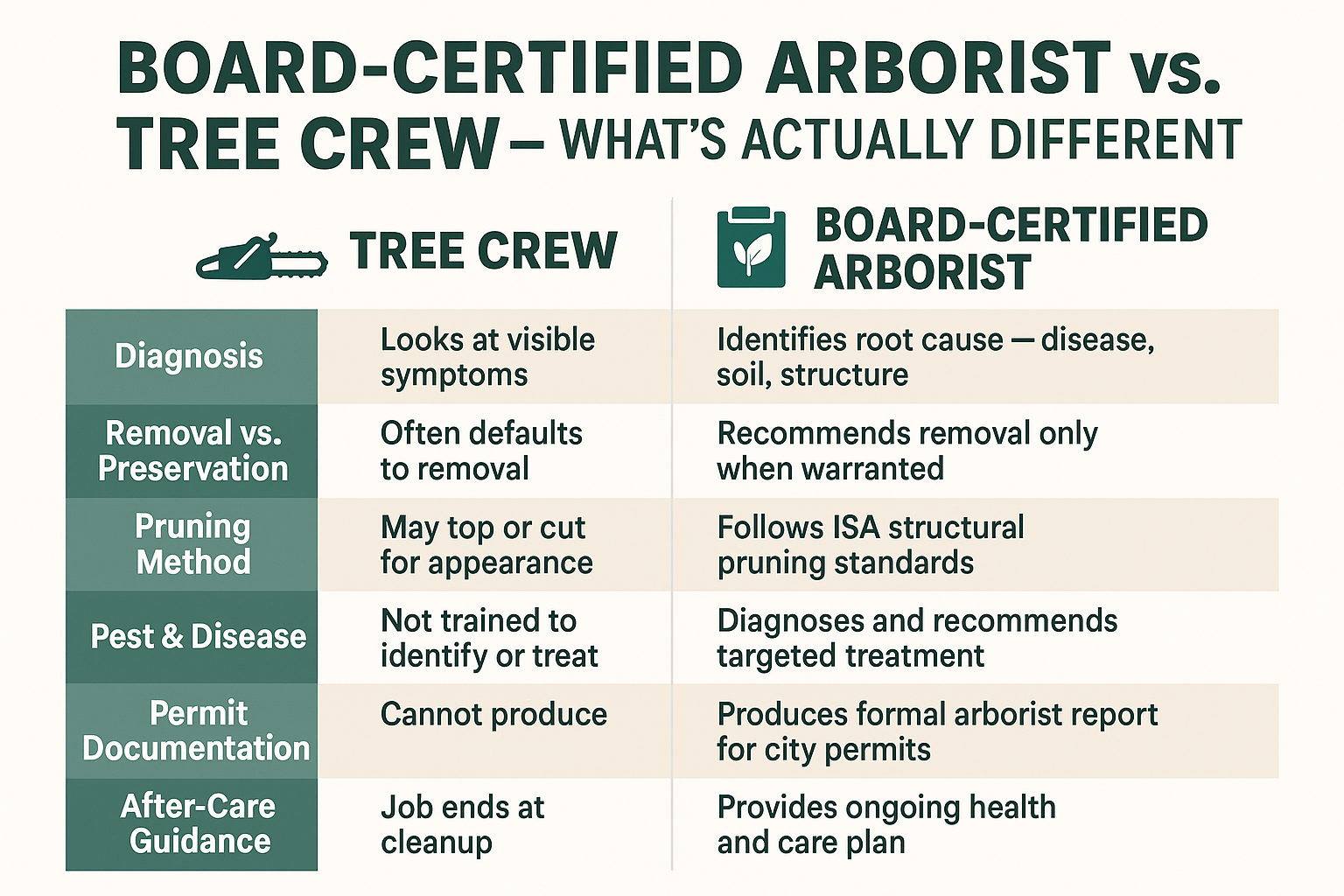
At a Glance: Arborist vs. Tree Crew
This comparison lays out the six key differences side by side — what each brings to your property and where the gap shows up.
4. Identify Pest and Disease — and Choose the Right Response
Earlier this year, a homeowner in Los Gatos reached out about a Palo Verde tree showing signs of powdery mildew. They just wanted it sprayed. That’s a reasonable first instinct — but whether spraying is the right call depends on the severity, the species, the time of year, and whether the underlying conditions favor reinfection.
A board-certified arborist can make that judgment. A crew with a sprayer cannot.
This matters especially for homeowners who prefer non-chemical approaches. There are targeted treatment options — including biological controls and cultural management practices — that work for certain pests and diseases but require training to apply correctly. Defaulting to chemical treatment when it isn’t needed, or using the wrong product for the pathogen present, can harm the tree and the surrounding landscape.
We also run into this with:
- Sudden Oak Death (Phytophthora ramorum), which is present in Santa Clara County and requires confirmed diagnosis before any treatment decision
- Anthracnose and fire blight on ornamentals and fruit trees, which are often mistaken for drought stress
- Aphid or scale infestations that look severe but may be manageable with minimal intervention
A crew that trims around a sick tree without identifying what’s wrong doesn’t solve the problem — they just clean up around it.
5. Produce the Arborist Report a City Permit Requires
This one surprises homeowners who are deep into a property project when they first hear about it.
If you’re developing, renovating, or doing any site work in San Jose that involves removing or impacting a protected tree, the City requires a formal arborist report as part of the permit application. That report has to be prepared by a licensed, certified arborist — it is a legal document, not just a friendly opinion.
We’ve worked with homeowners and real estate professionals on exactly this. One reviewer — a real estate agent — specifically named Robert as her go-to arborist for real estate projects because of how he handles the documentation side.
An arborist report for permit purposes typically covers:
- Species identification and tree inventory
- Health and structural condition ratings
- Assessment of project impacts on each tree
- Recommended protection measures during construction
- Mitigation or replacement requirements where removal is unavoidable
A labor crew can’t produce this. Neither can a landscaper without arborist credentials. If you’re unsure what San Jose’s protected tree requirements actually look like, this guide on what San Jose requires before a tree comes down covers the permit process in detail.
Two Ways to Start: Photo Review vs. On-Site Assessment
We offer two entry points depending on what you’re dealing with. Here’s how to think about which one fits your situation.
| Option | What It Covers | Best For |
|---|---|---|
| Free photo review | Initial read on visible symptoms, rough guidance on urgency | Early-stage questions, minor concerns, not sure if you need a full visit |
| On-site arborist consultation ($250) | Full assessment of every tree on the property, written findings, permit-ready documentation if needed | Mature trees with health concerns, pre-project planning, city permit requirements, anything structural |
| Labor crew estimate | Scope and pricing for approved work — trimming, removal, cleanup | After an assessment has already identified what needs to be done |
6. Build a Long-Term Care Plan — Not Just a One-Time Visit
A crew finishes the job, cleans up, and leaves. That’s the end of the transaction.
A board-certified arborist treats the visit as the beginning of an ongoing relationship with your trees. When we do an assessment, we’re not just answering “what needs to happen today” — we’re asking what the tree needs over the next three to five years, and what you as the homeowner can do in between visits to support it.
One of the things reviewers mention most often is that Robert took time after the work was done to explain watering schedules, fertilization timing, and which trees on the property needed watching. That kind of after-care guidance isn’t something you can bill separately — it’s just part of doing the work right.
For properties in Almaden Valley, Saratoga, and the Los Gatos foothills — where mature native oaks and drought-stressed trees are common — this long-term thinking matters more than in newer neighborhoods. A tree that looks fine today can decline fast in a dry summer without the right support plan in place.
If you’re thinking about what that kind of proactive care looks like before conditions change, preparing trees ahead of difficult weather seasons is a good place to think it through.
Frequently Asked Questions About Certified Arborist Assessments
Do I need to pay for an arborist visit just to get an estimate?
It depends on what you need. For straightforward trimming or a single obvious tree removal, a free estimate visit is usually sufficient. But if you have a tree showing signs of disease, a structural concern, a complex multi-tree property, or a project that might require a city permit, the $250 on-site arborist consultation is a different thing entirely — it’s a formal assessment with documented findings, not just a pricing conversation. Many homeowners find the consultation saves them money in the long run by avoiding work that wasn’t actually necessary.
What’s a Board-Certified Master Arborist, and is that different from a regular certified arborist?
Yes, there’s a meaningful difference. A Certified Arborist credential from the ISA (International Society of Arboriculture) requires passing a rigorous exam and maintaining continuing education. A Board-Certified Master Arborist is a higher designation — it requires extensive documented experience, additional examination, and peer review. It’s the ISA’s highest individual credential. Robert Apolinar holds this designation and is third-generation in the field, which is uncommon in this industry.
Can a certified arborist recommend non-chemical treatments for pests or disease?
Yes — and this is one area where arborist training really shows. Depending on the pest or pathogen involved, there are biological controls, cultural management changes, and physical interventions that can be effective without chemical application. Whether that’s the right path depends on the specific diagnosis, the severity, and the tree species. A certified arborist can walk you through those options. A crew with a sprayer generally can’t.
Do I need an arborist report if I’m just removing one tree in my backyard?
Maybe. San Jose has protected tree ordinances that apply to trees above certain size thresholds, regardless of whether they’re on private property. If the tree is large enough or is a protected species, removing it without a permit can result in fines. The safest approach is to have an arborist confirm the tree’s status before any work begins. This guide covers what San Jose requires before a tree comes down if you want the full picture.
What if I’m not in San Jose — does this still apply?
Protected tree ordinances exist in most South Bay cities, including Los Gatos, Saratoga, Campbell, and Cupertino — though the specific rules vary. The arborist assessment process is the same regardless of city. If you’re in any of those communities and have a tree project in mind, it’s worth a quick consultation to understand what your local requirements are before scheduling any removal work.
Not Sure What Your Trees Actually Need?
If something on your property looks off — or you’re heading into a renovation or sale and want to know where you stand — we’re happy to help you figure out the right starting point. You can submit photos for a free initial review or schedule an on-site arborist consultation. Reach San Jose Tree Service & Landscaping at (408) 422-1313 or visit sanjosetreemaintenance.com.