 Skip to content

Direct Answer: Cutting bamboo stalks does nothing lasting. Running bamboo spreads by underground rhizomes, so removal means cutting, treating, digging out the root mass, and monitoring for regrowth over multiple seasons.
A homeowner on the west side of San Jose wrote to us with a problem I hear often. Their neighbor had pulled out the main bamboo plant, but the roots had already traveled under the fence, and shoots kept coming up in both the front and back yard.
They had been cutting the canes down for months. Nothing changed. That is not a failure of effort, it is a failure of approach.
What you are almost certainly dealing with is running bamboo, the type planted along thousands of fence lines in Willow Glen, Almaden Valley, and the Saratoga foothills before people understood how it behaves. Here is what is happening underground, who is responsible for the cost, and what real removal takes.
Why Cutting the Canes Never Works
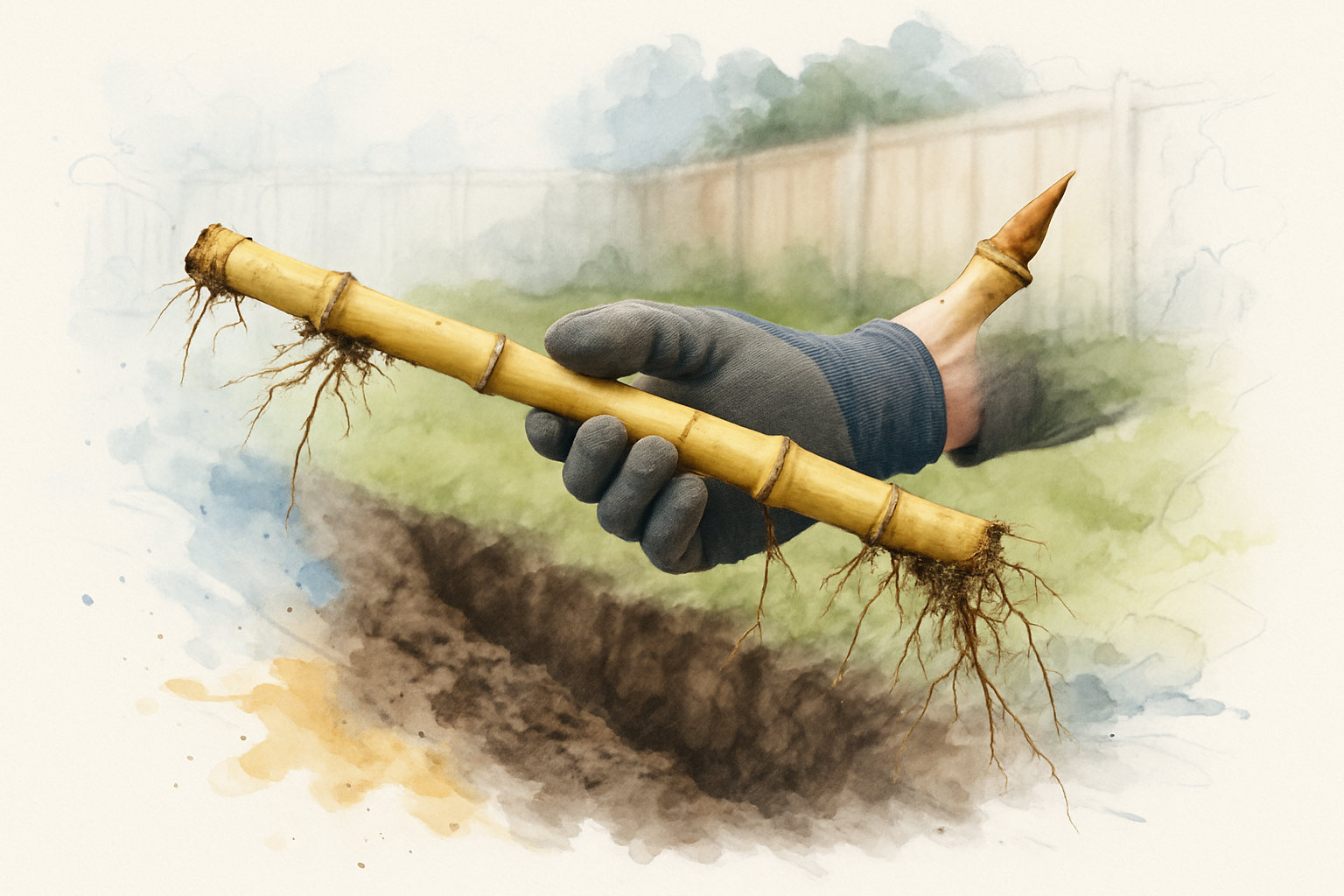
Bamboo is a grass. The part you see is not the plant, it is the visible tip of a spreading underground root system called rhizomes.
Those rhizomes run sideways, usually in the top 12 to 18 inches of soil, and they can push 15 feet or more from where the original plant sat. In a South Bay yard with irrigated beds and loose soil, they travel faster than people expect.
When you cut a cane, the rhizome is untouched. It simply sends up another shoot somewhere else, often further out than the last one.
What makes running bamboo so stubborn:
- A single node fragment left in the soil can start a new colony
- Rhizomes cross under fences, patios, and driveway edges without any surface sign
- Cutting alone can actually stimulate new shoots by triggering the plant’s stored energy reserves
- The plant stores carbohydrates underground, so it can outlast a season or two of cutting
- New shoots can emerge through gravel, lawn, planting beds, and cracks in hardscape
This is the same reason poison oak keeps returning when people just cut it back. The UC Statewide Integrated Pest Management Program makes the same point about rhizome-spreading weeds: removing the top growth without addressing the root system is a maintenance treadmill, not a solution.
Who Pays When the Bamboo Came From Next Door
This is the first question almost every homeowner asks, and the honest answer is not the one people want.
Under California property law, you generally have the right to cut roots and growth that cross onto your side of the property line. But the cost of that work falls on you, not on the neighbor whose plant started it.
If the bamboo is causing actual damage to structures or hardscape, a nuisance claim may be possible. That is a legal question for an attorney, not something I can settle in a blog post.
California has been tightening its stance on invasive bamboo, and cities have more room than they used to when it comes to requiring containment or removal where running bamboo spreads onto neighboring property. Rules vary by municipality, so what applies in San Jose may not match Los Gatos or Campbell.
My practical advice: talk to the neighbor before you do anything. Most people genuinely do not know their privacy screen is running under the fence. A shared removal, done on both sides at once, is far more effective than treating only your half while the source keeps feeding new growth.
Property line questions come up constantly around here, and they follow the same logic as who actually owns the tree in front of your house. Where the plant grows matters less than where the responsibility sits.
What I Look At Before Quoting Any Bamboo Work
Proper assessment before action applies here as much as it does with a mature oak. Two yards with the same amount of visible bamboo can be completely different jobs.
When I walk a property, I am mapping the spread, not counting canes:
- How far out the newest shoots are from the original planting spot
- Whether rhizomes have run under a patio, driveway apron, or foundation edge
- How close the mass sits to irrigation lines, utility runs, and sewer laterals
- What else is planted in the affected area that we need to protect
- Whether the source plant still exists on the neighbor’s side
- Soil conditions, since San Jose’s clay-heavy soils change how we excavate
That last point matters more than people think. In heavy clay, rhizomes tend to stay shallow and run along irrigation-softened soil, which often means a tighter, more predictable dig. In amended beds, they go deeper and wider.
Photos give me a useful first read on scope. A walk of the property tells me what the work actually is.
What Bamboo Removal Actually Involves
There is no single-visit version of this on an established stand. Anyone promising one is selling you a cane cutting.
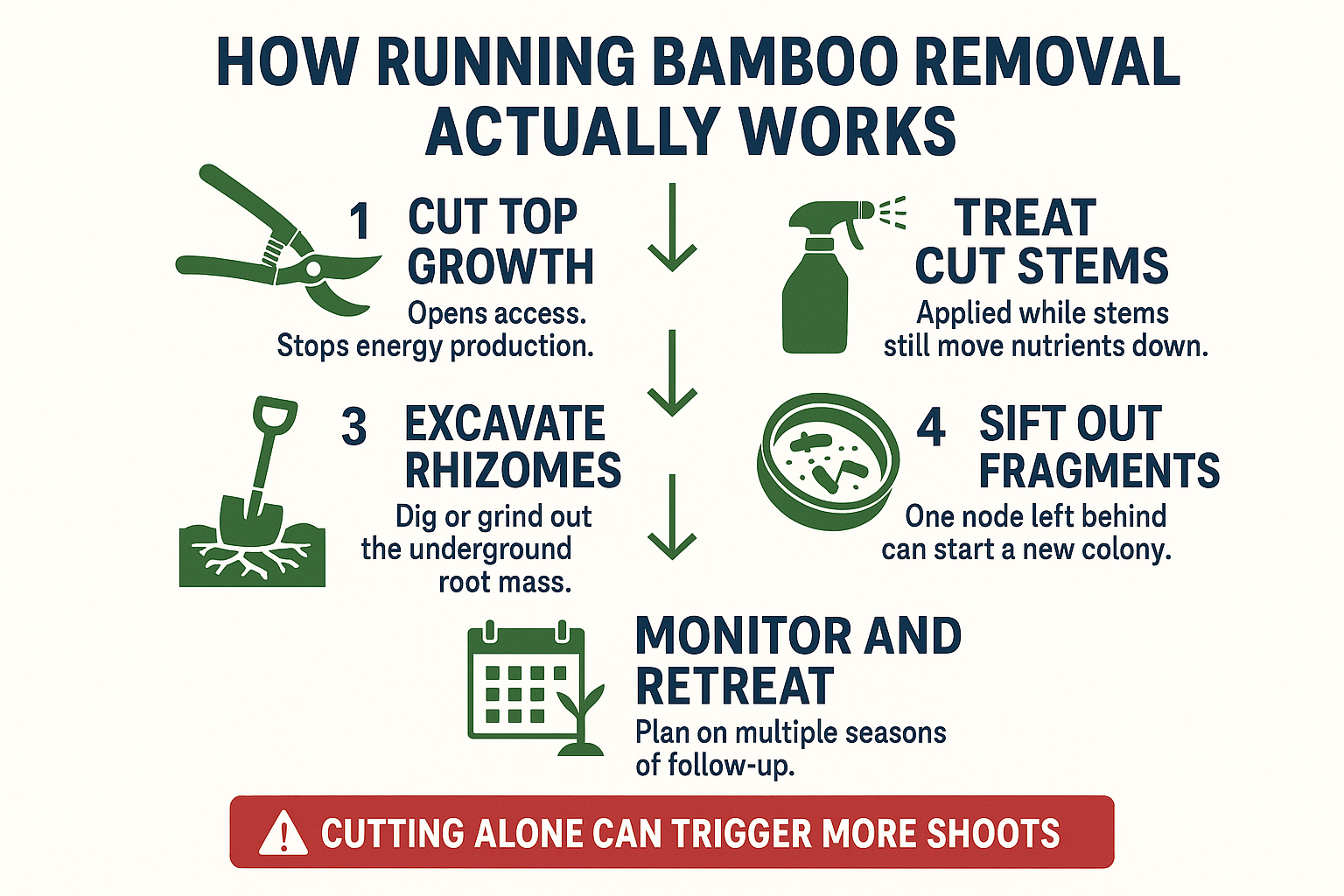
A sound removal sequence looks like this:
1. Cut the above-ground growth to open access and stop new energy production
2. Treat the freshly cut stems with an appropriate herbicide while they are still actively moving nutrients downward, which is the narrow window that matters
3. Excavate or grind out the rhizome mass as thoroughly as the site allows
4. Sift and remove fragments from the disturbed soil, since leftovers are the usual cause of return
5. Monitor and retreat any new shoots over the following seasons
Timing on step two is not optional. Treat at the wrong point in the plant’s cycle and the chemical never reaches the rhizome network.
All herbicide application on our jobs is done under a California State Qualified Applicators License, the same standard we hold ourselves to on weed abatement work across San Jose and poison oak removal.
Expect follow-up. I tell homeowners to plan on a multi-season process, with check-ins through at least one full growing cycle. Treating that as normal, rather than as a setback, is what separates a finished job from a recurring one.
The Bamboo Removal Sequence at a Glance
Here is the order of operations that actually clears an established stand, and why skipping a step sends you back to the start.
How Far the Spread Has Gone Changes Everything
Scope and cost track almost entirely with how far the rhizomes have traveled. This is why an early assessment saves real money.
| Stage of spread | What removal usually involves | Effect on scope and cost |
|---|---|---|
| Shoots only along the fence line, under 3 feet out | Cut, treat, trench and excavate a narrow band, install containment if desired | Smallest scope. Often one main visit plus follow-up checks |
| Shoots scattered 5 to 15 feet into the yard | Full cut and treat, wider excavation across beds and lawn, soil sifting | Meaningfully larger. Landscape repair usually needed afterward |
| Shoots in both front and back yard, or under hardscape | Multi-phase treatment, selective excavation, possible hardscape edge work, staged retreatment | Largest scope. Plan on multiple seasons and a phased approach |
| Source plant still growing on neighbor’s side | Your side treated as containment and control rather than elimination | Ongoing maintenance cost unless both sides are addressed |
What Goes in the Gap Afterward
Removing bamboo usually leaves a bare, disturbed strip right where the privacy used to be. That is the part homeowners underestimate.
Costs vary widely and depend far more on the size of the dig, access for equipment, and how much landscape has to be reset than on the bamboo itself. Rather than guessing at a number, I would rather walk the site and tell you what the work actually is.
For the screening you lose, there are better long-term options for South Bay yards:
- Clumping bamboo species, which stay in a defined footprint instead of running
- Evergreen hedge plantings sized correctly for the fence line at maturity
- A trellis or structure paired with climbing plants for faster coverage
- Layered drought-tolerant plantings that screen at eye level without a monoculture
Whatever goes back in, place it deliberately. Right tree, right place, right time applies just as much to a privacy screen as it does to a shade tree, and it is the same thinking that drives our landscape design and installation work.
If there are old stumps or woody root masses tangled into the same area, handle them at the same time. The stump removal guide covers how that work is priced and what grinding does and does not leave behind.
Frequently Asked Questions About Bamboo Removal in San Jose
Can I just keep cutting the shoots every time they appear?
You can, and some homeowners choose that as a maintenance plan. But understand what you are signing up for: cutting suppresses the plant, it does not kill it. Miss a season and the rhizomes regain ground quickly.
Will a root barrier stop bamboo from coming back?
A properly installed barrier can help contain spread, but only when it is deep enough, continuous, and installed after the existing rhizomes on your side are removed. Dropping a barrier on top of an established rhizome network just traps the problem inside your yard.
Can I make my neighbor pay for the removal?
Generally no, not for the routine work of clearing encroaching growth. California law lets you cut what crosses onto your property, but the cost is typically yours. If the bamboo is causing documented damage to structures, that becomes a separate legal question worth asking an attorney about.
How long before I can call it gone?
Plan on at least one full growing season of monitoring after the main removal, and often longer on a widespread stand. Any new shoot that appears gets treated. Homeowners who expect that timeline from the start are almost always happier with the outcome than those who expected one visit.
Should I send photos or have someone come out?
Photos are a good first step and often tell me enough to describe the likely scope. For anything past the fence line, especially where shoots have reached lawn, beds, or hardscape, a walk of the property is the only way to map how far the rhizomes have actually gone.
Not Sure How Far the Bamboo Has Spread?
Bamboo is very manageable when it is caught before the rhizomes have crossed the whole yard, and considerably harder once they have. If shoots are showing up in San Jose, Willow Glen, Almaden Valley, or out toward Saratoga and Los Gatos, an early look at the spread tells you what you are really dealing with. San Jose Tree Service & Landscaping is available at (408) 422-1313 or at sanjosetreemaintenance.com when you want a straight read on the scope.
