 Skip to content

Direct Answer: In California, whoever owns the ground under the trunk owns the tree. But paying for fence damage usually turns on negligence, not ownership, so document the tree’s condition and call your insurer.
The call usually comes the morning after a storm. A tree or a heavy limb has come down across a shared fence, half the debris is in one yard and half is in the other, and nobody knows who is supposed to deal with it.
One returning customer put it about as plainly as it gets: they had a tree fall on the fence during a storm and wanted someone to come out and assess. That is the whole situation in one sentence.
People ask me three questions, always in the same order. Is this my tree or theirs? Who pays for the fence? Can I touch any of it before someone official looks at it? I will take them in that order, because that is the order they show up in your head.
Tree Fell on Fence, Who Is Responsible? Start With the Trunk
Ownership in California comes down to one thing: where the trunk sits. Not the canopy, not the roots, not which yard the leaves land in every October.
If the trunk stands entirely on one side of the property line, that owner owns the whole tree. Branches reaching thirty feet over the neighbor’s patio do not change that.
If the trunk straddles the line, it is a boundary tree and both owners share it, which means shared decision-making about what happens to it. I have seen this come up on appeals in Saratoga where a mature valley oak’s trunk crossed multiple lots and the neighbors were all co-owners without realizing it.
Here is the part people get wrong. Ownership answers who owns the tree. It does not automatically answer who pays for the damage.
- Owning the tree makes you responsible for maintaining it
- It does not make you automatically liable for every branch that fails
- Insurance and liability follow a separate track, which I will get to next
Most of the time you can settle the ownership question in five minutes with a tape measure and your plat map. If you are not sure where the line actually runs, that is worth confirming before anyone starts making claims. Our piece on who actually owns the tree in front of your house walks through the street tree version of the same question, which trips up a lot of Willow Glen homeowners.
A Storm Event and a Failing Tree Are Two Different Conversations
This is where most fence-line disagreements actually live, and it has almost nothing to do with the tape measure.
California courts generally look at negligence rather than automatic responsibility. A healthy, maintained tree that comes down in a heavy winter storm is usually treated as a natural event. Nobody was careless. The wind won.
A tree that was visibly dead, splitting at a weak fork, or leaning hard toward the fence, and that had already been pointed out to its owner, is a different conversation entirely.
What tends to matter:
- Was there visible decay, deadwood, or a crack anyone could see from the ground
- Had the owner been notified in writing and done nothing
- Was there an arborist record of the tree’s condition from before it failed
- Did routine maintenance happen at all, or had the tree gone untouched for a decade
I am not going to tell you how your particular situation shakes out. That depends on facts I have not seen, and your insurer and, if things get tense, an attorney are the right people for that call.
What I can tell you is why documentation carries weight. A written condition report from before a storm is evidence. A photo taken after the fence is already flattened is just a photo of a flattened fence.
That is the real argument for an arborist walk-through in early fall, before the rain starts. It costs a fraction of a dispute and it puts the tree’s condition on paper while everyone still agrees on what it looks like.
How These Situations Usually Get Sorted Out
This is a general framework, not a prediction about your claim. Your insurer will have the final word on your specific policy.
| Scenario | How it is generally viewed | What helps your position |
|---|---|---|
| Healthy tree fails in a major storm | Typically treated as a natural event | Photos of the intact tree, past pruning invoices |
| Tree was visibly dead or split beforehand | Negligence questions come into play | Written notice to the owner, dated arborist report |
| Boundary tree with trunk on the line | Shared ownership, shared decisions | Survey or plat map showing the line |
| Branches overhanging the fence line | Owner is still the trunk owner | Documented trimming requests and responses |
| Tree failed after saturated soil loosened the root plate | Depends heavily on prior condition | Pre-season assessment noting root or lean issues |
The First 48 Hours: What to Do Before Anyone Starts Cutting
This is the sequence I give homeowners over the phone, and it is where most people lose ground by moving too fast.
Photograph First, Cut Second
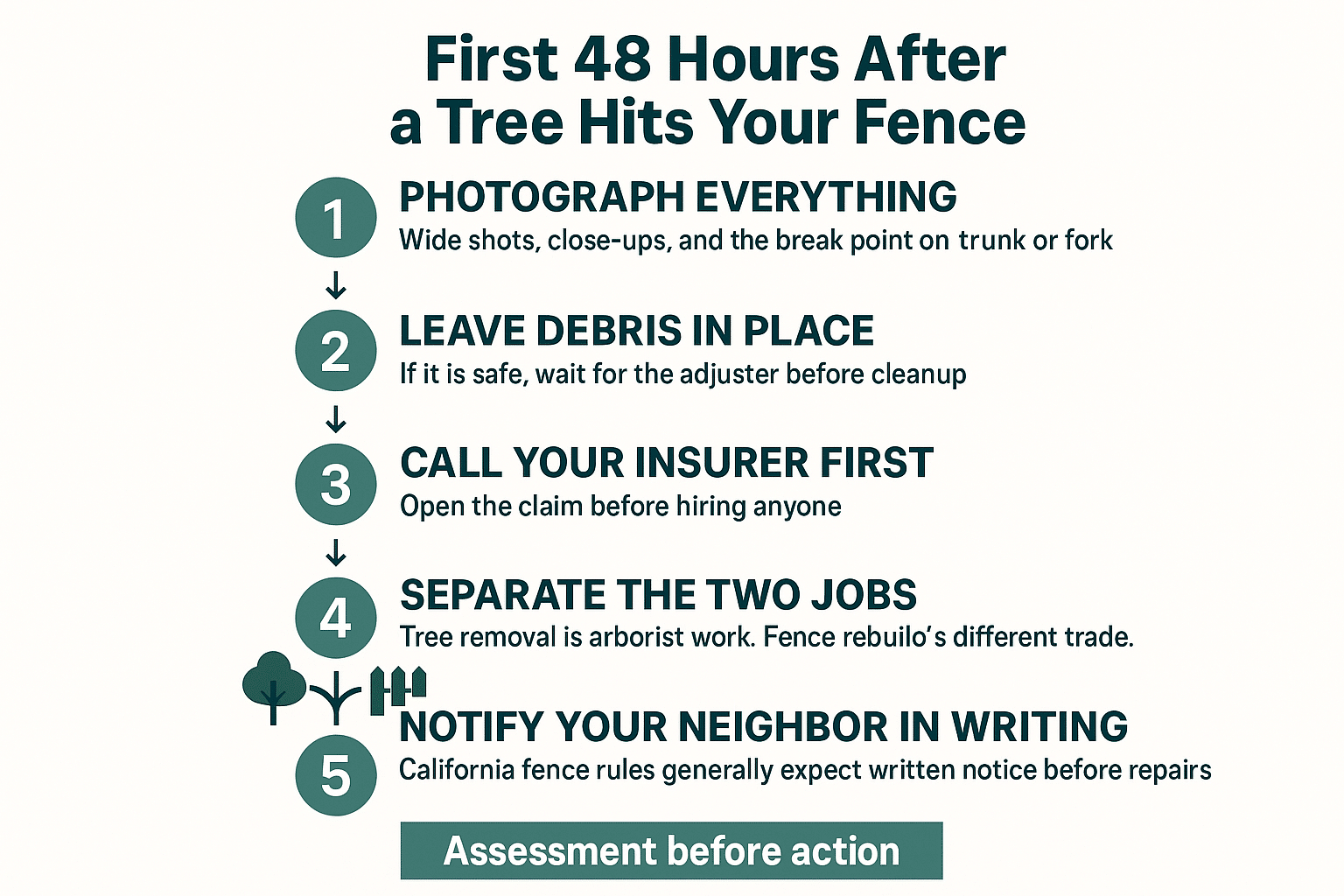
The instinct is to get the mess off the fence before dark. I understand it. But if you clear the debris before an adjuster sees it, you have thrown away the only record of what happened.
Shoot more than you think you need:
- Wide shots showing the tree, the fence, and both yards
- The failure point on the trunk or the fork, close up, because that is where decay shows
- The root plate if the tree tipped rather than snapped
- The damaged fence sections from both sides
- Anything else the tree hit on the way down
Leave the debris where it is until the adjuster has looked, as long as that can be done safely. If a limb is hanging over a walkway, a driveway, or a power service line, safety wins and you document as you go.
One more thing worth knowing. If part of the tree is still standing and it turns out to be an ordinance-size tree in San Jose, taking the rest of it down can still involve city process even after a storm. Rules and fees change, so verify current requirements with the city rather than assuming. Our explainer on what triggers a permit on your property covers how those thresholds work.
The Tree and the Fence Are Two Separate Bills
This surprises almost everyone. Clearing and cutting the tree is arborist and tree crew work. Rebuilding the fence is a different trade with its own estimate.
They are not one invoice, and they usually are not one contractor. Sorting that out early keeps the whole thing from stalling.
And here is the piece that really catches people off guard. California’s shared fence rules generally presume that adjoining owners split the upkeep of a boundary fence, and they generally expect written notice to your neighbor before you start repairs. A lot of homeowners assume the tree’s owner automatically covers the fence, and that is not how the fence statute is built.
So the honest answer to “who pays” is often layered:
- The tree cleanup may fall to whoever owns the trunk, or to each owner for the debris on their side, depending on the circumstances
- The fence repair may be a shared cost under boundary fence rules
- Insurance may cover part of it, depending on your policy and the cause
Cost varies widely depending on tree size, access, and how much rigging is needed to get pieces out without damaging what is left. A crane job in a tight Almaden Valley side yard is a different number than a limb you can drag out through an open gate. Our breakdown of what goes into the price of tree work explains the drivers so a quote makes sense when you get one.
Why This Particular Winter Deserves Your Attention
NOAA forecasters have been carrying an El Nino advisory with rising odds of a strong event heading into the 2026-27 winter. For trees in our area, the storms are only half the story.
The other half is the soil. Much of San Jose sits on heavy clay, which holds water instead of draining it. Saturated ground loosens the root plate on trees that looked completely fine through a dry summer.
That is how a tree with no visible canopy problem ends up on a fence in February. The failure was underground the whole time.
The usual candidates I see:
- Fence-line trees in mature-canopy neighborhoods like Willow Glen and Almaden Valley, often planted too close to the line decades ago
- Sloped lots in Los Gatos and Saratoga, where grade adds another load on the root system
- Trees with a lean that has changed over the past few years
- Trees with a weak fork or an old split that has never been addressed
If you have one of these along a shared line, the window to do something about it is now, not during the storm. A split or weak fork sometimes has options other than removal, including cabling and bracing, and a lean is not automatically a hazard. That is what an assessment is for. We go into the seasonal side of this in more detail in our guide on how El Nino winters change tree care planning.
Frequently Asked Questions About Fallen Trees and Shared Fences
My neighbor’s tree fell on my fence. Can I just cut it up and bill them?
I would not. Cutting first and asking later is how disputes get expensive. Document it, notify your insurer, and put your notice to your neighbor in writing before anyone runs a saw. If the debris is creating an immediate hazard, deal with the hazard and keep photographing as you go.
Does it matter that the branches were hanging over my yard for years?
Overhang does not transfer ownership. The trunk location decides ownership, period. What overhang can do is establish a history: if you asked in writing for the tree to be maintained and nothing happened, that record matters in a negligence discussion.
What is an arborist report and do I need one for this?
It is a written evaluation of a tree’s condition, species, size, and risk, based on an on-site look rather than a template. People request them for city permits, insurance claims, and neighbor disputes, and that last category comes up more than you would think. A verbal consultation costs less than a formal written report. Fees depend on scope, so ask for the exact figure before you book.
Can you tell what is wrong from photos I email?
Sometimes. Photos work well for a first read on obvious things like deadwood or an existing break. For anything involving root condition, internal decay, or a formal document, it needs to be on-site. We cover the tradeoff in more detail in our article on photo assessments versus on-site visits.
If the tree is mine, should I just take down every tree near the fence?
No, and I would push back hard on that. Healthy mature trees add real value on properties in Willow Glen, Almaden Valley, and Los Gatos, and most condition problems are manageable. Proper assessment before action. Removal is a last resort, not a default.
Getting the Condition on Paper Before the Next Storm
When a fence-line tree turns into a dispute or a claim, the thing that decides it is usually documentation, not cutting. Our owner is a Board-Certified Master Arborist, and we prepare written arborist reports and formal tree appraisals using the ISA Guide for Plant Appraisal, the standard insurers, courts, and municipalities recognize. One homeowner summed up what we aim for after storm damage: “They came promptly and told me what needed to be done. They gave me a detailed plan and cost of service.” If you have a tree along a shared line in San Jose, Los Gatos, Saratoga, or Campbell that you would like looked at before the rain settles in, San Jose Tree Service & Landscaping is available at (408) 422-1313 or at sanjosetreemaintenance.com.
