
Direct Answer: As of late September 2026 there is no statewide Zone 0 rule in force. The Board adopted it on August 19, 2026, but it is not operative until the Office of Administrative Law files it.
A homeowner above Saratoga wrote to us in August after seeing a headline about California’s new five-foot rule. They had just bought the place, wanted to be sure they had proper defensible space, and asked whether the shrubs along the foundation had to come out before winter.
Fair question. And the honest answer is messier than the headlines suggest. The Board of Forestry did adopt Zone 0. It is still not law.
So let me lay out where the rule actually stands as of late September 2026, who it would cover here in Santa Clara County, and what I would do in that first five feet while the state finishes its paperwork.
The California Zone 0 defensible space rule status, in plain terms
On August 19, 2026, the California State Board of Forestry and Fire Protection voted 8-0 to adopt emergency regulations establishing an ember-resistant defensible space zone within five feet of qualifying structures. That is Zone 0, written under AB 3074.
Adoption is not the finish line. An emergency regulation only takes effect when the Office of Administrative Law (OAL) approves it and files it with the Secretary of State.
Here is the sequence so far:
- August 19, 2026 – the Board adopts the emergency Zone 0 regulations
- August 28, 2026 – the Board submits them to OAL
- September 2, 2026 – OAL’s five-calendar-day public comment period closes
- September 8, 2026 – the Board pulls its filing back
OAL approval and filing are required before the rules are operative, and that has not happened. Board adoption alone does nothing to your yard.
When the rules do land, the expectation reported by policy trackers is that new construction complies on the effective date, while existing structures phase in over roughly three to five years. The rule is described as reaching about two million structures statewide.
You can follow the official record through the California Board of Forestry and Fire Protection, which posts its rulemaking packages and meeting materials.
Would it even apply to your property?
This is the part most homeowners skip, and it changes everything. Zone 0 is written for parcels in State Responsibility Areas (SRA) and, for incorporated cities and towns, in Very High Fire Hazard Severity Zones (VHFHSZ) inside the Local Responsibility Area (LRA).
A flat lot in central Willow Glen is a very different situation from a hillside parcel off Pierce Road in Saratoga or the upper reaches of Almaden Valley. Two homes ten minutes apart can sit on opposite sides of that line.
Before you change a thing, confirm three items:
- Whether your parcel sits in an SRA or a VHFHSZ within an LRA
- What your city or county fire agency already requires today
- What your insurer is asking for at renewal
That last one drives more real-world work than the state rule does right now. Several local Zone 0 ordinances are already law in California, and they are a separate matter from the state regulation. Saratoga is a good example of a city that has moved on its own timeline, which I covered in Saratoga’s updated tree rules and the five-foot zone around your house.
Santa Clara County also enforces its own vegetation standard, keeping flammable growth below six inches, with deadlines that fall in spring rather than mid-summer. That requirement exists whether or not Zone 0 is ever filed.
Zone 0 timeline and what each step actually means
Dates matter more than headlines on this one. Here is the record as it stands.
| Date | What happened | What it means for your yard |
|---|---|---|
| August 19, 2026 | Board of Forestry voted 8-0 to adopt emergency Zone 0 regulations under AB 3074 | Adoption alone does not make it enforceable |
| August 28, 2026 | Regulations submitted to the Office of Administrative Law | Starts the state review process |
| September 2, 2026 | OAL five-calendar-day public comment period closed | Public input window ended |
| September 8, 2026 | The Board pulled its filing back | No statewide Zone 0 rule is operative |
| Date not yet set | OAL approval and filing with the Secretary of State | New construction complies on the effective date; existing structures phase in over roughly three to five years |
What the first five feet is really about
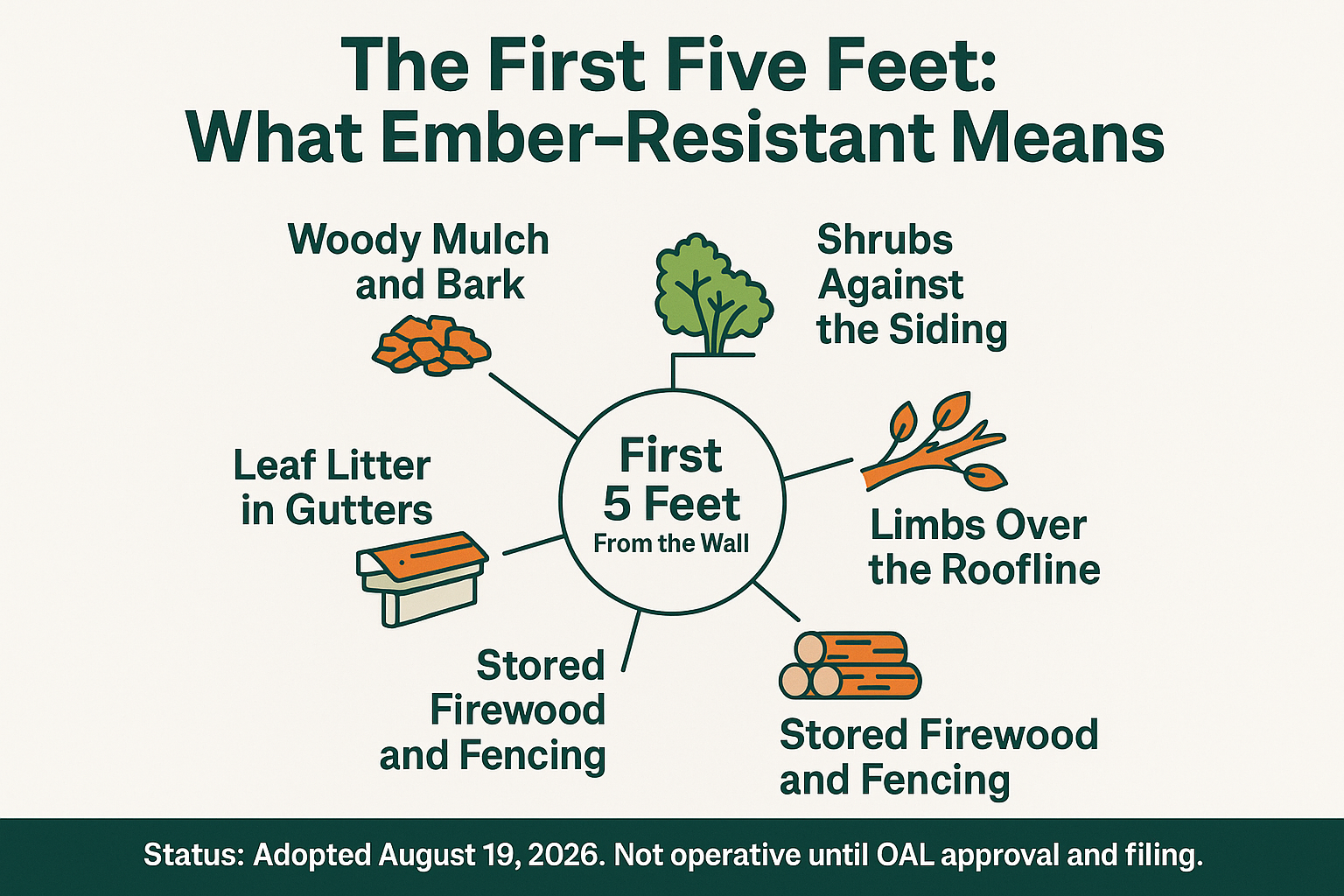
Zone 0 is an ember-resistant concept, not a landscaping style. This is the thinking behind it.
What I would actually do in that five feet right now
My advice to the homeowner above Saratoga was the same advice I would give you: do the cheap, reversible work now, and hold off on anything drastic until the rule is filed and you know your parcel’s status.
The low-cost moves that rarely get regretted:
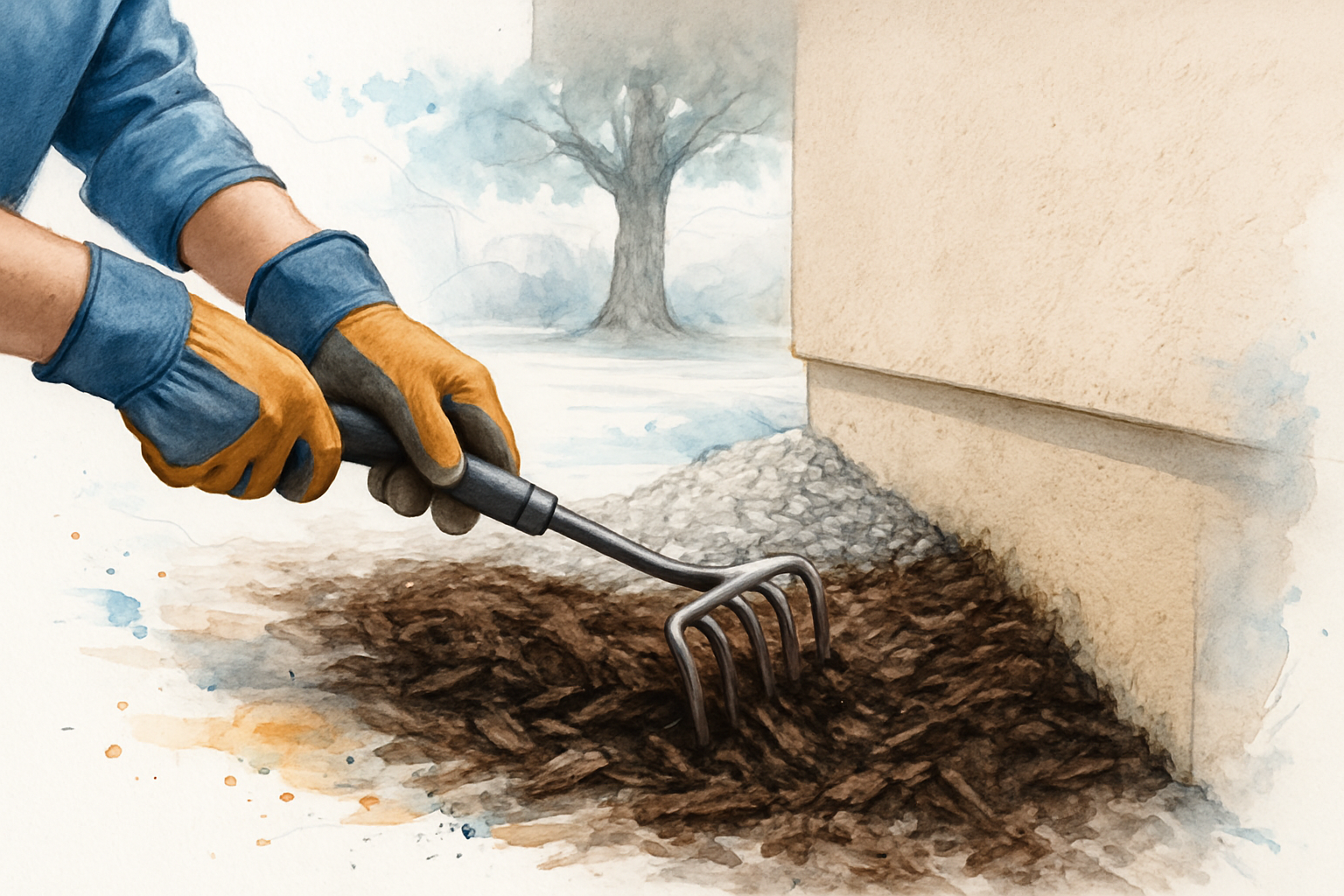
- Swap woody bark mulch against the foundation for gravel or bare, maintained soil
- Clear leaf litter out of gutters and off the roof valleys, especially under liquidambars and redwoods
- Move the firewood stack and the plastic storage bin away from the wall
- Pull dead material out of junipers, rosemary, and other resinous shrubs sitting tight to the siding
What I would not do is take a chainsaw to a mature tree over a rule that has not been filed. A healthy coast live oak forty feet from your house is not a Zone 0 problem, and oaks carry their own protections in San Jose, Cupertino, and Almaden that a panic decision can run straight into. I wrote more about that in why an oak in Cupertino or Almaden plays by different rules.
Proper assessment before action. Selective limb clearance over the roofline and thinning of the fuel underneath a canopy usually gets you further than removal, and it keeps the shade that makes a South Bay summer tolerable. Safety first, without destroying the tree.
If you just bought the place and have no history on the trees, an evaluation is a reasonable starting point. That is the same ground covered in what to do with the trees when you just bought the house.
Budgeting for a three to five year phase-in
Because existing structures would phase in over roughly three to five years, you are not looking at one large bill. You are looking at a plan.
Costs vary a lot by lot size, slope, access, and how much material has to be hauled out. Around San Jose and the Los Gatos foothills, a mulch swap and a foundation cleanup sits at the low end, while brush reduction on a steep parcel with limited truck access sits well above that.
The drivers that move a quote most:
- Slope and access for equipment and chipping
- Volume of material hauled off site
- Whether permitted trees are involved and need documentation
- Whether irrigation or planting beds have to be reworked after clearing
One thing worth knowing: an on-site verbal consultation and a formal written arborist report are two different products at two very different prices. A written report prepared for a permit, an appeal, or a neighbor dispute takes site measurements, research, and documentation, so it lands in a much higher range than a walk-through. Ask which one you actually need before you pay for either. Rates for both are best confirmed directly, since every property is different.
Frequently Asked Questions About the Zone 0 Rule
Do I have to rip out the shrubs against my house right now?
Not because of the state rule. As of late September 2026 the Zone 0 regulation is not operative, since the Board pulled its filing back on September 8, 2026. Your city ordinance or your insurer may ask for it sooner, so check those two first.
How do I find out if my parcel is in a Very High Fire Hazard Severity Zone?
Start with your city or county fire agency and the state hazard severity maps. In Santa Clara County the answer often depends on whether you are up in the foothills of Saratoga, Los Gatos, or upper Almaden Valley versus down on the valley floor.
Does Zone 0 mean my oak has to come down?
No. Zone 0 is about the first five feet around the structure, not about removing mature trees from the property. In most cases the right response is clearing limbs away from the roofline and reducing fuel beneath the canopy. Removal should be a last option after an assessment, and many protected trees here need a permit before anyone touches them.
My insurance company is already asking about the five feet. Does that mean the rule passed?
Insurers set their own underwriting standards and do not have to wait for a state regulation. Plenty of homeowners in the South Bay foothills are getting these requests right now while the statewide rule sits in limbo.
Can I send photos instead of paying for a site visit?
A lot of homeowners ask this, and photos are a reasonable first step for simple questions. For anything involving a permit, an appeal, or structural doubt about a tree, a photo cannot replace someone standing at the root collar looking at it.
Sorting out what the five feet around your house actually needs
If you are trying to figure out whether your parcel in San Jose, Saratoga, Los Gatos, or Almaden Valley falls under any of this, the useful first step is a look at the property before anything gets cut. Our arborist-led assessments cover defensible space alongside tree health and permit questions, and we work throughout Santa Clara County. The office line is (408) 422-1313, or you can read more at sanjosetreemaintenance.com.
