
Direct Answer: A tree protection zone is the ground around a trunk that must stay undisturbed during construction. It is usually 12 times trunk diameter, or the dripline plus five feet, and it limits where you can build.
Almost every ADU conversation I get pulled into starts with the same question: which trees have to come out? It is a fair question. But it is the second one, not the first.
The first question is which trees you plan to keep, and whether the plan as drawn actually lets them survive the build. One homeowner in our area put the order of operations better than I usually do when they asked for an assessment of which trees were removable and which had to be preserved, so they could estimate the buildable area on their lot. Trees first, then footprint.
That sequence is the whole argument here. Below I walk through how a tree protection zone during construction in San Jose gets calculated, why root damage tends to surface years after the crew is gone, and what Cupertino, Saratoga, and San Jose tend to ask for along the way.
The Trees You Keep Should Shape the Footprint, Not the Other Way Around
On a typical Willow Glen or Almaden Valley lot, the mature trees are the reason the yard feels the way it does. They are also the constraint nobody prices in until the plans are already stamped and the retaining wall is drawn.
When I walk a lot before design, I am sorting trees into three buckets:
- Removable. Poor structure, advanced decay, or a species and location that was never going to work long term.
- Preservable with real limits. The tree can stay, but the protection zone puts hard boundaries on grading, trenching, and hardscape.
- Preserve without question. Protected or heritage-size specimens where the city, not the homeowner, has the final say.
That third bucket matters more than people expect. San Jose regulates removal by trunk size and by heritage status, and the same logic follows you into Los Gatos, Saratoga, and Cupertino with different numbers. If you are unsure where your tree lands, San Jose’s ordinance-size tree rule is the place to start.
Do this sorting before the architect finalizes the footprint and you are designing around a known constraint. Do it after and you are either paying for a redesign or quietly agreeing to kill a tree you wanted to keep.
How a Tree Protection Zone During Construction Gets Calculated
There is no single universal formula, but two methods come up again and again in arborist reports here:
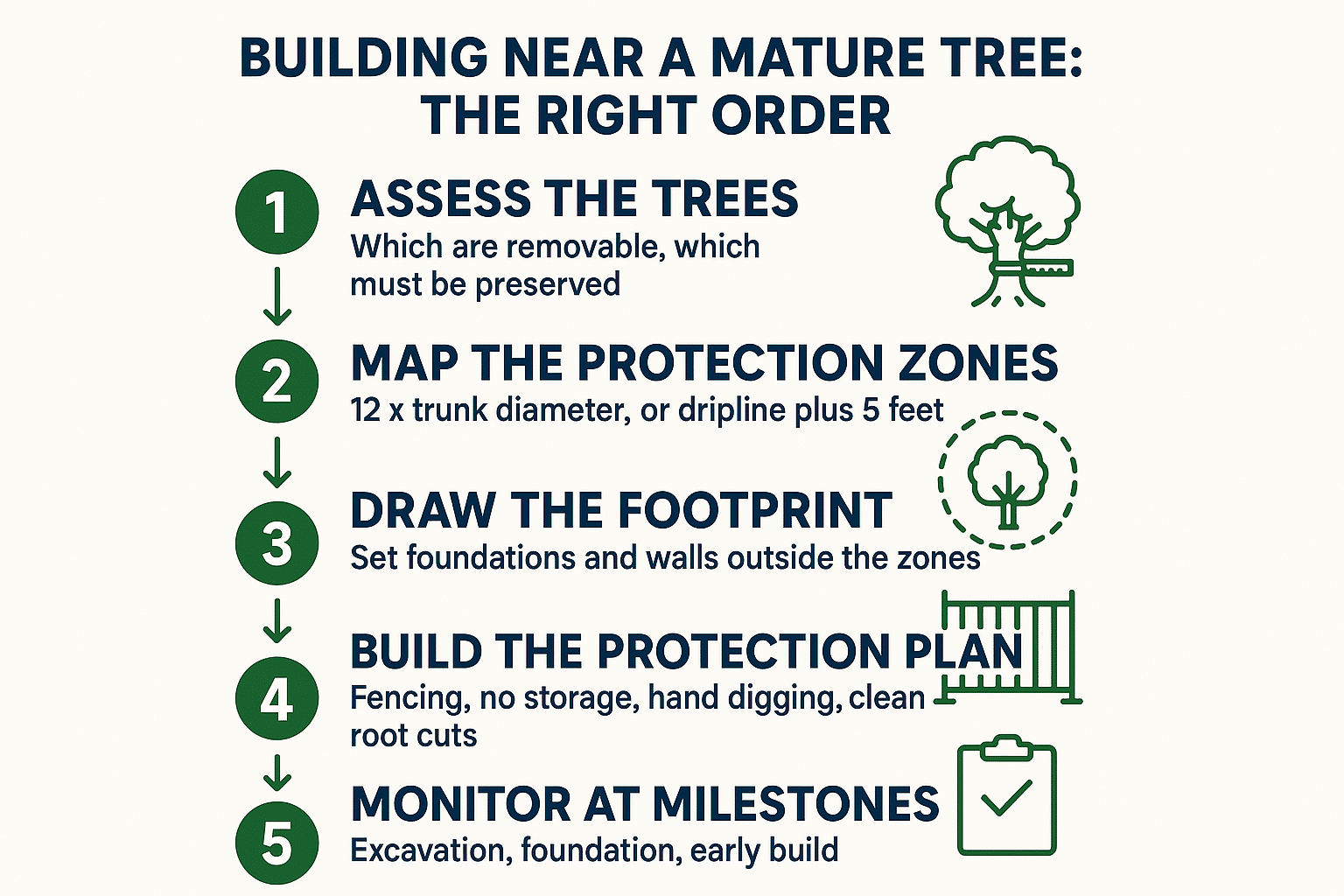
- 12 times the trunk diameter, measured at 4.5 feet above the ground (that measurement is called DBH).
- The dripline plus about five feet, meaning the outer edge of the canopy, then a buffer.
Run both and you usually get a workable range. Take a valley oak at 36 inches DBH, roughly 60 feet tall and 50 feet wide. Twelve times DBH puts the zone at about 36 feet from the trunk. Dripline plus five puts it near 30 feet.
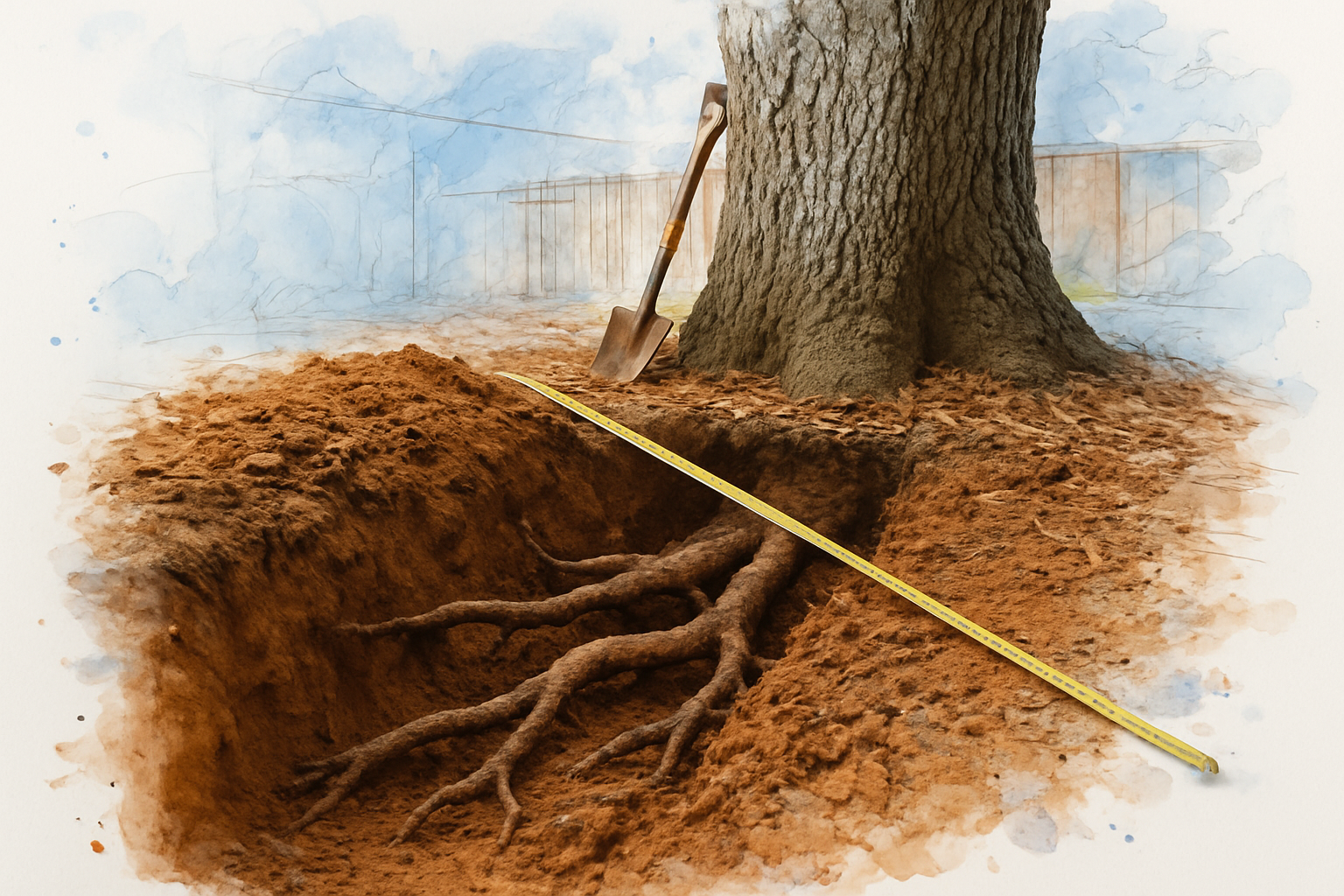
So call it 30 to 36 feet of ground that should stay undisturbed. Now picture a retaining wall drawn 18 feet from that same trunk. That wall sits well inside the zone, which means the excavation cuts structural roots.
Structural roots are not the fine feeder roots that pull in water. They are the anchoring system that holds a 60-foot tree upright in a February windstorm when the soil is saturated. Cut a meaningful share of them on one side and you have changed the tree’s stability, even if the canopy looks fine the following spring.
The Tree Usually Does Not Die During Construction
This is the part homeowners never see coming, and it is the reason I push so hard on planning.
Construction damage rarely kills a tree while the project is active. The tree looks the same the day the final inspection clears. Then the thinning canopy and branch dieback show up two to five years later, long after the contractor is gone, and nobody connects the two events.
Three things cause most of it:
- Roots severed on one side by trenching or excavation, which starves and destabilizes the tree unevenly.
- Soil compaction from trucks, equipment, and material stockpiles parked over the root zone.
- Grade changes that bury the root flare under new fill, cutting off oxygen at the base of the trunk.
Silicon Valley clay makes all three worse. Our soil compacts hard and drains slowly, so a single season of truck traffic across a root zone can do damage that no amount of watering fixes afterward.
Oaks are the least forgiving. Coast live oaks and valley oaks resent root disturbance, and then they get hit a second time when fresh landscaping around the finished ADU brings summer irrigation into a root zone that evolved to stay dry from June through October. If you have oaks in the plan, how oaks are handled in Cupertino and Almaden is worth reading before you plant anything under them.
The Order of Operations That Saves Trees
Here is the sequence I recommend to homeowners planning an ADU, an addition, or a rebuild on a lot with mature trees.
Where Roots Actually Get Cut on a South Bay Lot
These are the spots where roots get severed without anyone writing it down. None of them are on the demolition plan, and all of them happen inside the protection zone on a typical lot.
| Work item | What usually happens to roots | Lower-impact approach |
|---|---|---|
| Utility and sewer trenching | A trencher tears a continuous line of roots at full depth | Route around the zone, or bore under it |
| Irrigation line installation | Shallow trenches slice the feeder root mat | Hand dig or air excavate inside the zone |
| Driveway and patio subgrade | Soil is stripped and compacted well below the surface | Build up rather than cut down, use permeable sections |
| Pad grading and fill | Root flare gets buried under new soil | Keep original grade at the flare, retain the change farther out |
| Equipment access and staging | Repeated traffic compacts clay across the root zone | Fence the zone, designate a single access route |
What the Cities Around Here Ask For, and When
The permitting side is where most homeowners first hear the phrase tree protection zone, usually from a plan checker rather than from their own team.
A Cupertino homeowner reached out to us after the city attached an arborist comment to their ADU submittal, and the project could not move until documentation was in hand. A Saratoga homeowner had already met with the city arborist and learned that monitoring for a protected tree could be organized around construction milestones rather than a fixed inspection calendar. In that case the checkpoints were excavation, foundation, and the early build stages.
San Jose’s rules sit in Municipal Code 13.32, the Tree Removal Controls Ordinance, and heritage trees require consulting the City Arborist before any pruning or removal. The Planning Division’s own overview of the tree removal controls ordinance is a useful read before you assume a tree is yours to work on.
A tree protection plan typically spells out:
- Protective fencing installed at the zone line before any equipment arrives
- No material storage, parking, or concrete washout inside the fenced area
- Hand digging or air excavation where work must happen near roots
- Clean root pruning with proper tools instead of torn roots from a trencher
- Site visits at agreed milestones, with written observations for the file
On cost, I will not quote a number, because the honest answer is that it depends. What moves it is scope, how many trees are involved, and how many site visits the city expects. Ask any arborist for the billing structure up front, per visit versus per report versus hourly, so there are no surprises mid-project. Our own breakdown of when a visit is free and when it comes with a fee explains that distinction in more detail.
When the Trunk Straddles a Property Line
There is an ownership wrinkle that changes who gets a say. When a trunk sits across a property line, the tree is jointly owned by the adjoining owners.
That matters when a project next door proposes work inside the shared tree’s root zone. Neighbors can and do commission an independent assessment, or a peer review of the applicant’s arborist report, before a hearing.
The focus of that review is narrow and procedural: did the report actually evaluate root impact against the plan as currently drawn, and did it address long-term stability after that root loss? A written, on-site assessment carries weight in a public record in a way that a phone opinion never will.
None of this needs to be adversarial. Most of the time, a clear protection zone drawn early prevents the disagreement from happening at all. If you are working through who has standing on a shared or street-adjacent tree, this breakdown of tree ownership is a good starting point.
Frequently Asked Questions About Tree Protection Zones and ADU Projects
Can I build inside the tree protection zone at all?
Sometimes, with the right methods and city approval. Hand digging, air excavation, pier foundations that span between roots, and permeable surfaces built up rather than cut down can all reduce impact. What you cannot do is run a trencher through it and hope for the best.
When should I get an arborist involved in an ADU project?
Before the footprint is finalized. Assessment before action is not a slogan here, it is the difference between designing around a constraint and paying for a redesign. Once plans are stamped and the city attaches an arborist comment, your options narrow fast.
My tree survived construction two years ago and now the top is thinning. Is that related?
It very well could be. Delayed decline two to five years out is the normal pattern after root loss, compaction, or a buried root flare. A diagnostic visit can look at the root collar, the soil, and the canopy together to see whether the timing lines up with the work that was done.
Does an ADU or lot split change the tree rules on my property?
It changes what triggers review. A new footprint, new utility routes, and new grading all create impacts that did not exist before, and protected or ordinance-size trees get looked at closely during plan check. Lot splits in particular can put trees right on a new property line.
What does a project arborist actually do during construction?
Sets the fence line, specifies how digging near roots is handled, makes clean cuts where roots must be removed, and shows up at the milestones the city asks for. The written observations from those visits go into the project record.
Planning an ADU on a lot with trees you want to keep?
When a set of plans and a mature tree are competing for the same ground, it helps to have someone read both. Robert Apolinar is a Board-Certified Master Arborist, the highest ISA credential, and the company holds CSLB license #985639 with both tree service and landscaping classifications, along with BBB accreditation dating to 2013. Reports and preservation plans here come from an on-site evaluation rather than a desk review, and we work regularly inside the differing requirements of San Jose, Los Gatos, Saratoga, Campbell, and Cupertino. If you would like to talk it through, we can be reached at (408) 422-1313 or at sanjosetreemaintenance.com.
