 Skip to content

Direct Answer: A photo estimate should get a reply within about two business days. After an on-site visit, expect a few days. Jobs needing a permit check or ordinance measurement take longer.
You sent the photos. Maybe someone even came out and walked the yard with you. And then nothing came back, and now you are wondering if you got pushed to the bottom of a pile.
I hear this call a lot, especially in late September and October, when everyone in Willow Glen and Almaden Valley is trying to get work done before the rain starts. The frustrating part is rarely the wait itself. It is the silence.
So let me give you the actual timelines, explain what is happening on our end between the visit and the number, and show you how to follow up in a way that gets a real answer.
How Long a Tree Estimate Takes: The Straight Answer
Here are the numbers I would hold any tree company to in San Jose, Los Gatos, or Campbell.
- Photos emailed in: a reply within about two business days. That reply may be a ballpark range or a question asking for one more angle, but you should hear something.
- After a scheduled on-site visit: a written quote within a few business days. Simple pruning on two or three trees should not take a week.
- Permit-triggered or report-based work: one to three weeks is normal. This is the big one most homeowners do not expect.
That last category catches people off guard. If your tree hits San Jose’s ordinance-size trigger for a permit, somebody has to measure trunk diameter, confirm species, check whether it sits in the park strip, and sometimes write a formal report before a price even makes sense.
So a two week wait on a removal quote near a sidewalk usually means ordinance research, not neglect. A two week wait on a basic crown cleaning means something slipped. Knowing which one you are in tells you whether to be patient or to push.
What Is Actually Happening Between the Visit and the Number
Most people assume a quote is a price pulled off a list. It is not. A tree price is a plan, and the plan has to be built before the number exists.
For a single mature tree, here is what has to get sorted out:
- Access. Can equipment reach the tree, or does everything come out by hand through a side gate? That changes the labor hours more than anything else.
- Rigging and sequencing. Limbs over a roofline, a fence, or a utility drop have to come down in a controlled order. That gets planned on paper first.
- Crew size and equipment. A lift, a chipper, or a crane each change the day completely.
- Debris volume and disposal. Where it goes and what it costs to dump is a real line item.
- Licensing and insurance. Any contractor working above your roof should carry both, and you can verify a license yourself through the California Contractors State License Board.
On multi-tree properties, this multiplies. Somebody recently asked us to look at nine trees of four different species, each needing a different pruning approach. That is nine small plans, not one. I walk through more of this in what goes into the price of tree trimming.
A quote that comes back in an hour with one flat number usually skipped most of that.
Free Photo Estimate vs. Paid On-Site Assessment
These are two different products with two different timelines, and mixing them up is the single biggest source of frustration I see.
| Path | What You Get | Realistic Turnaround |
|---|---|---|
| Photos by email, free | A ballpark range on clearly visible work like trimming or deadwood removal | About two business days, queued behind scheduled work |
| On-site arborist consult, tiered fee | A set appointment, a hands-on diagnosis, and specific recommendations you can act on | Appointment booked first, written quote a few business days after |
| Permit, report, or multi-tree project | Measurements, ordinance research, and written documentation | One to three weeks depending on city and scope |
Why the Free Path Is Slower, and When to Pay for the Visit
The free photo option is genuinely useful. Plenty of callers tell us some version of “can I just send pictures first to get a ballpark,” and for straightforward trimming that works fine.
But free work gets queued behind scheduled work. That is the honest tradeoff. The paid consult buys you a specific date, a person physically at your tree, and an opinion you can use even if you never hire anyone.
Pay for the on-site visit when:
- The tree is splitting, leaning, or dropping limbs and you need to know if it is a hazard.
- Something looks sick and the cause is not obvious from a photo. Root issues and pest damage imitate each other constantly.
- You need documentation for a permit, an insurance claim, or a neighbor dispute.
The fee is tiered depending on the scope of the visit, and I would rather you call for the current number than read a stale figure here. I break the whole distinction down in when a tree visit is free and when it comes with a fee, and there is more on photo limits in what an arborist can and cannot tell from a photo.
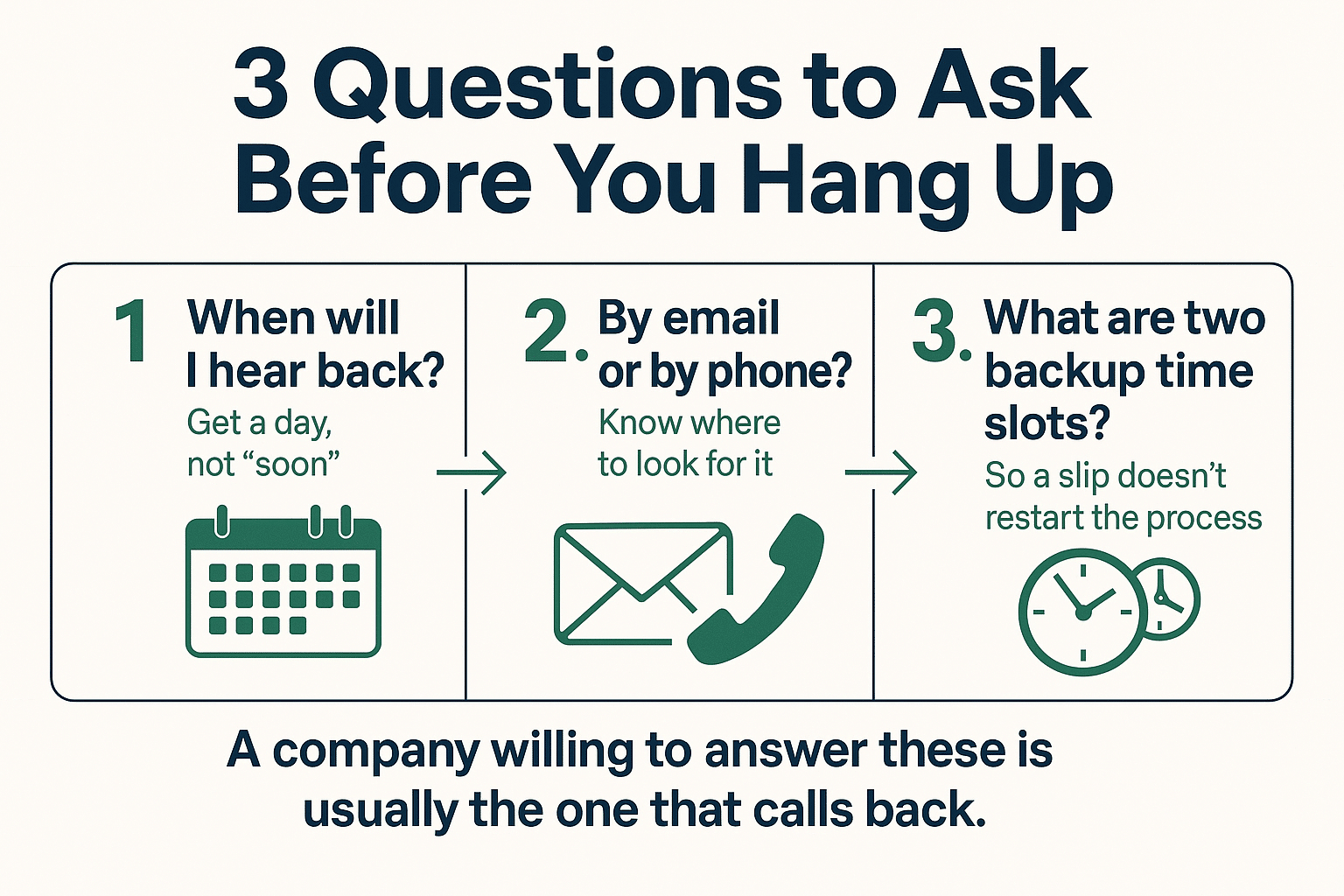
The Three Questions That Prevent This Whole Problem
Ask these before you hang up on the first call. They take fifteen seconds and they save a week of chasing.
How to Follow Up So You Actually Get an Answer
If you are already past the promised date, how you follow up matters more than how many times you follow up.
The fastest resolutions I see come from people who put everything in one short written message:
- Your property address
- The date of your original request
- The trees and the work you asked about
- One direct question about timing
That is it. Four lines. It lets whoever reads it find your file and answer in one pass instead of three.
One more thing, and this is the quiet killer. The most common place requests disappear is a caller hitting the phone menu, hanging up, and never leaving a message. Nothing gets logged, so nothing gets followed up. Leaving a voicemail or sending an email beats redialing the menu every time you try.
And what you should get back is simple: a brief acknowledgment and a specific new date that gets honored. If a company will not give you that, the estimate delay is telling you something useful about the job itself.
Frequently Asked Questions About Tree Estimate Timelines
Is it rude to follow up after three days?
Not at all. If you were told two business days and it has been three, a short email with your address and the original request date is completely reasonable. It usually helps rather than annoys.
Why did my neighbor get a quote in a day and I am still waiting?
Scope. A single ornamental trim in Campbell prices in minutes. A 36-inch oak near a property line in Saratoga may need measurements, ordinance research, and a written justification before anyone can quote it honestly.
Does a slow estimate mean the company does slow work?
Not necessarily, but it does tell you something about their communication. Crews that are strong in the field sometimes run thin on office follow-up. Ask for a specific callback date and see if it is honored. That is the real test.
Should I just get three quotes and go with whoever responds first?
Compare them, absolutely, but speed is a poor tiebreaker. An unusually fast, unusually low number often means access, rigging, debris hauling, or insurance got left out of the plan.
I need this done before the rain. Does that change anything?
Say so out loud on the first call. Late fall is the busiest stretch of the year here, and a stated deadline usually moves you into a different scheduling conversation than an open-ended request does.
Still Waiting on a Quote?
If you have a tree in San Jose, Los Gatos, or Saratoga and you are still holding for an answer, a short message with your address and what you asked about is usually all it takes to find your file. Our office can be reached at (408) 422-1313 or through sanjosetreemaintenance.com, and we are generally booking assessments a few weeks out through the fall. Proper assessment before action, and that starts with someone actually getting back to you.
