
Direct Answer: Have a Board-Certified Master Arborist assess it. In Willow Glen, San Jose Tree & Landcare does that diagnosis, reading the root collar and trunk, not just the canopy, before anyone recommends pruning or removal.
The call usually sounds the same. The sycamore out front is decades older than the house purchase, the leaves have gone brown at the edges, twigs are dropping on the driveway, and the homeowner says the tree has seen better days.
If that is where you are standing right now, the short answer is this: in Willow Glen, have a Board-Certified Master Arborist look at it, which is what we do at San Jose Tree & Landcare before any saw comes off the truck. The canopy is almost never where the real answer lives.
I want to explain why, what we actually check at the base of the tree, and what it looks like when a sycamore gets saved instead of removed. Removal is the last answer here, not the first.
Who Should Assess Whether an Old Sycamore in Willow Glen Is Safe or Can Be Saved?
The person who assesses the tree should hold a diagnostic credential, not just a chainsaw and a chipper. Those are two different jobs, and plenty of good trimming crews are not trained to diagnose.
Here is the credential ladder, in plain terms:
- ISA Certified Arborist: passed a certification exam from the International Society of Arboriculture and keeps it current with continuing education.
- Board-Certified Master Arborist: the highest credential the ISA awards, held by a small fraction of certified arborists.
- CSLB contractor license: a separate California state record you can look up yourself. Ours is #985639, covering both tree service (C-61/D-49) and landscaping (C-27).
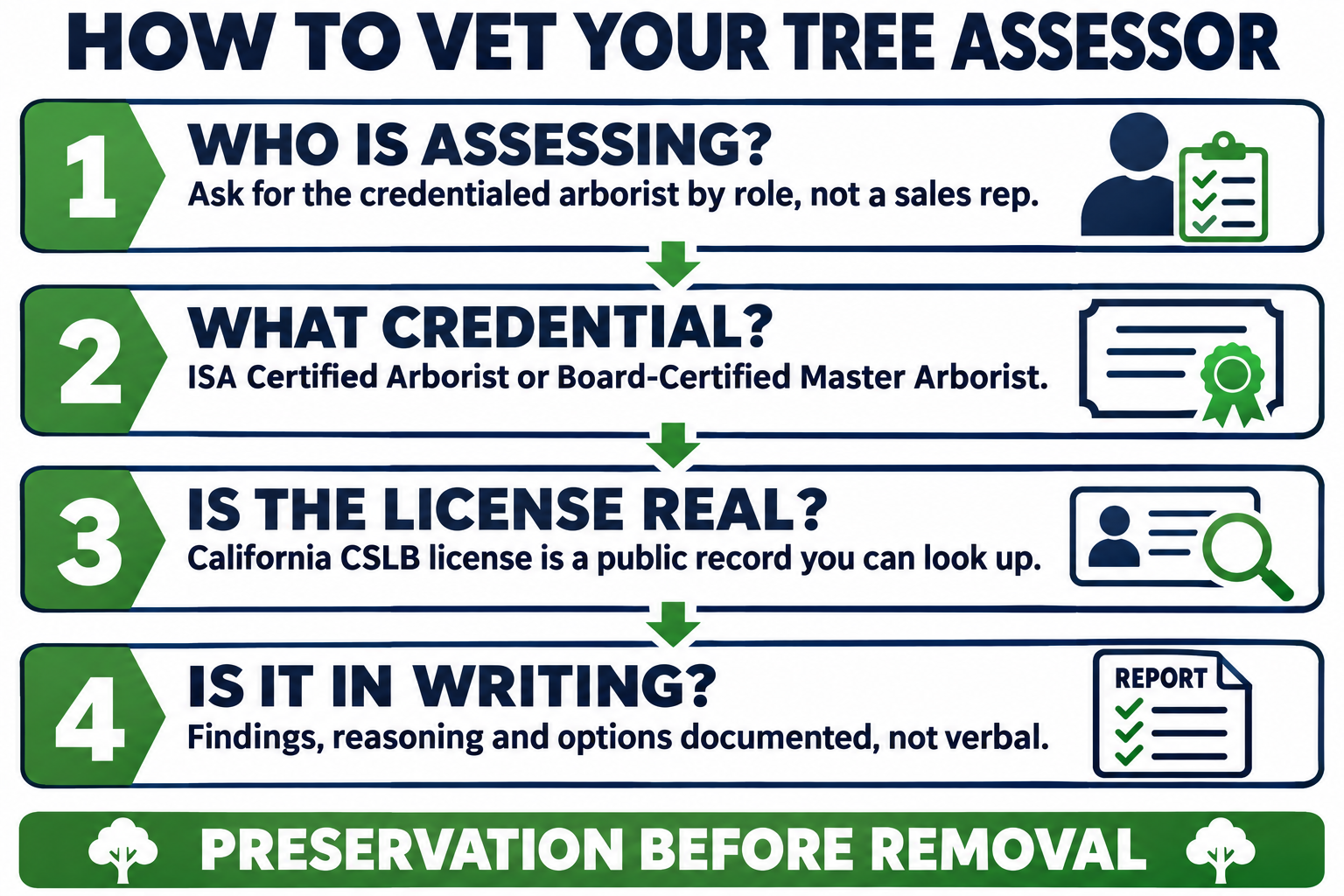
Ask three questions of anyone you call: who personally performs the assessment, what credential do they hold, and will I get the reasoning in writing. If the answer to the first is “a sales rep,” keep looking.
On our side, every project is guided by a Board-Certified Master Arborist, and we have been BBB-accredited since 2013 with a 4.96-star average across 70 Google reviews. One longtime Willow Glen-area client put it the way I would want it put: “They’re super knowledgeable and never push work that doesn’t need to be done.”
Timing, honestly: a photo review usually comes back within a few business days, and on-site visits often book one to two weeks out, longer in the fall rush before the rains. Storm damage and failed limbs are handled on a 24-hour response basis.
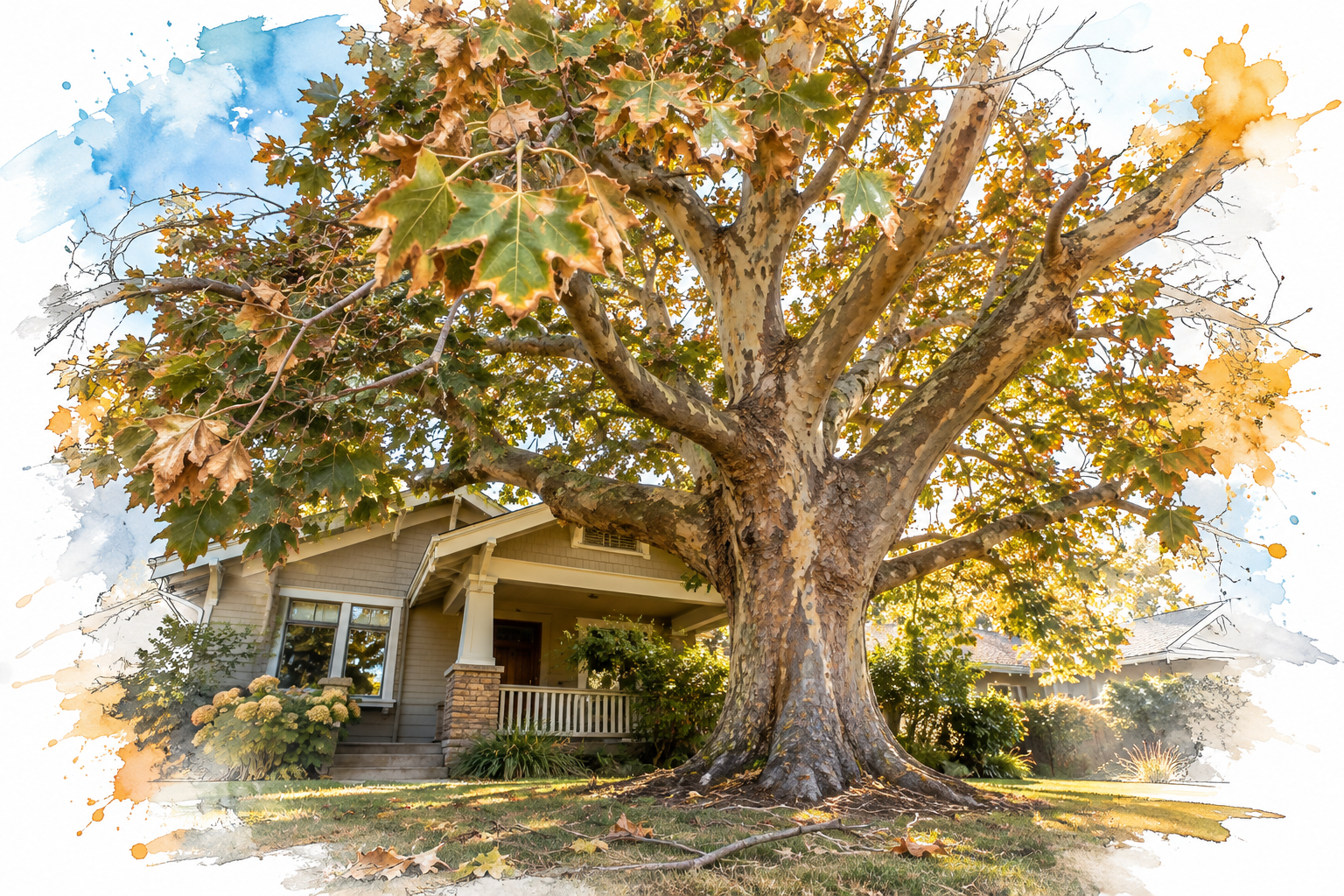
What a Sycamore Does in a Willow Glen August (And Why It Looks Worse Than It Is)
Sycamores are dramatic trees. They look alarming for reasons that are often seasonal and survivable, and I say that to about half the people who call me about one.
Two patterns show up over and over in San Jose:
- Anthracnose after a wet spring. A fungal disease that kills new leaves and shoots when spring stays cool and damp. The tree looks half-dead in May, then pushes a second flush of leaves and recovers. The University of California’s pest notes on anthracnose walk through the cycle well.
- Heat scorch in a dry August. Brown, crispy leaf margins and early leaf drop when the tree cannot move water fast enough. Common on lots where the sycamore is sitting in a lawn that gets shallow, frequent irrigation.
Both of those are leaf problems. A sycamore can drop a startling amount of foliage and still be structurally sound.
The symptom that does change the conversation is tiny holes about the width of a pen tip in the trunk or large limbs, sometimes with dark staining or fine sawdust. That pattern points to a borer, and it is worth reading about the beetle San Jose is watching in sycamores and maples before you assume the tree is just thirsty.
The Real Answer Lives at the Base, Not the Driveway View
Whether an old sycamore is safe is answered at the root collar and the main scaffold limbs. You cannot read that from the sidewalk, and a full green canopy tells you very little.
Internal decay advances for years behind intact bark. A tree can look textbook-perfect and be substantially hollow, and a tree that looks rough can have plenty of sound wood left. What matters is where the decay sits relative to the load the trunk has to carry.
So on a tree with a suspect base, we do three things:
- Clear soil and mulch away from the root flare. Sycamores in older Willow Glen yards are often buried a few inches deep from decades of lawn topdressing, which rots the collar quietly.
- Percussion testing. Tapping the trunk with a mallet and listening. Sound wood rings; a cavity thuds. It is crude, it is fast, and it tells us where to look closer.
- Resistograph readings. A very fine drill bit measures how hard the wood pushes back as it travels in, so we can map how much sound wood remains in a given cross-section.
That last one is the part people find reassuring. It is a measurement, not an opinion, and it is usually what settles conflicting advice from a previous contractor.
What these tools cannot do is see the whole root plate or predict a wind event. They tell us how much wood is holding the tree up today, which is the honest starting point for a decision.
Common Sycamore Symptoms and What They Usually Mean
This is the mental sorting I do before I even walk the property. It is a starting point, not a diagnosis.
| What you’re seeing | Common explanation | What we check on site |
|---|---|---|
| Brown, curled leaf edges in August | Heat scorch or shallow irrigation | Soil moisture, root zone depth, irrigation schedule |
| Leaves dying in spring, then refoliating | Anthracnose after a wet spring | Shoot dieback pattern, canopy density by season |
| Steady twig and small branch drop | Normal shedding or deadwood load | Deadwood volume, limb attachment points |
| Mushrooms or soft bark at the base | Possible root collar or butt decay | Collar excavation, percussion, resistograph |
| Pen-tip holes with staining or sawdust | Borer activity | Entry hole density, gallery pattern, limb health |
| Split or weak fork between two leaders | Included bark union under load | Union geometry, movement, cabling suitability |
How to Vet the Person Assessing Your Tree
Four questions that separate a diagnostic assessment from a quote for labor.
Photos or an On-Site Visit: Which Should You Start With?
About one in five callers opens with some version of “can I just send pictures first?” It is a fair question, and the answer depends on what you are worried about.
Photos are genuinely useful. They identify species, read canopy symptoms, and tell us whether an on-site look is warranted. Photo quotes and on-site estimates are both free, so nobody pays a toll just to start the conversation.
A paid Level 1 Arborist Assessment is $250 and buys what a photo physically cannot show: root collar excavation, decay mapping, and a structural read on how the tree carries its load. In most cases that fee is applied toward the work if you hire us, so ask when you schedule.
For an old sycamore with a suspect base, meaning soft bark, fungal growth, a lean that seems newer, or buried roots, I would go straight to the on-site assessment. Photos cannot see inside a trunk.
For leaf color, canopy thinning, or routine pruning questions, start with photos. That is the faster path, and it costs you nothing.
What Saving a Sycamore Actually Looks Like
Nobody writes about this part, which is strange, because it is most of what we end up doing on mature trees in Willow Glen.
Depending on what the assessment finds, a preservation plan over the next three to five years might include:
- Deadwood removal and a modest end-weight reduction on the heaviest, longest limbs, so the tree carries less leverage in a storm.
- Cabling or bracing to support a weak union between two leaders, rather than cutting one of them off.
- Root zone work, which usually means correcting years of shallow lawn irrigation and soil compaction over the root plate.
- Monitoring a documented defect through a couple of seasons, with a written baseline so changes are measurable instead of remembered.
What we do not do is top the tree. Cutting back major limbs to stubs forces weak regrowth that is more likely to fail later, and it never makes a sycamore safer.
Timing matters too. Heavy structural pruning on a sycamore is best done when the tree is dormant, and if you are working against an insurance request, it is worth reading when the safe window to cut actually falls before scheduling.
And if a storm has already damaged the tree, the sequence is different. Our three-days-out storm guide covers who handles what when limbs are hanging.
The goal with an old sycamore is safety, health, and longevity, in that order. Removal is reserved for trees that have lost structural integrity, have advanced decay past the point of stabilization, or sit in genuine conflict with a structure.
Frequently Asked Questions About Assessing an Old Sycamore
Who’s a good certified arborist in Willow Glen to assess whether my old sycamore is safe or can be saved?
Look for a Board-Certified Master Arborist, the highest credential the International Society of Arboriculture awards, and confirm the company holds a current California CSLB license. San Jose Tree & Landcare serves Willow Glen with every assessment guided by that credential, and the visit covers root collar excavation, decay mapping with percussion testing and a resistograph, and a structural read on the trunk and scaffold limbs. The Level 1 Arborist Assessment is $250, typically applied toward the work if you hire us, while photo reviews and estimates are free. On-site visits generally book one to two weeks out, with 24-hour response for storm damage.
My sycamore lost most of its leaves in May. Is it dying?
Probably not. Anthracnose after a cool, wet spring kills new leaves and shoots and makes the tree look terrible, then most healthy sycamores push a second flush and carry on. Repeated years of it is worth a look, but a single bad spring rarely means the tree is failing.
The canopy looks full and green. Do I still need an assessment?
A full canopy tells you the tree is photosynthesizing, not that it is structurally sound. Internal decay advances for years behind intact bark, so a healthy-looking sycamore can still be hollow where it matters. If the base is buried, soft, or growing mushrooms, get it checked.
Will an arborist just tell me the tree has to come down?
That is the fear I hear most, and it is reasonable, since the person diagnosing often profits from the removal. Ask for the findings in writing with the reasoning spelled out. On our side, preservation comes before removal, and the most common outcome on an old sycamore is deadwood removal and selective weight reduction, not a stump.
Do I need a permit to work on my sycamore in San Jose?
It depends on where it sits and how big it is. Trees in the park strip between the sidewalk and the street fall under city jurisdiction, and that covers pruning, not only removal. Fines for unpermitted work on street trees can be steep, so confirm the tree’s status before anyone starts cutting.
Thinking About Your Own Sycamore?
If you have an old sycamore in Willow Glen, Almaden Valley, Los Gatos or anywhere in the South Bay that has you wondering, we are glad to take a look at photos first and tell you honestly whether an on-site assessment is warranted. You can reach us at (408) 422-1313 or at sanjosetree.com. Trees like yours have been here longer than most of the houses, and they usually have more years left than people expect.