 Skip to content

Direct Answer: An El Niño advisory means saturated soil and storm wind can expose existing tree defects. The smart move is a pre-storm arborist inspection in summer or early fall — before scheduling gets tight and emergency rates kick in.
Most San Jose homeowners don’t think about their trees until a branch is down or a trunk is leaning toward the roof. But in a year when NOAA has issued an El Niño Advisory with a 96% probability it persists through winter — and a 63% chance of a very strong event from November through January — waiting for something to go wrong is the expensive way to handle it.
That doesn’t mean a flood is guaranteed. The precipitation signal for Northern California in an El Niño year is actually weak. What it does mean is that the conditions that lead to tree failures — saturated soil, wind loading, existing structural defects — are worth taking seriously before the first storm rolls through.
This article walks through exactly how El Niño weather patterns change the risks your trees face, what an arborist looks at in a pre-storm inspection, and why late summer through early fall is the window that matters most.
Why El Niño Weather Is a Tree Problem, Not Just a Rain Problem
When people hear El Niño, they think wet winters. That’s part of it — but for trees, the real danger is a chain reaction that starts underground.
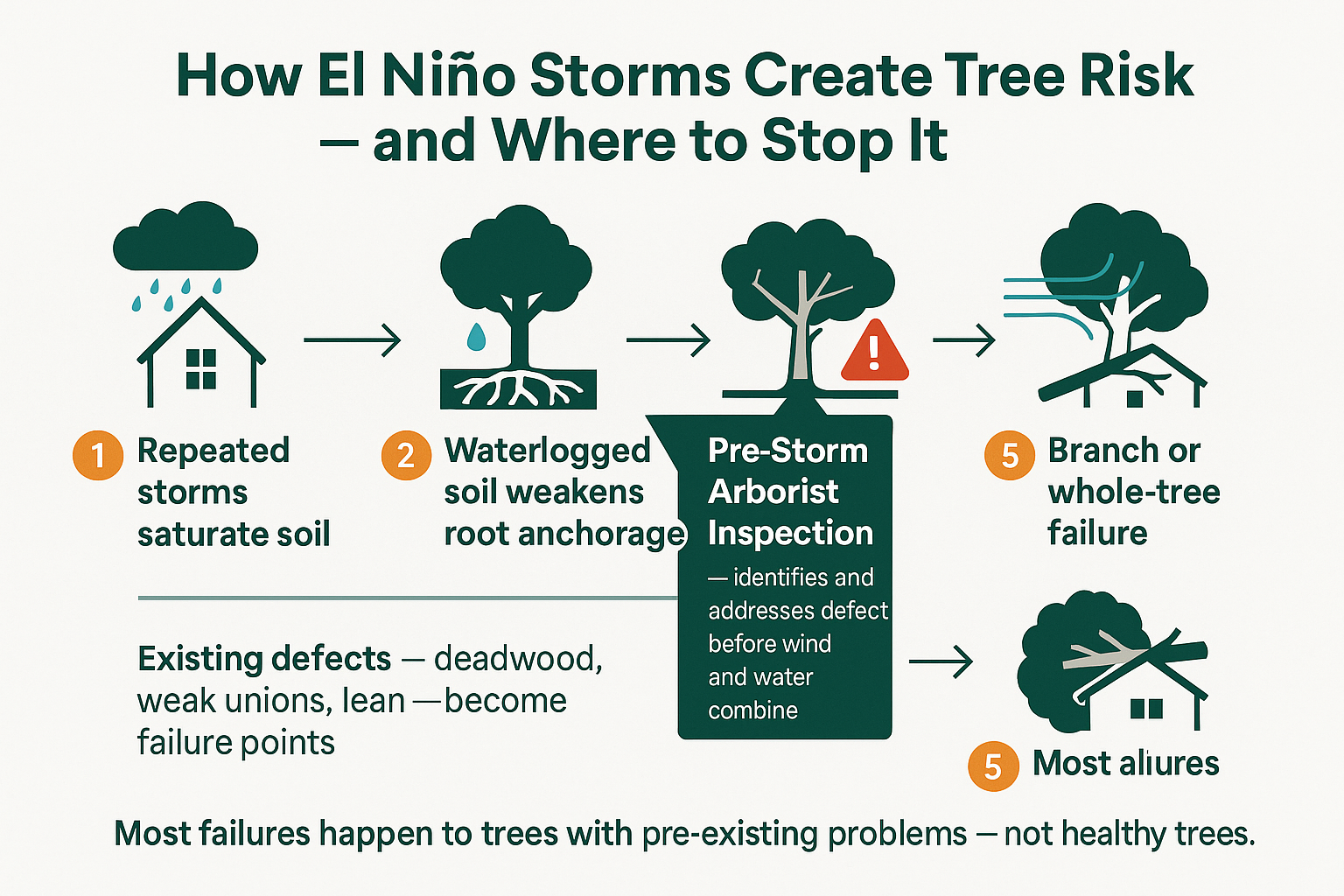
Repeated storms saturate the soil. Saturated soil loses its grip on root systems. A tree that looked perfectly stable in August can become a genuine structural risk by February — not because anything changed visibly above ground, but because the soil holding it in place got waterlogged for weeks at a time.
Wind makes this worse. El Niño winters in the South Bay tend to bring atmospheric river events — the kind of multi-day rain sequences that drench the Santa Cruz Mountains and funnel strong winds through neighborhoods in Willow Glen, Almaden Valley, and the Los Gatos foothills. Wind acting on a healthy tree with good root anchorage is rarely the problem. Wind acting on a tree that already has a weak union, a hidden decay pocket, or roots compromised by years of drought stress — that’s when branches come down on roofs and driveways.
Silicon Valley’s mature neighborhoods carry a lot of that hidden risk. Many of the large camphor, eucalyptus, and coast live oak trees in established yards spent the last several dry summers under significant stress. Drought-stressed trees don’t recover their structural integrity the moment the rain returns — in fact, sudden soil saturation after a dry period can make root anchorage worse in the short term, not better.
The good news is that most of these risks are visible to a trained eye before they become emergencies. That’s the whole point of getting a professional tree assessment before storm season.
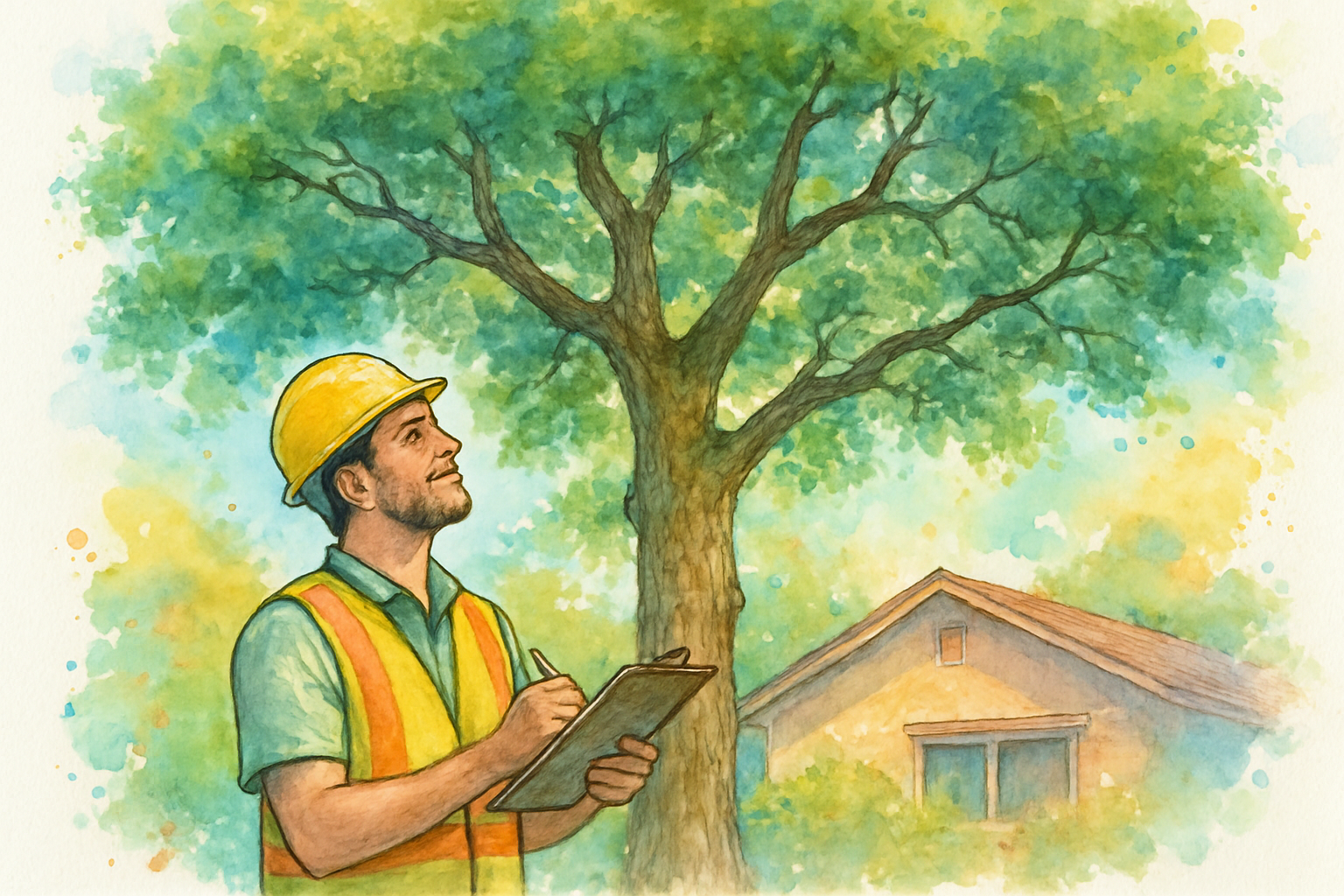
What an Arborist Actually Documents in a Pre-Storm Inspection
A pre-storm inspection isn’t a quick walk around the yard. Done properly, it follows a specific priority order — starting with the trees most likely to cause property damage or injury if they fail.
Priority targets are trees positioned over:
– Roofs, gutters, and attic vents
– Driveways and parked vehicles
– Play structures, patios, and outdoor living areas
– Utility lines and fences bordering neighbors
Once the high-consequence trees are identified, the arborist works through a checklist of defects that increase storm risk:
- Deadwood — branches that died back over the summer but are still attached. These are the most common cause of storm breakage.
- Weak branch unions — included bark or co-dominant stems that can split under load. Often invisible to a homeowner but clear to a trained arborist.
- Lean changes — a tree that has shifted its lean since the last inspection may indicate root movement or soil instability.
- Crown density — a dense, unpruned canopy acts like a sail in high wind. Thinning reduces wind resistance significantly.
- Root zone conditions — signs of root damage, soil compaction, or previous excavation near the base.
One thing homeowners frequently tell us: they had no idea how much a professional eye picks up that they’d walked past for years. As one customer in Almaden put it after Robert walked her property, she’d expected a short visit and a list of removal recommendations — and was relieved to learn that most of her trees just needed monitoring or targeted pruning, not removal.
That matches what we see across most assessments. The outcome of a good inspection is a prioritized plan, not a bill of work. Understanding when a tree problem requires an arborist rather than just a trimmer is the first step in getting that kind of honest answer.
The El Niño Tree Risk Chain: How Storms Turn Hidden Defects Into Real Damage
This shows the step-by-step progression from El Niño weather conditions to tree failure — and where in that chain a pre-storm inspection breaks the cycle.
Why Timing Matters More Than Most Homeowners Realize
There’s a narrow window for getting proactive tree work done before winter conditions set in — and it’s earlier than most people assume.
Summer through early fall is the right time to schedule inspections, pruning, cabling and bracing, or permitted removals. Here’s why that window matters:
- Structural pruning takes time to heal before the stress of a wet winter. Work done in September or October gives the tree a better recovery window than work done in November.
- Permitted removals — required for any protected tree in San Jose and many surrounding cities — involve a City review process that can take weeks. Starting the permit process in August is very different from starting it after the first storm.
- Scheduling availability tightens significantly as fall progresses. Crews that are easy to book in August are often weeks out by late October.
- Emergency work costs more. A proactive pruning job and an emergency call after a branch comes down on a fence are not the same price — not even close. Several customers who called us after winter storms in prior years mentioned they wished they’d scheduled the inspection the summer before.
For homeowners in fire-adjacent communities like Saratoga and the Los Gatos foothills, the timing equation has an additional dimension: summer and early fall is also when defensible space work needs to happen. Addressing tree structure before fire season ends and storm season begins means fewer trips, less disruption, and one clear plan rather than two reactive ones.
For a fuller look at what homeowners can do before conditions shift, this pre-El Niño preparation guide is a good companion read.
Pre-Storm Tree Work: Timing and What Drives It
This table summarizes the main types of pre-storm tree work, the best window to schedule each, and the key factor that makes timing matter.
| Type of Work | Best Window | Why Timing Matters |
|---|---|---|
| Arborist inspection | July – October | Leaves room to act on findings before winter access gets harder |
| Structural pruning / thinning | August – October | Allows healing time before wet season; avoids scheduling crunch |
| Cabling and bracing | Summer – early fall | Best installed before soil saturation changes tree movement |
| Permitted tree removal | As early as possible | City permit review in San Jose can take several weeks |
| Deadwood removal | Anytime — but before first storm | Dry summer conditions mean deadwood is fully formed and identifiable |
| Emergency storm response | After an event | Reactive, higher cost — what you’re trying to avoid with the above |
Most Trees Just Need a Plan — Not a Removal List
One of the most consistent themes in what San Jose homeowners tell us before an assessment: they’re bracing for bad news. They’ve heard stories about contractors who show up and recommend taking everything down. That fear is understandable — and it’s also why what happens in a real assessment often surprises people.
The vast majority of trees we inspect don’t need removal. They need targeted work — a deadwood clearance, a thinning to reduce wind resistance, a support cable for a heavy co-dominant stem, or simply a documented baseline so the arborist knows what to watch for next season.
Removal is the right call when a tree poses a genuine, unmitigatable risk to people or structures. But it should always follow honest assessment — not precede it. As one long-time customer in Willow Glen put it in her review: Robert “never pushes work that doesn’t need to be done.”
That philosophy is especially important in the context of El Niño planning. The goal isn’t to clear your yard. The goal is to understand exactly which trees carry real risk, address those specifically, and leave everything else alone. A good assessment gives you that clarity — a prioritized list of what needs attention now, what to watch over the next six months, and what is genuinely fine.
If you want to understand more about what that assessment actually covers in practice, this detailed breakdown of what a certified arborist does is worth reading before you schedule anything.
Frequently Asked Questions About El Niño Tree Care Planning
Does El Niño definitely mean a wet winter in San Jose?
Not necessarily. NOAA’s June 2026 advisory puts the odds of El Niño persisting through winter at 96%, with a 63% chance of a very strong event from November through January. But Northern California’s precipitation signal in El Niño years is actually weak compared to Southern California — we can see wet winters, dry ones, or something in between. The value of the advisory isn’t as a rain guarantee. It’s as a reminder that the conditions that lead to tree failures — saturated soil, wind loading, existing defects — are worth addressing before the season starts, not after.
Which trees should I be most concerned about heading into a wet winter?
Start with any large tree positioned over your roof, driveway, or a play area. After that, look for visible deadwood, any tree that seems to have shifted its lean, and large-diameter trees that haven’t been inspected in several years. Trees that spent the last few dry summers under drought stress are also worth a closer look — they may have developed internal decay or root damage that isn’t obvious from the street.
Is it too late to do something if I wait until November?
It depends on what the tree needs. A deadwood removal can happen any time before a storm. But if a tree needs permitted removal, structural pruning, or cabling work, late fall creates real scheduling and access problems — and the City of San Jose permit process alone can take several weeks. Summer through early October is the window where you still have room to act on what an inspection finds.
Will the arborist just recommend removing my trees?
In our experience, that concern comes up constantly before an assessment — and it almost never matches the outcome. Most trees we evaluate need targeted work, not removal. Removal is the right answer when a tree poses a genuine, documented risk that can’t be addressed another way. An honest arborist tells you which category your trees fall into. The goal is safety, health, and longevity — not the biggest possible job.
How much does a pre-storm tree inspection cost in San Jose?
Inspection costs vary depending on the number of trees, the property size, and what level of documentation you need. A basic site assessment is different from a formal written risk assessment report, which carries its own fee. For exact pricing on your specific situation, it’s best to contact San Jose Tree Service & Landscaping directly — the scope of the visit drives the cost more than any single benchmark number.
What happens after the inspection — do I have to act on everything right away?
No. The outcome of a good assessment is a prioritized plan, not a pressure list. Some findings are urgent — a large dead limb over a roof needs to come down before the first storm. Others are watch items that can be addressed in the next pruning cycle. Robert walks through each finding and explains what needs action now, what can wait, and what just needs monitoring. You decide what to move on and when.
Ready to Know Where Your Trees Actually Stand?
Robert Apolinar is a third-generation Board-Certified Master Arborist who leads every assessment personally — not a crew foreman, not a salesperson. San Jose Tree Service & Landscaping has been BBB-accredited since 2013 and holds active CSLB licenses in both tree service and landscaping, which means one visit, one expert, and one honest plan for your property. If you have mature trees in San Jose, Willow Glen, Almaden Valley, Los Gatos, or the surrounding South Bay communities and want to understand your risk picture before winter, reach out at (408) 422-1313 or visit sanjosetreemaintenance.com to request an assessment.
