 Skip to content

Direct Answer: A single broken sprinkler or irrigation leak can waste more than 9,300 gallons of water per year — most of it invisible, happening in the middle of the night while you sleep.
Most homeowners in San Jose don’t find out they have a broken sprinkler until the water bill arrives. By then, the damage is already done — to the bill, to the soil, and sometimes to the trees growing right next to those irrigation zones.
Research on residential irrigation systems puts the number at more than 9,300 gallons per year lost from a single broken head or leaking valve. In a region where Santa Clara Valley Water tracks household usage closely and where drought restrictions can return without much warning, that’s not a small thing.
This article breaks down where that water actually goes, how to figure out whether you have a simple repair or a bigger problem, and why irrigation changes can affect your mature trees in ways that a sprinkler-only company is unlikely to flag.
Where 9,300 Gallons Actually Goes
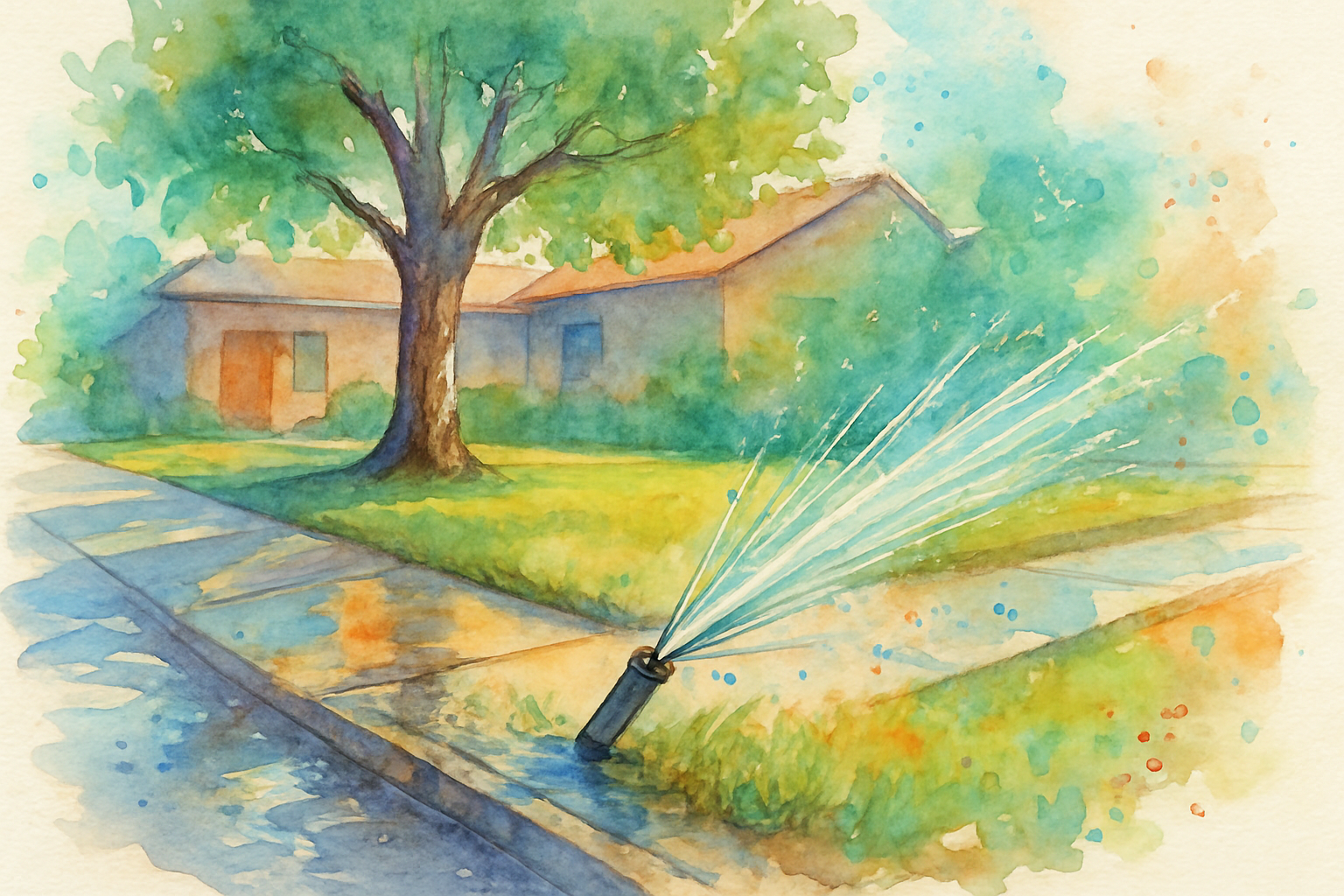
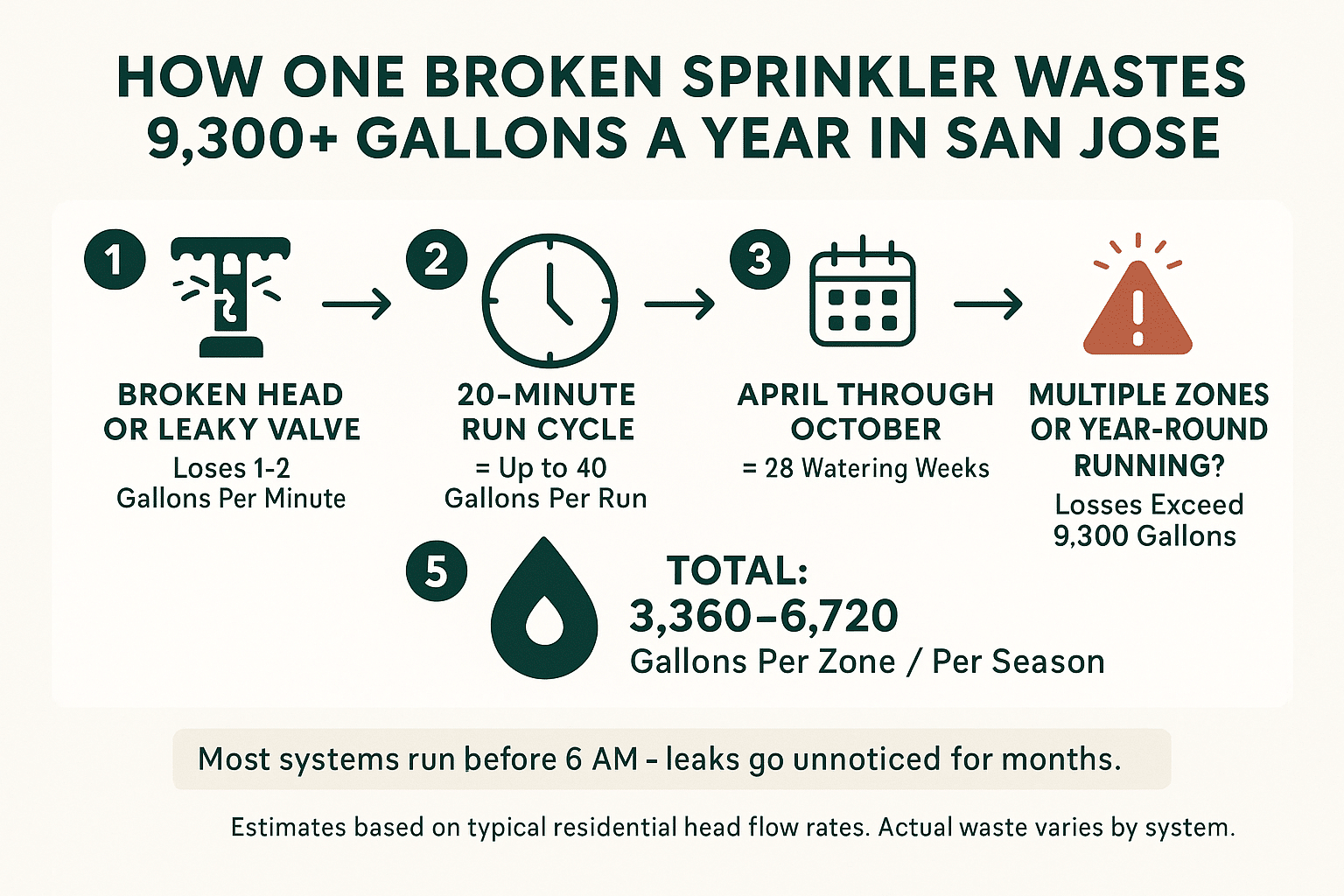
That number sounds large, but the math is straightforward. A single broken pop-up head spraying sideways instead of rotating can lose 1–2 gallons per minute during a run cycle. If the system runs for 20 minutes, three days a week, across a full irrigation season — roughly April through October in San Jose — you’re looking at several thousand gallons before anyone notices.
The problem is how invisible it tends to be. Most irrigation systems run early in the morning, before anyone is outside. A head that’s slightly cracked, a valve that doesn’t fully close, or a lateral line with a slow weep — none of these announce themselves loudly.
What homeowners usually see instead are the downstream clues:
- Soggy soil in one zone that never fully dries out
- Dry patches in another zone where pressure loss has cut coverage
- A water bill that jumped between billing cycles with no clear explanation
- Fungal growth or moss near the base of a sprinkler head
- One section of lawn that looks greener — or deader — than the rest
By the time one of these signals shows up, the system has usually been losing water for weeks or months. And if a mature oak, redwood, or fruit tree sits nearby, the soil saturation may already be affecting its root zone in ways that aren’t obvious above ground.
A Simple Triage Framework Before You Call Anyone
Not every sprinkler problem requires a full system redesign. And not every problem is as simple as swapping a head. Before calling a landscaping company, it helps to know roughly what category you’re dealing with — because the cost and complexity vary a lot.
Category 1: Simple head or valve repair
This is the most common scenario. A pop-up head gets clipped by a mower, a seal wears out, or a rotor stops spinning. If you can identify the specific head or zone causing the problem, a repair is usually quick. Most of these fixes can run anywhere from a modest flat-rate visit to a few hundred dollars depending on the number of heads and access, though exact costs depend on your specific system — it’s always worth getting an assessment before assuming.
Category 2: Controller reprogramming
This one surprises a lot of homeowners. Many people program their irrigation controllers in peak summer — usually June or July — and never touch them again. But San Jose’s dry summers give way to cooler, wetter falls, and a system still running a full summer schedule in October or November is watering ground that doesn’t need it. Your irrigation system is running — but is it actually working? covers this gap in more detail. A simple schedule adjustment in September or October alone can save thousands of gallons and meaningfully reduce your annual water use.
Category 3: System redesign
If your home was built in the 1980s or 1990s — common in Willow Glen, Cambrian, and parts of Almaden Valley — the original irrigation system was almost certainly designed for a turf-heavy landscape. If you’ve since converted to drought-tolerant plants, installed native groundcovers, or removed a lawn entirely, your old system is probably watering the wrong zones at the wrong rates. This is when a redesign makes sense, not just a repair.
Knowing which category fits your situation before you schedule a visit saves time and helps you ask better questions.
The Broken Sprinkler Water Loss Breakdown
This infographic shows how a single irrigation fault compounds into thousands of wasted gallons across a typical San Jose watering season.
Why Your Trees Are the Variable Nobody Mentions
Sprinkler companies fix irrigation. They’re good at it. But there’s a piece of this puzzle that rarely comes up in a standard repair visit: what irrigation changes do to the mature trees on your property.
Established trees — oaks, redwoods, mature fruit trees, old camphor trees common in Willow Glen and Almaden — have adapted over years to the existing moisture pattern in your soil. When that pattern changes suddenly, whether from a broken head flooding a zone or a zone being shut off entirely, roots notice.
A few things that happen in the field and are rarely explained to homeowners:
- Overwatering from a broken head can promote root rot and fungal disease in trees that prefer well-drained soil, particularly California native oaks
- Cutting off a zone that previously reached a tree’s drip line changes its moisture baseline — this matters most during San Jose’s dry summers, when trees rely on any supplemental water they’ve been receiving
- Lawn irrigation schedules (frequent, shallow cycles) and tree watering schedules (infrequent, deep cycles) have opposite requirements — running them off the same zone is a compromise that doesn’t fully serve either
One homeowner who submitted a form inquiry put it well: they’d bought an Eichler home with mature fruit trees and an existing irrigation system, and they genuinely didn’t know what the watering rules should be for any of it. That’s not an unusual situation. New homeowners inherit a system that was built for a landscape they may have already changed — and nobody hands them a manual.
If you’re dealing with both an irrigation issue and trees you want to keep healthy, it’s worth getting an assessment that looks at both together. When does a tree problem require an arborist — not just a trimmer? walks through how to tell the difference.
Sprinkler Problem Triage at a Glance
Use this as a rough starting point to figure out what type of irrigation issue you’re likely dealing with — and what kind of fix it typically points to.
| What You’re Seeing | Likely Cause | Typical Fix |
|---|---|---|
| One head spraying sideways or not at all | Damaged or clogged head | Head replacement — usually a straightforward repair |
| One zone always soggy, others dry | Failed valve or cracked lateral line | Valve repair or line splice — moderate scope |
| Water bill jumped with no obvious cause | Slow leak underground or valve not closing fully | System pressure test and inspection needed |
| System runs fine but plants look stressed | Schedule mismatch for plant types or season | Controller reprogramming and zone audit |
| Old system, major plant changes since install | System designed for different landscape | Zone redesign may be the most cost-effective path |
| Tree near wet zone showing leaf drop or decline | Root zone oversaturation affecting tree health | Arborist and irrigation assessment together |
The Set-It-and-Forget-It Mistake That Costs San Jose Homeowners Every Fall
Of all the irrigation problems we encounter, this one is probably the most common — and the most preventable.
Homeowners program their controllers in late June when temperatures hit the mid-90s in South San Jose and Almaden Valley, and they don’t touch them again. The system runs that same summer schedule through September, October, and sometimes into November — watering on a schedule designed for 95-degree days when the actual temperatures have dropped 30 degrees and the soil retains moisture far longer.
A fall schedule reduction is one of the highest-return adjustments you can make. Dropping run times or reducing frequency by early September typically saves several thousand gallons before the first winter rains arrive. If your controller has seasonal adjustment settings (most controllers installed after 2010 do), you can reduce runtime across all zones by a percentage without reprogramming each one individually.
This connects directly to why sprinkler problems get expensive when you wait on them — overwatering in fall also softens soil, which can affect how well established trees are anchored heading into winter storm season. It’s not just a water bill issue.
Frequently Asked Questions About Irrigation Waste and Sprinkler Problems
Is 9,300 gallons really accurate, or is that a worst-case number?
It’s based on regional irrigation research and reflects a full season of a single broken head running unchecked. The actual number for your yard depends on how many zones are affected, how long cycles run, and whether the system runs year-round. Some homeowners lose less. Some lose considerably more, particularly if a valve fails to close between cycles. The main point is that even one faulty component compounds quickly when no one is checking.
We just bought a house with an existing irrigation system. Where do we even start?
Start with a zone-by-zone documentation visit — someone who can walk the property, identify every zone, note what each zone is actually watering, and set appropriate schedules for the plants that exist today (not the landscape the original owner had). This kind of consult is a legitimate starting point, not a sales visit. Several homeowners who’ve called us came in with exactly this situation — no documentation, no idea what the previous owner had programmed, and mature trees or fruit trees mixed into the zones with no separation between lawn and tree watering.
My sprinklers seem to be working fine. Could I still be wasting water?
Absolutely. A system that runs and hits its zones is not necessarily running at the right frequency, duration, or time of year. The most common source of invisible waste isn’t a broken head — it’s a schedule that was set once and never adjusted. If your controller is still on a summer program in October, you’re likely overwatering by a significant margin.
How does a broken sprinkler actually affect a nearby tree?
It depends on the tree and the soil. A zone that’s been flooding soil near an oak’s root zone can promote conditions that favor root rot fungi — particularly Phytophthora, which thrives in saturated clay soils common in parts of San Jose. On the other hand, a zone that gets shut off entirely can stress a tree that has come to rely on that supplemental moisture during summer. Either way, the tree doesn’t signal the problem immediately — by the time you see leaf drop or crown dieback, the root zone has already been affected for weeks or months.
What’s the difference between getting a sprinkler company out versus a landscaping company that also does irrigation?
A sprinkler-only company will fix the mechanical problem — and they’re good at that. What they typically won’t factor in is the plant and tree context. If you have mature trees, drought-tolerant plantings, or a mixed landscape with different water needs in the same yard, an integrated assessment that connects irrigation to plant health tends to catch things a mechanical-only visit misses. That’s especially true if you’re considering redesigning zones or switching to drip.
Have Questions About Your Irrigation System or the Trees Around It?
San Jose Tree Service & Landscaping holds both a C-27 Landscaping license and a C-61/D-49 Tree Service classification — one of the few contractors in the South Bay who can assess irrigation, landscape, and tree health together in a single visit. Customers consistently say they wished they’d known sooner that one call covers it all. If you’d like to talk through what’s happening in your yard, reach Robert and the team at (408) 422-1313 or visit sanjosetreemaintenance.com to request an assessment.
