 Skip to content

Direct Answer: Landscape design around mature trees requires protecting the root zone first. Any grading, irrigation changes, or hardscape within the drip line of an established tree must be planned before a single shovel goes in the ground.
We hear a version of the same request almost every week, especially from homeowners in Almaden Valley and Willow Glen: they want to redo the backyard — new plants, updated irrigation, maybe a patio or deck — but they absolutely do not want to hurt the big oak or the old camphor that’s been there for forty years. That tension is real, and it doesn’t get enough honest attention.
The hard truth is that most landscape contractors approach a redesign by focusing on what’s going in the ground, not what’s already there. A mature tree doesn’t announce when it’s been injured. The damage from a careless redesign — cut roots, a buried trunk flare, irrigation aimed at the wrong zone — often doesn’t show up visibly for two to five years. By then, people assume the tree just declined on its own.
This article is about how to approach a landscape redesign when mature trees are part of the picture. Specifically: what design decisions protect those trees upfront, what the full scope of a project like this usually involves, and what the process actually looks like from start to finish.
Why the Root Zone Is the Real Design Constraint
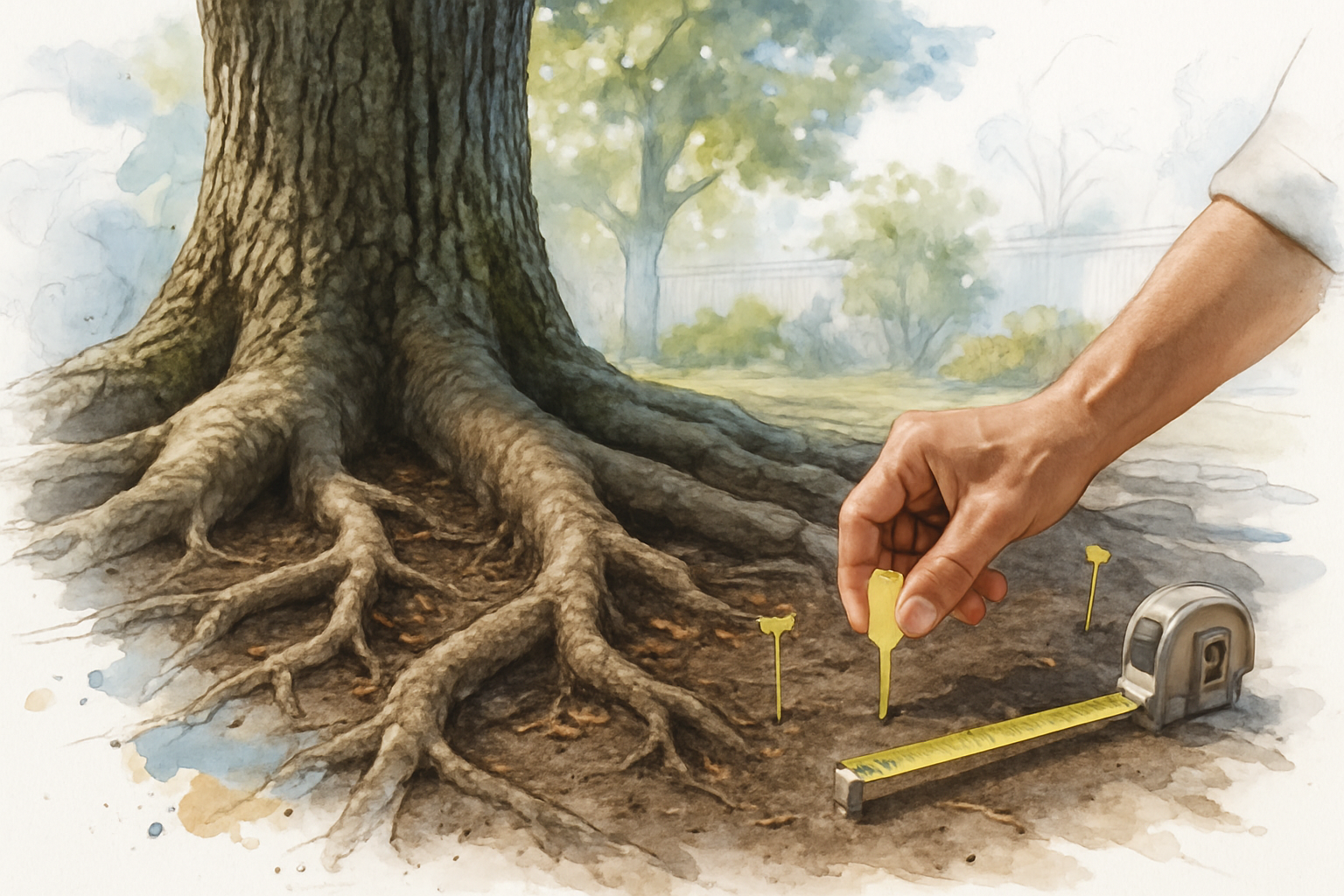
Most people picture tree roots as a mirror image of the canopy — going down as deep as the branches go wide. That’s not really how it works. The majority of a mature tree’s feeder roots sit in the top 12 to 18 inches of soil, and they spread well beyond the drip line in every direction.
That matters enormously for design decisions. Here’s what can cause serious damage to a mature tree when a redesign is done without accounting for root zones:
- Grade changes — even raising or lowering the soil by a few inches over the root zone can suffocate feeder roots or expose them to conditions they can’t tolerate
- Irrigation changes — shifting from lawn sprinklers to drip lines, or moving emitters away from a tree that’s spent decades adapting to that water source, can stress or starve the root system
- Hardscape installation — compacting soil with equipment, pouring concrete, or laying pavers within the drip line restricts oxygen exchange and can kill roots over time
- Trenching for new irrigation or electrical lines — even a single trench through a critical root zone can remove enough root mass to tip a tree toward decline
The ISA (International Society of Arboriculture) recommends treating the area from the trunk out to at least the drip line — and ideally 1.5 times that radius — as a protected zone during any construction or landscape work.
When I walk a property before a redesign, the first thing I’m mapping is where those root zones fall relative to what the homeowner wants to change. That determines what’s possible before we ever talk about plant selection or paving materials.
What a Redesign Around Mature Trees Actually Involves
One thing that genuinely surprises homeowners who call us for a landscape redesign is how many pieces end up being part of the same project. People often expect to hire a landscaper, then separately hire an arborist, then separately call an irrigation contractor. But when mature trees are in the mix, those things can’t be treated as separate jobs.
Here’s what a thoughtful redesign typically pulls together:
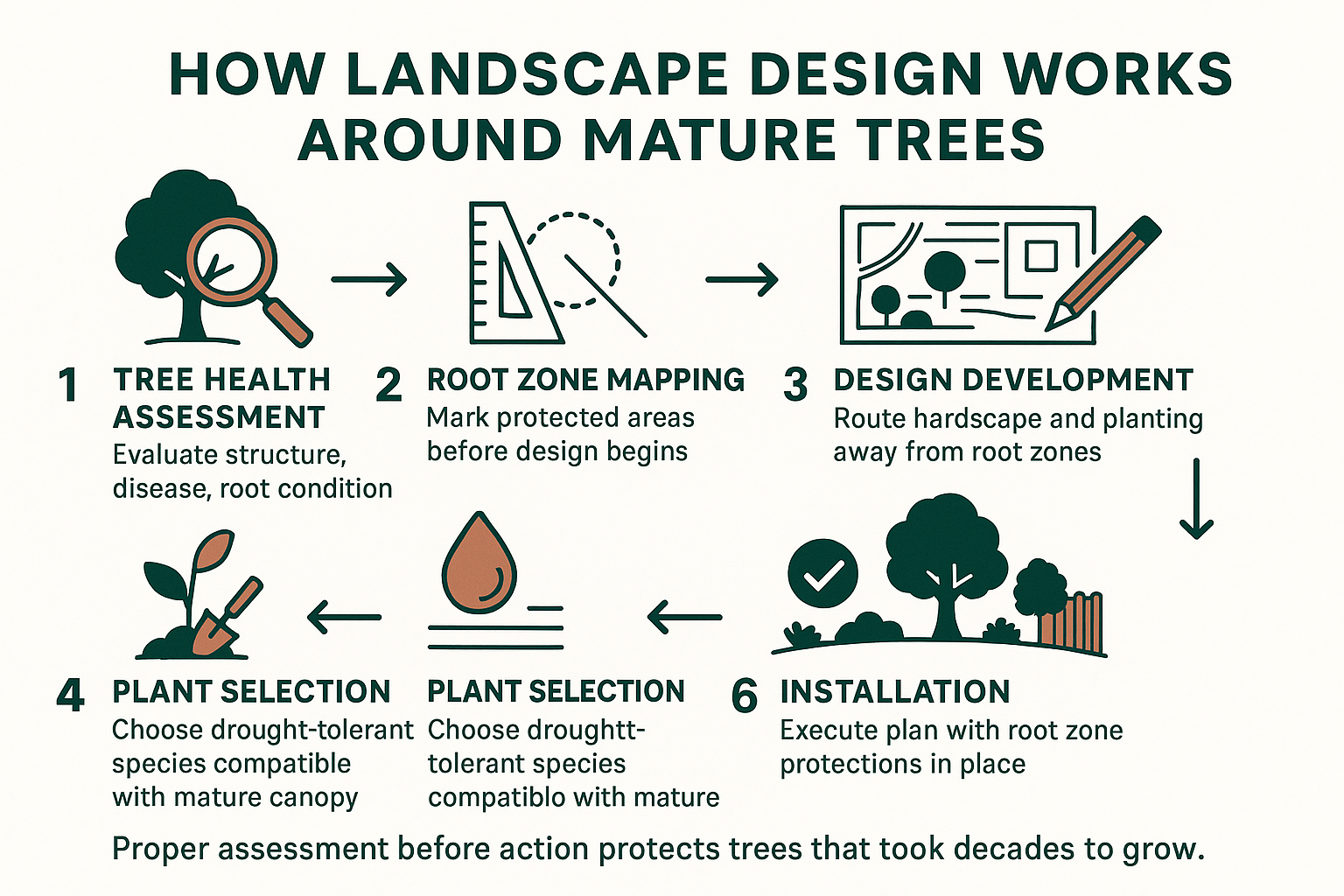
- Tree health assessment — before any design work begins, the existing trees need to be evaluated. Are they structurally sound? Do they have root issues, disease, or structural problems that affect where design elements can safely go? A certified arborist assessment answers these questions before a plan is drawn.
- Root zone mapping — identifying exactly where the protected zones fall so the design routes hardscape, irrigation, and planting away from them
- Drought-tolerant plant selection — replacing lawn or thirsty plants with species that can thrive under the canopy and won’t compete aggressively with established tree roots
- Irrigation redesign — converting from overhead spray to drip, adjusting zones, and making sure mature trees aren’t suddenly overwatered or underwatered by a new system. An irrigation system that’s even slightly off can quietly waste hundreds of gallons a month — something we’ve written about in detail when it comes to how much water a broken sprinkler quietly wastes.
- Hardscape placement — patios, pathways, and decks routed around root zones, sometimes using permeable materials where proximity is unavoidable
One of our reviewers put it plainly: “San Jose Tree Service does it all” — and that observation came from someone who expected to need multiple contractors. When the tree work and the landscape design live under the same roof, you don’t get competing decisions. The arborist’s input shapes the design from the start, not after the fact.
The Landscape Design Process When Mature Trees Are Involved
This step-by-step overview shows how a mature-tree-aware redesign typically unfolds, from first assessment through final installation.
Will It Look Natural, or Will It Look Installed?
This is one of the most consistent concerns I hear from homeowners in established neighborhoods — Willow Glen, Saratoga, Los Gatos. They don’t want a yard that looks like it came out of a catalog. They want a redesign that fits the character of a property that’s been lived in.
That concern is completely legitimate, and it actually aligns well with what mature-tree-aware design already demands. When you’re working around established trees, you’re not starting with a blank slate. The trees set the structure, the canopy determines the light, and the soil conditions under a decades-old oak are already very specific. Good design reads those conditions and responds to them — it doesn’t override them.
Plant selection matters enormously here. California natives and drought-tolerant species — manzanita, coffeeberry, deer grass, native sedges — tend to look at home under a mature canopy in a way that imported ornamentals often don’t. They’re also better suited to the dry, root-competitive conditions under large trees, and they align with where water-efficient landscaping is heading across the South Bay.
For homeowners thinking about a redesign that qualifies for rebates, Valley Water’s residential program for Summer 2026 offers up to $3,000 for projects that incorporate water-efficient turf alternatives and qualifying irrigation upgrades. That’s not a guarantee of eligibility — your specific project and property would need to be evaluated — but it’s a meaningful financial factor worth asking about when you’re planning the scope of a redesign.
Common Landscape Changes and Their Risk to Mature Trees
Not every change carries the same level of risk. This table gives a general sense of how common redesign decisions interact with established tree health — and what to consider before proceeding.
| Design Decision | Risk to Mature Trees | What to Consider |
|---|---|---|
| Lawn removal / turf replacement | Low to moderate | Changes in soil moisture; ensure tree’s water needs are maintained through redesigned irrigation |
| Drip irrigation installation | Low if planned correctly | Emitter placement must account for existing tree root zones and water habits |
| Concrete or paver patio | High within drip line | Soil compaction and oxygen deprivation; route hardscape outside root zone or use permeable alternatives |
| Raised planters near tree base | High | Altering grade around the trunk can bury the trunk flare and cause decline over time |
| Trenching for new irrigation lines | High if within root zone | Hand-digging or air spading in critical zones minimizes root damage |
| Drought-tolerant plant installation | Low | Choose species compatible with shade and dry conditions under established canopy |
What Comes Before Any Design Work Begins
The single most important step in a mature-tree landscape redesign doesn’t involve plants or irrigation at all. It’s the assessment — understanding what the existing trees are actually telling you before any plans get drawn.
That means looking at structural integrity, root zone health, signs of disease or stress, and whether any trees have existing issues that need to be addressed before a redesign layers new activity on top of them. Silicon Valley’s dry summers and occasional wet winters put particular stress on trees that are already struggling — and a tree that looks fine in spring can show serious decline by fall if root damage from a spring redesign goes undetected. We’ve covered how wet seasons can accelerate problems in already-stressed trees in this piece on El Niño and struggling trees.
For properties with protected trees — particularly in San Jose, Los Gatos, or Saratoga where municipal tree ordinances apply — knowing the regulatory picture before you design is also important. Certain species and size thresholds trigger permit requirements that affect what’s possible. What San Jose requires before a tree comes down is a good starting point if you’re uncertain about the rules in your municipality.
The goal of this upfront work isn’t to slow a project down. It’s to make sure that what gets designed is actually buildable — and that the mature trees on the property are still thriving five years after the project is done.
Frequently Asked Questions About Landscape Design and Mature Tree Protection
Can I install a patio near my mature oak without harming it?
It depends on where the patio falls relative to the tree’s root zone. As a general rule, hardscape within the drip line of a mature oak carries real risk — soil compaction and reduced oxygen exchange can cause decline that shows up years later. That said, it’s not always a hard no. Permeable paving materials, careful routing, and hand-digging near roots can sometimes make it work. A tree assessment before design begins is the right way to know what’s actually possible for your specific tree and yard.
I’m replacing my lawn with drought-tolerant plants. Will changing the irrigation hurt my established trees?
It can, yes — and this is one of the most commonly overlooked risks in a turf-replacement project. A mature tree that’s been watered by lawn sprinklers for decades has adapted its root behavior around that water source. Shifting abruptly to drip-only or removing supplemental irrigation entirely can stress the tree, particularly during San Jose’s dry summers from June through October. The irrigation redesign should account for the trees’ established water needs, not just the new plants.
Does a landscape redesign require an arborist, or can a landscaper handle it?
When mature trees are part of the picture, an arborist’s input is worth having before design decisions get locked in. A landscaper focuses on what’s going in the ground. An arborist looks at what’s already there — root zone location, structural health, species-specific vulnerabilities — and that information should shape the design, not follow it. The two roles work best when they’re coordinated from the beginning, not handed off sequentially. You can read more about what a certified arborist actually does that a general crew doesn’t.
My redesign might qualify for a Valley Water rebate. How does that work with a tree-protection design?
Valley Water’s residential rebate program for Summer 2026 covers projects that incorporate water-efficient turf alternatives and qualifying irrigation upgrades — potentially up to $3,000 depending on the project scope. A redesign built around mature trees often naturally qualifies, since drought-tolerant plant selection and drip irrigation are standard elements of root-zone-aware design. Your eligibility depends on the specific changes being made and your property’s existing water use, so it’s worth asking about when you request an assessment.
How do I know if my tree was damaged by a previous landscaping project?
Often you don’t — not right away. Symptoms like thinning canopy, early leaf drop, dieback in the upper crown, or sudden decline can appear two to five years after the damaging work was done. If a tree on your property started declining after any grade work, new hardscape, or irrigation changes, it’s worth having an arborist evaluate it. Early diagnosis gives you more options than waiting until the decline is advanced.
Will a mature-tree-aware landscape design look natural or look like a template?
A well-done design reads the property first and responds to what’s already there. Mature trees set the canopy, the light, and the soil conditions — good plant selection works with those conditions rather than against them. California natives and drought-tolerant species tend to look like they belong on an established property in Willow Glen or Saratoga in a way that generic ornamentals don’t. The goal is a yard that looks like it grew in place, not one that looks like it was installed last Tuesday.
Ready to Plan a Redesign That Works With Your Trees — Not Against Them?
If you have mature trees on your property and you’re thinking about a landscape redesign, we’re glad to take a look at the full picture — tree health, root zone, irrigation, and design scope together. San Jose Tree Service & Landscaping holds both a C-27 Landscaping license and a C-61/D-49 Tree Service classification, which means we can assess the trees and plan the landscape under one contractor rather than coordinating between multiple vendors. Reach us at (408) 422-1313 or visit sanjosetreemaintenance.com to start with an assessment.