 Skip to content

Direct Answer: Most tree pest and disease problems in San Jose are treatable when caught early. A proper diagnosis, not a guess, is always the right first step before any treatment or removal decision.
Every week, homeowners across San Jose, Willow Glen, and Almaden Valley reach out with some version of the same concern: something looks wrong with their tree, and they have no idea whether it’s serious. A sticky residue on the patio furniture. Leaves turning brown too early. Bark that looks different than it did last season. These are real warning signs, and the uncertainty behind them is completely understandable.
The problem is that the internet tends to give two kinds of answers: either ‘don’t worry about it’ or ‘remove the tree immediately.’ Neither is usually correct. Good tree care starts with a proper assessment, not a reaction.
I put together this FAQ to address the questions we hear most often, including a few that came directly from homeowners who submitted photos or called us this spring. If something on your property is worrying you, there’s a good chance your exact question is answered below.
Can Powdery Mildew on a Palo Verde Be Sprayed?
This one came in recently from a homeowner in Los Gatos who noticed a chalky white coating on their Palo Verde’s stems and foliage. Yes, powdery mildew is a fungal condition, and it can be treated. But whether spraying is the right move depends on a few things.
Palo Verdes are tough, drought-adapted trees that thrive in Silicon Valley’s dry summers. A mild case of powdery mildew on an otherwise healthy tree may resolve on its own once temperatures rise and humidity drops, which happens reliably here by late June. Spraying an antifungal when the tree doesn’t need it is money spent without benefit.
When treatment does make sense, the options include:
- Neem oil or potassium bicarbonate sprays for lighter infections
- Improved air circulation through selective pruning
- Systemic fungicide for persistent or recurring cases
The deciding factors are how widespread the infection is, whether the tree is already stressed, and how long the symptoms have been present. A quick photo assessment can usually tell us enough to give you a real answer before anyone sets foot in your yard.
What Is the Sticky Stuff Dripping From My Tree?
If you’ve noticed a shiny, tacky residue on your car, patio, or anything sitting under a tree, the likely culprit is honeydew, a waste product excreted by soft-bodied insects feeding on the tree’s sap. Aphids are the most common source in San Jose neighborhoods, but scale insects and whiteflies produce it too.
Honeydew itself is not the only problem. It creates a surface where sooty mold grows, leaving a black coating on leaves and surfaces below the canopy. The mold looks alarming but is actually secondary, treat the insect infestation and the mold clears up on its own.
For most aphid infestations, treatment options are available that don’t require heavy chemical application. A strong water spray can knock aphid colonies off smaller branches. Natural predators, ladybugs, lacewings, often do real work if you’re not also using broad-spectrum pesticides that kill them off. For larger or recurring infestations, a targeted systemic insecticide applied to the root zone is sometimes the more responsible choice because it limits exposure to beneficial insects.
If you’ve been seeing honeydew for more than a few weeks, it’s worth having someone look at the actual infestation load before assuming it will clear on its own.
Can Spider Mites on Trees Be Treated?
Yes, and this is one where acting early makes a significant difference. Spider mites are not insects, they’re arachnids, and most standard insecticides won’t touch them. That matters a lot if someone tries to treat a mite problem with the wrong product.
In San Jose, spider mite activity tends to spike during hot, dry stretches, exactly the kind of weather we see from July through September. Stressed trees, particularly those with irrigation problems or compacted soil, are more vulnerable. A tree that’s already struggling going into summer is more likely to show a mite problem by August.
Signs to watch for:
- Fine webbing on leaf undersides or between branches
- Leaves with a stippled, bronzed, or faded look
- Leaf drop earlier than normal for the species
For mild cases, miticides labeled for spider mites, including some organic options like neem oil or insecticidal soap, can be effective when applied properly. For heavier infestations on larger trees, a professional application with the right product matters. If you have concerns about what’s being used near your garden or yard, ask specifically about non-chemical or reduced-chemical options, that’s a fair question and one we take seriously. When does a tree problem require an arborist, not just a trimmer? is worth reading if you’re trying to figure out what level of help you actually need.
“Our Elm Tree’s Leaves Are Wilting and Browning. The Bark Around the Trunk Looks to Have Changed in Appearance.”
This is a verbatim question that came to us, and I’m including it exactly because the combination of symptoms matters. Wilting, browning leaves paired with bark that has visibly changed is not something to sit on.
Those two symptoms together can indicate several different conditions:
- Dutch elm disease, a fungal infection spread by bark beetles that is serious and fast-moving
- Bacterial wetwood (also called slime flux), which discolors bark and produces a foul smell
- Phytophthora root rot, which shows up first in the canopy before the crown collapses
- Borers or other cambium-feeding insects, which damage bark from the inside and are often invisible until significant harm is done
Some of these conditions are treatable. Some are not. And a couple of them, if left unaddressed, can spread to neighboring trees.
What I want to be very direct about here: diagnosis must come before any treat-or-remove decision. Sending photos of the bark change and the leaf symptoms is a good starting point. But for something involving both the canopy and the trunk, an on-site inspection by a certified arborist is almost always the right call. You need eyes on the actual tissue, not just the surface. What a certified arborist actually covers during a professional tree assessment explains what that process looks like and why it matters.
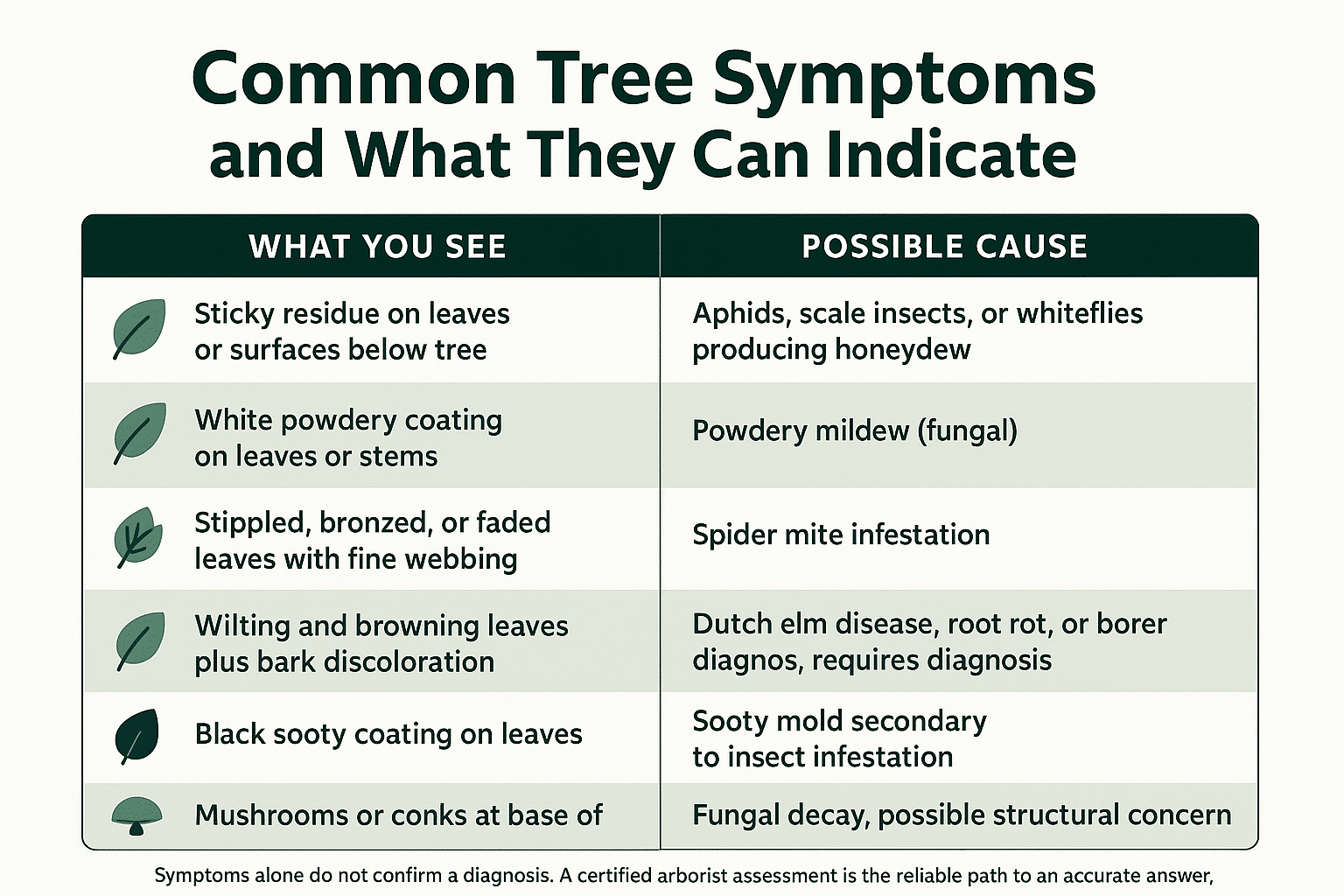
Common Tree Symptoms and What They Can Indicate
This quick reference shows the most frequent visible symptoms homeowners notice and the conditions they’re often associated with, not a diagnosis, but a starting point for understanding what you’re seeing.
Is a 50-Year-Old Fruit Tree With Fungus Still Savable?
Often, yes, and this question deserves a direct answer rather than a vague ‘it depends.’ Mature fruit trees, particularly the kinds you find in older Willow Glen and Almaden Valley neighborhoods, have decades of root development behind them. That root system is a real asset, and it’s worth trying to protect.
Fungal issues in older fruit trees fall into two broad categories. Surface or canopy fungi, things like brown rot, powdery mildew, or leaf curl, are almost always manageable with the right treatment plan and some pruning to open up airflow. Wood decay fungi that have penetrated into the heartwood or major scaffold branches are a more serious conversation, but even then, the question is where the decay is located and how far it has progressed.
A tree that is 50 years old with fungus in one major branch is a very different situation from a tree with decay throughout the central trunk. I’ve seen older trees that looked alarming on the outside turn out to be structurally sound and worth preserving with the right care. I’ve also seen trees that appeared to be fine from the street show serious hidden decay at inspection.
The only honest answer comes after someone actually looks at the tree. Removal should not be the default recommendation for a mature, established tree showing disease symptoms. How El Niño wet seasons hit struggling trees hardest covers related conditions that tend to accelerate fungal problems in older trees, worth reading if your fruit tree has been through a few rough winters.
Photo Assessment vs. On-Site Arborist Visit: When Each Makes Sense
One of the most common questions we get is whether a photo submission is enough or whether someone actually needs to come out. Here’s a practical breakdown.
| Situation | Photo Assessment | On-Site Arborist Visit |
|---|---|---|
| Visible pest (aphids, scale, mites) on leaves or stems | Usually sufficient to identify and recommend treatment | Needed if infestation is heavy or tree is large |
| Powdery mildew or surface fungal spots | Usually sufficient for common species | Recommended if symptoms are spreading rapidly |
| Wilting leaves with bark changes | Good starting point, but on-site almost always needed | Strongly recommended, multiple possible diagnoses |
| Sticky honeydew with sooty mold | Often sufficient to confirm pest source | Needed if source is unclear or infestation is severe |
| Suspected wood decay or structural concern | Photos can flag concern, but cannot confirm decay depth | Required, bark and wood need hands-on inspection |
| Older or high-value tree with any symptom | Good first step to triage urgency | Recommended for any significant management decision |
Are There Non-Chemical Treatment Options?
This is a question I hear from a lot of homeowners in Saratoga and Los Gatos especially, where there’s genuine interest in keeping the landscape as natural as possible. The honest answer is: sometimes yes, sometimes the responsible choice is a targeted chemical treatment, and knowing the difference matters.
For many common pests, non-chemical approaches work well when the infestation is caught early:
- Aphids and soft-bodied insects: Strong water sprays, insecticidal soap, or neem oil are often effective on smaller trees
- Powdery mildew: Improved air circulation through pruning, potassium bicarbonate, or neem oil for mild cases
- Spider mites: Miticide soaps and oil sprays, plus addressing the underlying stress (usually irrigation or soil issues)
Where non-chemical options fall short is with serious, systemic infections or large trees where thorough coverage is physically impossible without proper equipment. The International Society of Arboriculture outlines integrated pest management as the preferred framework, meaning you start with the least invasive option and escalate only when needed. That’s exactly how we approach treatment decisions.
If you ask us specifically for a non-chemical approach first, we’ll tell you honestly whether it’s viable for your situation or whether it would likely just delay a problem that needs more direct intervention.
Does a Sick Tree Always Mean Removal?
No, and I want to say that clearly, because a lot of homeowners come to us already bracing for that answer. The goal is always safety, health, and longevity, not removal by default.
The cases where removal is genuinely the right call are specific:
- Structural failure is imminent and the tree poses a direct hazard
- Decay has progressed to the point where the tree cannot be made structurally sound
- A disease is present that cannot be stopped and poses a transmission risk to other trees
- The tree is dead with no salvageable value
For most homeowners calling us about disease or pest symptoms, we find a treatable condition. Proper assessment frequently reveals that what looked alarming from the street is manageable with the right care plan. 6 things a board-certified arborist does that a tree crew doesn’t goes deeper on why the diagnostic step changes everything about how a tree problem gets handled.
When removal is necessary, we’ll tell you that directly and explain why. But we don’t lead with it, and we don’t recommend it when there’s a real preservation option on the table.
Frequently Asked Questions About Tree Pests and Disease in San Jose
Do I need someone to come out, or can I just send photos?
For a lot of common pest and disease questions, photos are a great starting point, and often enough to give you a meaningful answer without an on-site visit. Many of the callers who reached out to us this spring were surprised to learn that a free photo evaluation could identify the problem and get them a treatment direction within a day or two. Send clear photos of the affected leaves, any bark changes, and a wider shot of the whole tree. For situations involving bark damage, suspected structural decay, or symptoms on a large or high-value tree, an in-person inspection is usually the more reliable path. We’ll tell you which applies to your situation after we see the photos.
Can a tree recover from Dutch elm disease?
Dutch elm disease is serious, and recovery depends heavily on how early it’s caught. If the infection is detected in one or two limbs before it reaches the root system, aggressive pruning well below the infected wood, sometimes combined with fungicide injection, can stop the spread. Once the disease reaches the root system or has advanced through the vascular tissue throughout the tree, the prognosis is poor. This is exactly the kind of situation where diagnosis speed matters. If you’re seeing wilting, yellowing, or browning that is moving through the canopy over a period of weeks, get an assessment quickly.
My neighbor’s tree looks sick. Could it spread to my trees?
Some conditions do spread, and some don’t. Fungal diseases that are airborne, like powdery mildew, can move from tree to tree under the right humidity conditions. Dutch elm disease spreads through root grafts and bark beetle movement, which is why infected trees are a genuine concern for neighboring elms. Aphids and spider mites will absolutely move to adjacent plants. If your neighbor has a visibly diseased tree and yours is showing early symptoms, it’s worth having someone look at both situations together rather than treating them as unrelated.
Is it safe to try treating a pest problem myself before calling an arborist?
For small trees and confirmed, common pests, aphids on a young fruit tree, for example, a homeowner-applied neem oil or insecticidal soap is a reasonable first step. Where DIY treatment gets risky is when the pest or disease hasn’t been correctly identified. Applying the wrong product, or the right product at the wrong concentration, can harm the tree or kill beneficial insects without touching the actual problem. If you’re uncertain what you’re looking at, a photo assessment before you treat is a low-effort way to make sure you’re not making things worse.
How much does tree pest or disease treatment typically cost?
Costs vary quite a bit depending on the species, tree size, type of treatment, and how accessible the canopy is. A treatment for aphids on a small ornamental tree is a very different job than a systemic fungicide injection into a 60-foot oak. Many South Bay homeowners find that pest and disease treatment is significantly less expensive than removal, which is one more reason a proper diagnosis first almost always saves money in the long run. For a specific estimate, the most reliable path is to send photos or schedule an assessment so we can give you a number based on what your tree actually needs.
Who leads the disease and pest diagnosis at San Jose Tree Service?
Assessments are led by Robert, a third-generation Board-Certified Master Arborist, a credential held by a very small percentage of arborists nationally. Reviewers describe him consistently as ‘extremely knowledgeable,’ and that expertise is specifically what you’re hiring when you ask for a diagnosis. This isn’t a spray crew making a judgment call, it’s someone with deep, specific training in tree health and disease pathology making a recommendation backed by real assessment.
Have a Tree Question You Don’t See Answered Here?
If something on your property is worrying you, a change in the bark, leaves that don’t look right, or a sticky mess you can’t explain, the easiest first step is to send us photos. San Jose Tree Service & Landscaping offers a free photo-based evaluation for homeowners across San Jose, Willow Glen, Almaden Valley, Los Gatos, Campbell, and surrounding communities. For situations that need eyes on the ground, we can schedule an on-site assessment with Robert directly. Reach us at (408) 422-1313 or visit sanjosetreemaintenance.com, BBB-accredited since 2013, and rated 4.96 stars across 70 Google reviews.