 Skip to content

Direct Answer: Tree cabling installs steel or synthetic cables in the canopy to support a weak union or heavy branch, reducing failure risk without removing the tree.
I hear some version of the same thing on almost every assessment call: a homeowner spotted something worrying in their tree, a fork that looks like it’s splitting apart, a massive limb hanging over the roof, and a neighbor or a handyman told them the whole tree needs to come down. Most of the time, that’s not what I find when I get there.
Structural problems in trees are real, and they deserve serious attention. But the jump from ‘this tree has a defect’ to ‘this tree has to go’ skips a step that matters a great deal: a proper assessment to determine whether the defect is manageable. In many cases, it is.
One of the most common tools for managing it is tree cabling and bracing, a technique most homeowners have never heard of until an arborist brings it up. This article explains what it actually is, which problems it addresses, and where its limits are.
The Two Structural Problems That Most Often Lead to a Cabling Recommendation
In my experience working with mature trees across San Jose, the Willow Glen neighborhood, and the foothill communities around Saratoga and Los Gatos, two specific conditions come up again and again when cabling becomes the right conversation.
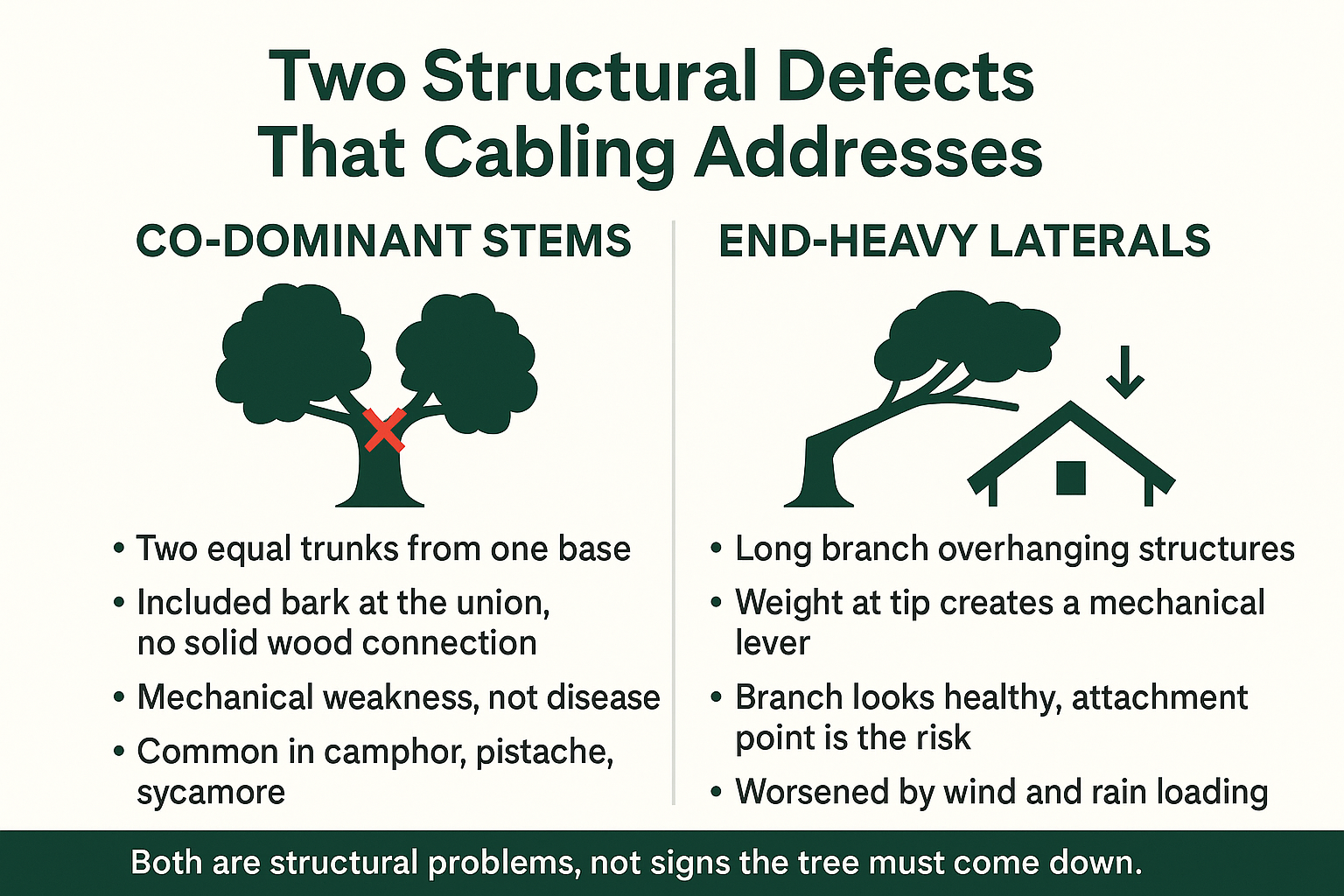
The first is co-dominant stems. This is where two trunks of roughly equal size grow from a single base. As they grow, the bark between them gets compressed and trapped rather than forming a clean branch collar. That trapped bark, called included bark, creates a mechanical weakness at the union. There’s no solid wood connection holding the two stems together the way a healthy branch-to-trunk attachment would. It’s not a disease, and it doesn’t look alarming from a distance, but under the right loading conditions it can fail without much warning.
Co-dominant stems are extremely common in fast-growing trees planted in residential yards decades ago. I see it regularly in camphor trees, Chinese pistache, and sycamores throughout Willow Glen and Almaden Valley. In neighborhoods with 60- to 80-year-old trees, this kind of structure is practically routine, which is exactly why a structural assessment is part of good stewardship regardless of whether a storm season is approaching.
The second condition is end-heavy laterals. These are long horizontal branches, often extending over a patio, a fence, or a roofline, where so much weight has accumulated at the tip that a single storm loading event could split the branch from the trunk. The branch may look healthy and green. The problem isn’t the branch itself; it’s the mechanical lever it creates when wind or rain adds dynamic load to a canopy that’s grown beyond what the attachment point can bear.
Both of these problems share something important: they’re structural, not biological. A tree with either issue isn’t necessarily sick or dying. It just has a defect that needs to be managed.
What Cabling Actually Does, and How It Works
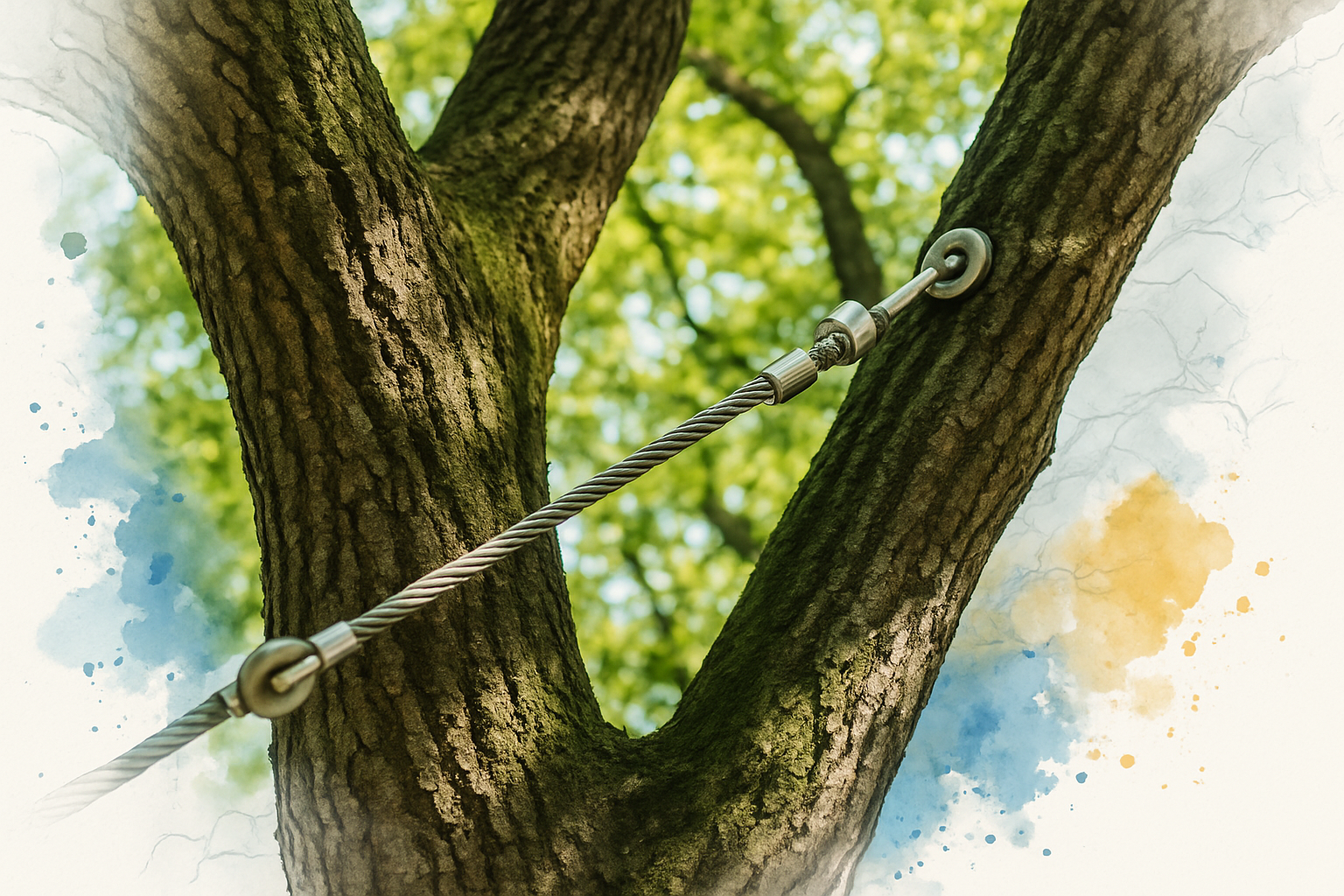
Tree cabling installs steel or high-strength synthetic cables in the upper portion of the canopy, connected to hardware anchored into the wood of each stem or branch being supported. The cable doesn’t hold the tree rigid, it limits the range of movement between two parts of the tree, redistributing load away from the weak union before it reaches the point of failure.
For a co-dominant stem situation, the cable runs between the two trunks at a height that allows it to catch dynamic movement during wind or storm loading. For an end-heavy lateral, the cable typically anchors higher on the trunk or to another scaffold branch, taking some of the weight off the attachment point.
The ISA, the International Society of Arboriculture publishes standards for cabling installation, and any properly installed system follows those guidelines for hardware type, cable placement height, and load calculations. A cable installed in the wrong location or at the wrong angle doesn’t just fail to help, it can actually concentrate stress rather than relieve it. This is work that requires an arborist, not a general contractor.
In terms of what homeowners might expect to spend, costs vary significantly based on tree size, canopy access, number of attachment points, and whether steel or synthetic cable is used. Many jobs involve more than one cable, which affects the total. I’d point anyone with a specific tree to reach out for an assessment rather than budget off a number found online, the variation is genuinely wide.
For context on what goes into the broader cost of professional tree work, this breakdown of tree trimming pricing in San Jose covers many of the same factors.
Co-Dominant Stems vs. End-Heavy Laterals: What Each Problem Looks Like
This infographic compares the two structural defects that most often lead to a cabling recommendation in South Bay trees.
Why Storm Season Makes This Worth Thinking About Now
NOAA’s June 2026 El Niño advisory flagged increased storm-season uncertainty heading into this winter, with the potential for strong winds and above-average precipitation across Northern California. When saturated soils and high winds combine, trees with existing structural defects face a much greater chance of mechanical failure than they would in a dry, calm season.
I want to be careful not to overstate the certainty here, no one can predict exactly what San Jose’s coming winter will bring. But for a homeowner who already knows they have a co-dominant stem over the back patio or a long oak limb reaching toward the roofline, that uncertainty is reason enough to get an assessment done before the season starts rather than during it.
We’ve written more about this pattern and what to watch for in trees heading into a wet season in this article on how El Niño winters change tree care planning in San Jose. The short version: trees with known weaknesses don’t get more forgiving under storm loading. And a cabling installation takes time to schedule, source materials for, and complete properly, it’s not something that gets done the day before a storm hits.
For homeowners in Saratoga or the Los Gatos foothills specifically, fire-wind events in dry fall months add another loading scenario worth considering. Those communities tend to have larger, older specimens that have had decades to develop the structural complexity that makes this kind of assessment worthwhile.
Cabling vs. Removal: When Each Makes Sense
This is a rough guide to the decision an arborist is working through during a structural assessment. No table replaces an on-site evaluation, but this gives homeowners a sense of the logic.
| Tree Condition | Cabling May Be Appropriate | Removal More Likely Indicated |
|---|---|---|
| Structural defect | Co-dominant stems with manageable included bark, no decay present | Included bark combined with significant internal decay |
| Branch condition | End-heavy lateral on otherwise healthy tree with sound attachment | Branch union showing active decay or structural compromise |
| Root system | Root plate intact and stable | Root plate damaged, lifted, or severely declining |
| Overall health | Tree is otherwise healthy and vigorous | Tree has advanced disease, major deadwood, or significant crown dieback |
| Follow-up requirement | Annual or biennial inspection to check cable hardware and tree response | No follow-up needed, stump management only |
What Cabling Cannot Do
This is where I think it’s important to be direct with homeowners, because some contractors either oversell cabling or dismiss it entirely, and neither serves you well.
Cabling does not save a tree that has significant internal decay, particularly at the root collar or in the main scaffold branches. A cable can redistribute mechanical load between healthy wood. It cannot compensate for wood that is no longer structurally sound. If decay is present, the assessment has to determine the extent and location before any cabling recommendation is meaningful. We use percussion testing and resistograph technology for this, the latter uses a fine drill to measure wood resistance and map the actual extent of decay rather than guessing from the outside.
Cabling does not eliminate the need for follow-up inspections. Hardware needs to be checked, typically on an annual or biennial basis, to confirm the cable hasn’t become too tight as the tree grows, that the anchor points remain sound, and that the underlying defect hasn’t progressed. Cabling is an ongoing management tool, not a one-time fix.
And cabling is not a substitute for proper pruning. In many cases, reducing the weight on an end-heavy lateral through careful crown reduction is part of the same treatment plan as installing a cable. The two approaches work together. If you’re weighing these options for a tree, this article on when a tree problem requires an arborist rather than just a trimmer explains why the distinction matters.
For any tree where structural integrity is genuinely in question, an arborist report may also be appropriate, particularly if you’re dealing with a neighbor dispute, an insurance question, or a city permit situation. This article on what San Jose requires before a tree comes down covers the permit side of the conversation.
Frequently Asked Questions About Tree Cabling and Bracing
How do I know if my tree actually has a structural problem worth assessing?
The most common signs are a V-shaped fork where two trunks meet (especially if you can see compressed or ingrown bark in the crotch), a long heavy branch extending over your house or patio with no secondary support, or a tree that has cracked or shifted noticeably after a previous storm. If you’re unsure, an on-site evaluation is the only honest answer, visual symptoms alone don’t tell the whole story.
Is cabling a permanent solution?
No. It’s a long-term management tool, and it requires periodic inspection to make sure the hardware is still performing correctly as the tree grows. Think of it like a structural support system that needs occasional check-ins, not a one-time installation you forget about.
Can I install a cable myself or hire a general handyman to do it?
I’d strongly advise against it. Cable placement, anchor depth, and load calculations all depend on the specific geometry of the tree and the defect being addressed. Incorrect installation can concentrate stress rather than relieve it, which makes the situation worse. This is arborist work.
My neighbor told me the tree is dangerous and needs to come out. Do I need to remove it?
Not without a proper assessment first. ‘Dangerous’ is a meaningful word, but it requires a qualified arborist to evaluate whether the risk is real, how significant it is, and whether it can be managed. A neighbor’s opinion, even a well-meaning one, is not a tree risk assessment. Get the evaluation before making a decision that can’t be undone.
Does cabling affect the health of the tree?
When installed correctly by a qualified arborist, cabling has minimal impact on tree health. The hardware penetrates the wood, but trees compartmentalize around it over time. The bigger risk to tree health in most cases is the structural defect going unaddressed, not the cable itself.
Want a Structural Assessment Before the Storm Season Starts?
If you have a mature tree with a fork that worries you, a heavy limb over your roof, or a neighbor who’s convinced you the whole thing needs to go, a proper on-site evaluation is the right first step. San Jose Tree Service & Landscaping conducts structural assessments across San Jose, Willow Glen, Almaden Valley, Saratoga, Los Gatos, and Campbell. You can reach us at (408) 422-1313 or visit sanjosetreemaintenance.com to request an assessment.
