
Direct Answer: A struggling oak is rarely a lost cause. The key is identifying what it’s showing you, sparse canopy, bark changes, or root-zone moisture, before guessing at a fix.
I hear a version of the same question almost every week, usually from homeowners in Willow Glen or Almaden Valley who have lived with a large oak for years and suddenly noticed something feels off. The canopy looks thinner than it did last spring. There’s a patch of bark that looks darker than it should. The tree isn’t dead, but something isn’t right, and they don’t know what to do about it.
That uncertainty is completely reasonable. Coast Live Oaks are one of the most common trees on South Bay residential properties, and they’re also one of the most frequently misread. The signs they send are real, but they don’t always mean what people assume they mean. And the instinct to fix something quickly, more water, a quick trim, is sometimes exactly the wrong move.
This article is about learning to read what your oak is actually telling you, before you do anything to it. That’s always the right place to start.
What a Sparse Canopy in August Actually Means
When a Coast Live Oak starts looking thin in the height of summer, the first assumption most homeowners make is that the tree needs water. It looks stressed, so more water must help. I understand the logic, but it’s often wrong, and in some cases, it makes things significantly worse.
Established Coast Live Oaks in the South Bay are adapted to dry summers. That’s not a fun fact, it’s the core of their biology. They slow down through our long dry season, and some canopy thinning in August is not automatically a distress signal. What you’re sometimes seeing is a tree doing exactly what it evolved to do.
The dangerous part is this: summer irrigation around established oaks is one of the fastest ways to invite Phytophthora root rot, a fungal disease that thrives in warm, waterlogged soil. The pathogen attacks the root system quietly, often before any canopy symptoms appear. By the time the crown looks genuinely sick, the damage beneath the soil is already well advanced.
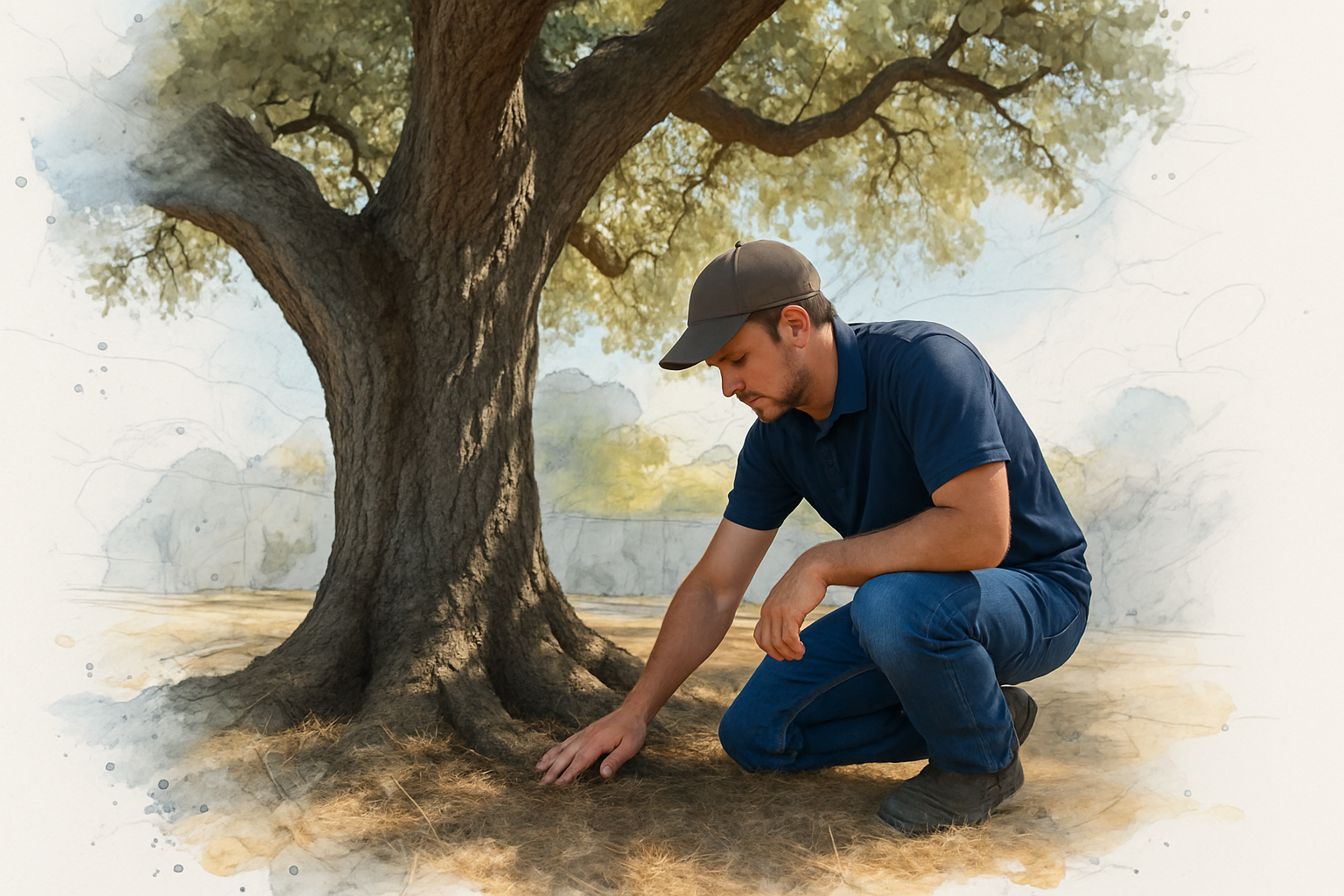
Before reaching for the hose, I’d encourage you to check the root flare area, the zone at the base of the trunk where the tree meets the soil. Is the soil there consistently moist? Is there standing water nearby after irrigation runs? Wet soil at the root flare in August, on an established oak, is a more meaningful warning sign than a slightly thin canopy. If you’re seeing that combination, the tree may need less water, not more. That’s one of those counterintuitive realities that’s hard to accept until you’ve seen how quickly things can turn.
For a deeper look at what color and canopy changes can mean across different tree species, this breakdown of what color changes actually signal covers a lot of the same diagnostic ground.
The Pruning Window That Most Homeowners Miss
If you have a mature oak that needs pruning work, timing matters more than most people realize. This isn’t a small technical detail, getting the timing wrong can introduce a disease risk that is very difficult to reverse.
Sudden Oak Death, caused by the pathogen Phytophthora ramorum, spreads partly through fresh pruning wounds. Cutting into an oak at the wrong time of year leaves an open wound that is far more vulnerable to infection. The University of California Cooperative Extension has documented how wound susceptibility and pathogen activity both peak during spring and early summer in California’s coastal and foothill regions.
The generally preferred window for oak pruning in the South Bay is late summer into fall, roughly late August through November. At that point, wound-sealing activity in the tree is stronger, and the environmental conditions that favor pathogen spread are less favorable. That said, I want to be honest: the right timing depends on the specific tree, its health status, and what cuts are being made. A blanket rule only goes so far.
There’s also a permit issue worth knowing about. San Jose’s tree ordinance requires a permit before pruning or removing certain protected trees, including oaks above a specific diameter threshold. Trees over 12 inches in diameter at breast height often fall into this category. If your oak is mature and substantial, it’s worth confirming permit requirements before scheduling any work, both to stay compliant and because the permit process sometimes surfaces other information about the tree’s status. You can read more about what San Jose specifically requires before any tree work begins.
And if there’s any structural concern about the tree, a large co-dominant stem, a crack in a major limb, that’s a separate conversation entirely. Cabling or bracing may be an option worth exploring before removal comes up. Removal is rarely the only answer when a tree has a structural weak spot.
How to Read What Your Oak Is Telling You
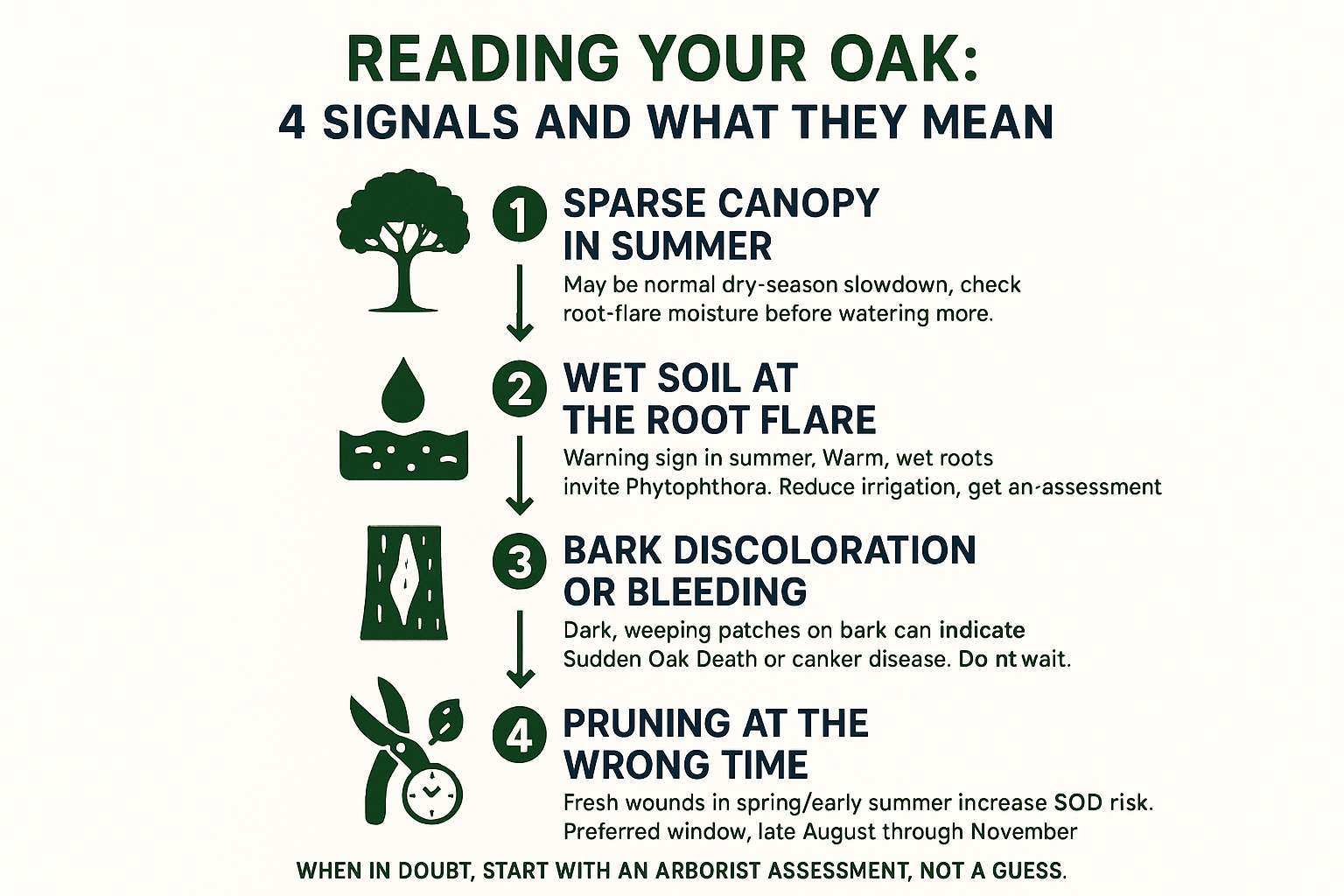
This visual walks through the four most common signals an oak sends, and what each one most often means in the South Bay context.
Common Oak Symptoms and What They Most Often Indicate
These are the most frequent observations homeowners describe when they call about an oak. The right column reflects what each symptom commonly points toward, not a diagnosis, but a starting framework for the conversation.
| What You’re Seeing | What It Often Indicates | Recommended First Step |
|---|---|---|
| Thin or sparse canopy in July-August | Normal seasonal slowdown OR early drought stress | Check root-flare moisture; hold irrigation |
| Dark, weeping patches on bark | Possible Phytophthora or Sudden Oak Death | Arborist assessment, do not prune or treat yet |
| Yellowing leaves, starting at branch tips | Root stress, poor drainage, or soil compaction | Diagnostic consultation; soil and root-zone evaluation |
| Mushy or discolored root flare | Phytophthora root rot (advanced) | Immediate arborist assessment; root zone inspection |
| Dead or brittle branches throughout canopy | Drought stress, disease, or structural decline | Risk assessment before any pruning work |
| Canopy thinning after wet winter | Root stress from waterlogging; possible fungal activity | Evaluation before assuming drought is the cause |
Why the Tree That Has Been There 50 Years Deserves a Real Assessment
One caller described their oak exactly this way: it had been on the property for 50 years, and they wanted to keep it if at all possible. That framing resonates with me, because it reflects how most oak owners actually feel about these trees. They’re not just plants, they’re part of the property in a way that a younger tree simply isn’t yet.
A well-timed intervention on a struggling oak nearly always outperforms removal and replacement. A mature oak that took 50 years to reach its current canopy spread cannot be replaced in any practical sense. A 15-gallon nursery tree planted today will take decades to approach that scale, and that assumes ideal conditions and consistent care. The math strongly favors preserving what’s already there if the tree’s condition allows it.
What I’ve seen repeatedly is that homeowners who wait, hoping the tree will recover on its own, or Googling symptoms and applying a general fix, often narrow their options without realizing it. A tree that was recoverable in spring can be significantly harder to work with by fall, especially if it’s been receiving the wrong care in the meantime.
The question one form submission captured perfectly was this: a homeowner with an oak in Cupertino simply wanted to know what services they should be doing before anything went wrong. That’s actually a great question, and the honest answer is that it depends entirely on what an on-site assessment finds. There’s no universal oak maintenance checklist that applies to every tree in every yard. The soil, the irrigation setup, the tree’s age and structure, what’s growing nearby, all of it matters.
For anyone who has recently moved into a home with mature oaks, this is exactly the situation where a new homeowner tree assessment pays for itself quickly. And if your oak or any other tree showed stress after a heavy winter, this piece on how wet seasons hit struggling trees is worth a read before assuming the problem is drought.
Frequently Asked Questions About Oak Tree Care in San Jose
Should I water my Coast Live Oak during a dry summer?
For most established Coast Live Oaks in the South Bay, the answer is no, or at least not the way most homeowners imagine. These trees are adapted to dry summers and do not need supplemental irrigation once their root systems are mature. Summer watering near the root flare can actually create conditions that invite Phytophthora root rot, which is far more damaging than drought stress in most cases. If your oak is newly planted or clearly in decline, that’s a different conversation, but irrigation decisions for oaks should always come after a proper look at the tree and its soil conditions, not before.
When is the best time to prune an oak tree in San Jose?
Late summer through fall, roughly late August into November, is the generally preferred window for oak pruning in the South Bay. Pruning during spring or early summer, when the Phytophthora ramorum pathogen is most active, increases the risk of Sudden Oak Death infecting fresh wounds. An arborist should evaluate the tree before any cuts are made, especially on larger trees that may also fall under San Jose’s permit requirements.
Does my oak need a permit before I can trim or remove it?
Possibly. San Jose’s tree ordinance protects oaks and other designated species above certain size thresholds, generally 12 inches in diameter at breast height or larger. If your tree falls into that category, a permit is typically required before removal and may be required before significant pruning. A certified arborist can help you determine what applies to your specific tree and walk you through the permit process. You can read a broader overview of what San Jose requires before a tree comes down.
What does a dark, weeping patch on my oak’s bark mean?
It’s a symptom worth taking seriously. Dark, bleeding patches on oak bark, sometimes with a sour smell, can be associated with Sudden Oak Death or other canker diseases. It doesn’t automatically mean the tree is lost, but it does mean you should get an arborist to look at it before doing anything else. Don’t prune around the area, and don’t treat it with anything until you know what you’re dealing with. Early diagnosis gives you more options.
My oak has been there for decades and looks fine. Does it still need professional attention?
A tree that looks fine on the outside can still have internal decay, root-zone stress, or structural issues that aren’t visible from the ground. Mature trees carry more consequence when something does go wrong, a large failing branch or a compromised root system on a 60-year-old oak is a different situation than the same problem on a young tree. Periodic arborist assessments catch these things early, when the range of options is widest. Most homeowners find that an annual or biannual check-in is far less expensive than reacting to a problem after it’s progressed.
What does an arborist consultation actually look like?
From what I’ve seen in practice, a good consultation doesn’t just end with a report or a recommended service list. It ends with the homeowner actually understanding their tree, what it needs, what to watch for, and how their watering and care habits affect it. One reviewer noted that after their visit, they felt trained on how to care for all of the trees on their property. That’s the goal: not just a checklist, but genuine clarity about what’s happening and why.
Ready to Get a Clear Answer About Your Oak?
If something about your oak has been nagging at you, a patch of bark, a thinning canopy, a gut feeling that something isn’t right, the most useful thing you can do is get someone knowledgeable to look at it in person. Not a Google search, not a neighbor’s opinion, and not a treatment applied on a guess. San Jose Tree Service & Landscaping offers arborist consultations across San Jose, Willow Glen, Almaden Valley, Los Gatos, and the surrounding South Bay communities. You can reach us at (408) 422-1313 or visit sanjosetreemaintenance.com to request an assessment.
