
Direct Answer: Color changes in tree leaves signal different problems, nutrient deficiency, root stress, vascular disease, or fungal infection. Each one points toward a different diagnosis and a different response.
About 12 percent of calls we received in June 2026 were specifically about tree health, leaves turning yellow, canopies browning out, powdery white coatings appearing on branches, bark looking different than it used to. These weren’t vague worries. Homeowners in San Jose, Los Gatos, and the surrounding South Bay region were describing specific things they were seeing, and they wanted to know what those things meant.
The problem is that yellowing, browning, and disease symptoms all look similar from the ground, especially early on. A tree that looks like it’s dying might be recoverable. A tree that looks stressed but stable might have an advancing vascular problem that’s been building for months underground. The canopy is often the last place a serious problem becomes visible, which is why what you’re seeing right now matters.
This article isn’t a remote diagnosis tool. No article can tell you exactly what’s wrong with your specific tree. What it can do is help you understand the three most common visible symptom patterns, what each one typically signals, and why getting the description right before an arborist visit makes that visit faster and more useful for everyone.
What Yellowing Leaves Are Actually Telling You
Yellow leaves, the technical term is chlorosis, are one of the most common tree health complaints we hear. And they’re also one of the most misread, because yellowing has a long list of possible causes that require very different responses.
The most common drivers of chlorosis in South Bay trees include:
- Nutrient deficiency, particularly iron or manganese, which is common in San Jose’s clay-heavy soils where pH levels can block root uptake even when nutrients are present
- Overwatering or poor drainage, which compresses soil pore space and suffocates roots, preventing them from delivering water and minerals to the canopy
- Root damage, which can follow construction activity, soil compaction, or grade changes, often showing up in the canopy a full season or two later
- Early-stage disease, where a fungal or bacterial pathogen is beginning to interfere with the tree’s vascular system
Here’s what makes chlorosis tricky: a tree with yellowing leaves from iron deficiency looks nearly identical to one with yellowing leaves from root rot. But the treatment is completely different. One might need a soil amendment and adjusted irrigation. The other might need a formal root-zone inspection and a structural assessment.
When one homeowner describes their tree as “just looking pale,” that’s not enough to work with. The questions I’d want answered are: Did it happen gradually or suddenly? Is the yellowing on older leaves at the interior or on new growth at the tips? Is it the whole tree or one side? Those details narrow the diagnostic path considerably. You can read more about how tree pest and disease questions San Jose homeowners keep asking map to different underlying causes.
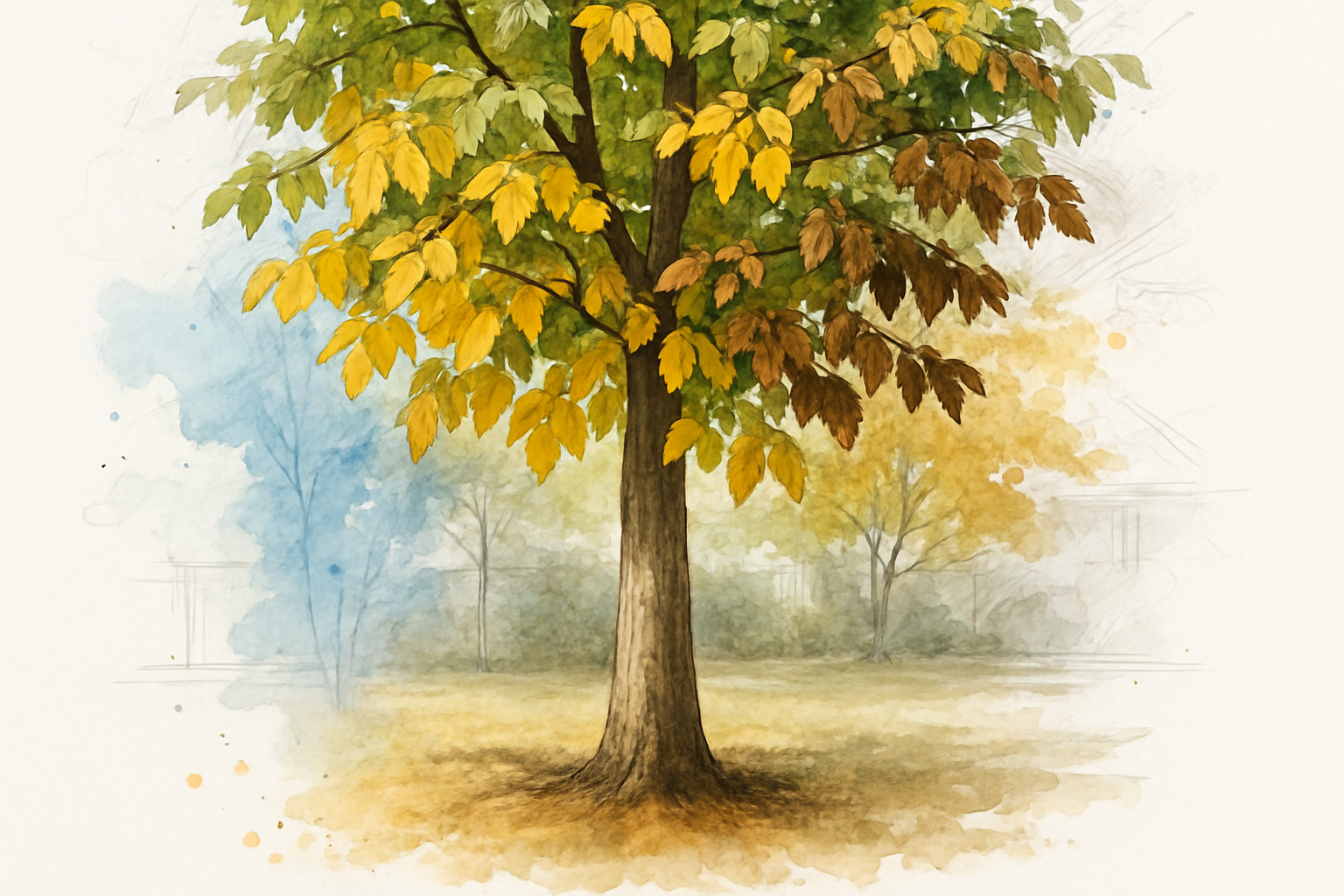
When Browning and Wilting Appear Together, This Is the More Urgent Pattern
A caller described an elm with leaves that were wilting and browning at the same time as bark changes becoming visible on the trunk. That combination, canopy browning plus bark changes, is a different category of concern than simple chlorosis.
Browning and wilting together, especially when accompanied by bark discoloration or canker-like lesions, often points toward one of two things: vascular disease or root rot. Both disrupt the tree’s ability to move water from the roots upward. The canopy browns because it’s essentially dehydrating, even when there’s adequate moisture in the soil.
Vascular diseases like Verticillium wilt and Fusarium can move through a tree’s sapwood faster than you’d expect. By the time the canopy shows symptoms, the infection has often been spreading through the vascular tissue for weeks or months. That’s not a reason to panic, it’s a reason not to wait.
Root rot, which is typically caused by Phytophthora or similar water mold pathogens, often looks very similar from the ground but has a different treatment pathway. Some cases are manageable if caught at the right stage. Others have progressed to the point where the root system can no longer support the tree structurally. That’s exactly why one caller said something we hear often: “it might need to be removed, or it might just need treatment, I’m not sure.” That uncertainty is honest, and it’s the right reason to get a proper assessment before making any decision.
If you’ve ever wondered when a tree problem requires an arborist rather than just a trimmer, browning paired with bark changes is a clear example of when the arborist call is the right first move.
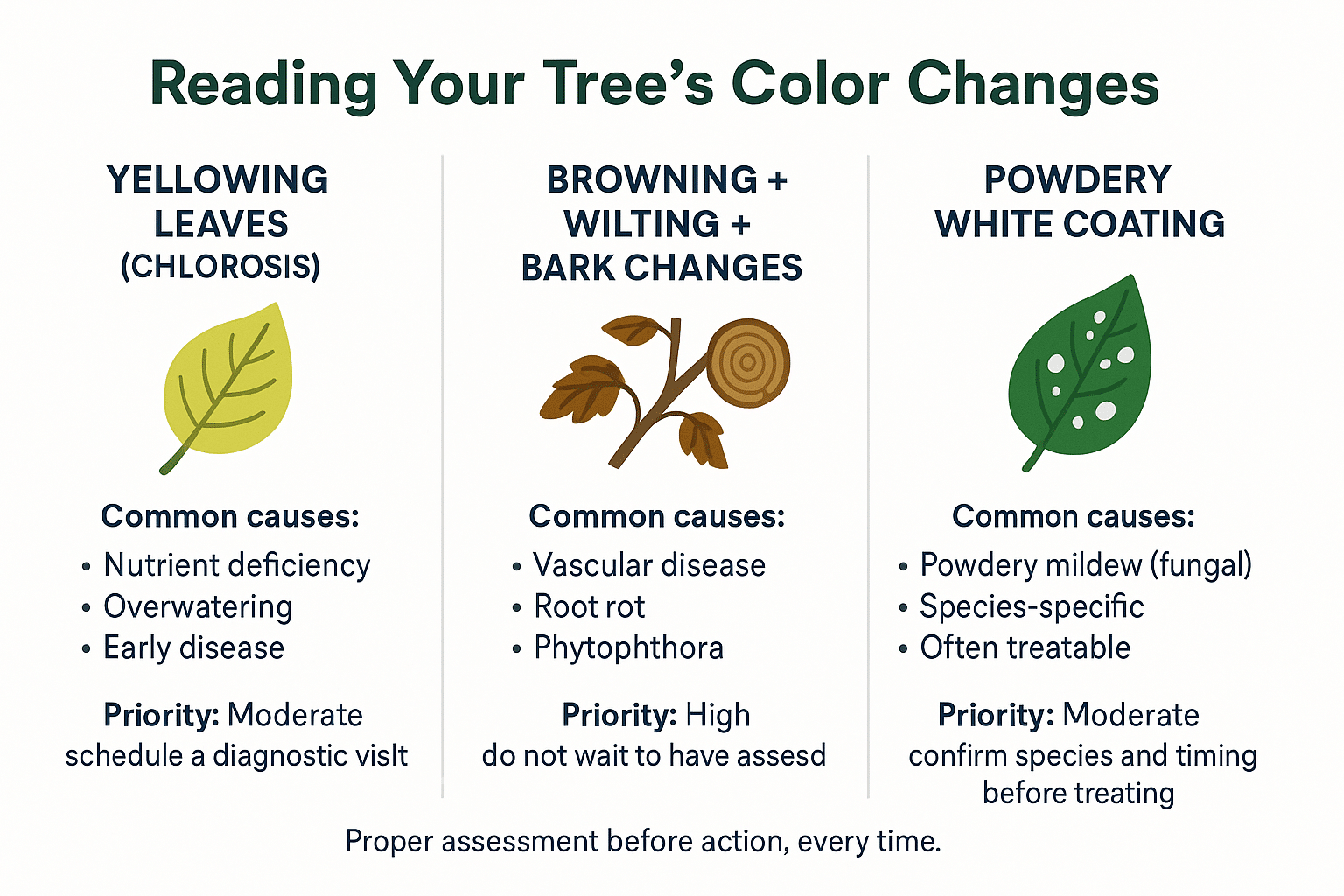
Three Symptom Patterns and What They Typically Signal
This reference shows the three most common visible symptom patterns, what each one often indicates, and what the diagnostic priority is for each.
Powdery White Coating: Usually Fungal, Often Species-Specific
A homeowner in Los Gatos reached out about a Palo Verde in their backyard showing a powdery white coating on the leaves. That’s powdery mildew, a fungal issue that looks alarming but is generally one of the more manageable problems a tree can develop.
Powdery mildew spreads by spores and tends to appear when warm days meet cooler nights with high humidity, conditions that are familiar to anyone who has spent a Silicon Valley summer near the foothills. It’s common on a wide range of species, but the specific fungal pathogen and the right treatment approach often depend on the tree species involved.
A few things worth knowing about powdery mildew:
- It typically does not kill a mature, otherwise healthy tree on its own
- Repeated heavy infections on a tree that is already stressed from drought or root problems can compound existing decline
- Treatment timing matters, fungicide application is most effective early in the infection cycle, before the coating spreads across most of the canopy
- Some species are more susceptible than others, which is why the species ID is part of the first conversation
The key is not to conflate powdery mildew with more serious disease. Misreading a treatable fungal issue as terminal decline leads to unnecessary removal. And missing an advancing disease while assuming it’s “just mildew” leads to delayed action. Both mistakes have real costs, which is why a proper look at the actual tree, not a photo, not a description, is the most reliable way forward.
Sudden Oak Death: A Specific Concern for Los Gatos and Saratoga Homeowners
If you have coast live oaks on your property and you live in or near the Los Gatos or Saratoga foothill neighborhoods, there is one specific disease worth knowing by name: Sudden Oak Death, caused by the pathogen Phytophthora ramorum.
The UC ANR Sudden Oak Death pest notes confirm that proximity to California bay laurel is the single greatest predictor of infection risk in coast live oaks. Bay laurel acts as a reservoir host, it carries the pathogen without showing significant symptoms, and it spreads it during wet conditions. If your coast live oak is growing near bay laurels and it’s rapidly browning from the top down, that symptom pattern warrants a specific diagnostic conversation, not a wait-and-see approach.
The same resource notes that high-value trees can be preventatively treated once they reach a susceptible size. That’s a meaningful window, but it’s only useful if the tree is evaluated before the disease has advanced.
I’d be cautious about reading any single symptom as a confirmed Sudden Oak Death diagnosis. Rapid canopy browning in a coast live oak can also result from other stressors, including drought, crown damage, or other root pathogens. The point is that a browning coast live oak near bay laurels is a situation that warrants an arborist consultation and diagnostics before any other decision is made. If that evaluation leads to a formal disease assessment, the written documentation from that process can also matter if a permit or preservation report becomes part of the picture.
Quick Reference: Visible Symptom vs. What to Ask the Arborist
Use this as a starting point for describing what you’re seeing before your consultation. The more specific your description, the more productive the visit.
| What You’re Seeing | Where on the Tree | What to Mention to the Arborist |
|---|---|---|
| Yellowing leaves | Interior canopy or older leaves near trunk | When did it start? Is it the whole tree or one section? Any recent irrigation or construction changes? |
| Yellowing leaves | New growth at branch tips | Recent fertilizer changes? Has the soil been compacted or disturbed? |
| Browning + wilting | Canopy, spreading from one side or from the top | Is bark changing color or texture near the base? How fast did the browning appear? |
| Bark discoloration or lesions | Trunk or scaffold branches | Is there any oozing or dark staining? Any recent pruning cuts nearby? |
| White powdery coating | Leaf surfaces, often upper side | What species is the tree? How much of the canopy is affected? Has it appeared before? |
| Rapid canopy browning | Top of tree first, moving downward | Are there California bay laurels nearby? Has the area had heavy rain recently? |
Why ‘Waiting to See How Bad It Gets’ Usually Makes Things Harder
The most common mistake I see with tree health problems is waiting. Not because people don’t care about their trees, they clearly do, but because the visible symptoms are confusing and the decision feels large.
Here’s what’s worth understanding: the first visible signs in the canopy usually reflect a root-zone or vascular problem that has been developing for months. What you’re seeing above ground is not the beginning of the problem. It’s the point where the problem has become visible above ground.
That gap between actual onset and visible symptom is precisely why a proper assessment before action is the right sequence, not just the cautious one, but the practical one. A diagnosis made early opens more options. A diagnosis made late narrows them.
Tammy D., a customer who had concerns about her hedges and trees, put it simply in her review: “Robert was quick to assess the issues we are having with our hedges and trees. Once he determined the cause of the problem, he laid out a treatment plan right away.” That’s what an assessment-first visit actually looks like, not a sales call, but a structured diagnostic process that leads to a clear recommendation.
If you’re unsure whether what you’re seeing is serious, a description plus photos can sometimes help narrow the question before a site visit. But for any of the patterns described above, especially browning with bark changes or a rapidly declining coast live oak, an on-site evaluation by a certified arborist is the only way to get a reliable answer. You can also read more about what to watch when struggling trees face wet winters, since seasonal stress often makes underlying health issues visible for the first time.
Frequently Asked Questions About Tree Health Diagnostics
Can I tell from photos whether my tree is diseased or just stressed?
Photos can help narrow the conversation and rule out a few obvious causes. But they can’t replace a hands-on evaluation. Internal decay, vascular disease, and root problems are often invisible from above, and two trees with identical-looking canopy symptoms can have completely different underlying causes. Photos are a good starting point for a conversation, not a substitute for a diagnosis.
My oak is turning brown fast. Should I be worried about Sudden Oak Death?
Rapid canopy browning in a coast live oak is worth taking seriously, especially if there are California bay laurels nearby and you’re in a foothill area like Saratoga or Los Gatos. Sudden Oak Death is one possible cause, but not the only one, drought stress, root pathogens, and other vascular diseases can produce similar symptoms. The right move is a certified arborist evaluation, not a remote diagnosis. If Sudden Oak Death is confirmed, early-stage treatment options exist for trees that haven’t yet suffered severe decline.
Is powdery mildew going to kill my tree?
In most cases, powdery mildew alone won’t kill a mature, otherwise healthy tree. It’s a fungal issue that can usually be managed when caught and treated at the right stage. The concern is when a tree already dealing with drought stress, root problems, or another disease also has to contend with repeated heavy mildew infections. That combination can compound decline. Getting an accurate picture of the tree’s overall health helps determine how urgently treatment is needed.
How do I describe what I’m seeing so the arborist visit is more useful?
Try to note four things before the call or visit: where on the tree the symptoms appear (interior vs. tips, top vs. bottom, one side vs. all sides), how quickly the change happened, what the bark looks like near the base, and whether anything changed recently, irrigation, construction nearby, a wet winter followed by a long dry stretch. That level of detail helps an arborist arrive at the property with a much clearer starting hypothesis.
My tree looks bad but I don’t want to remove it. Is removal always the answer?
No. Removal is appropriate when a tree has died and lost structural integrity, has decay that’s advanced beyond stabilization, or is creating a genuine safety risk that can’t be managed. Many trees that look alarming are recoverable with the right treatment. The goal is always a proper diagnosis first, understanding whether you’re dealing with a treatable condition, a manageable risk, or a genuine removal situation. You can read more about this in Before You Remove a Tree in San Jose, Read This First.
What does a tree health diagnostic visit actually involve?
A diagnostic consultation typically starts with a visual inspection of the full tree, canopy, bark, branch attachment, and root collar at the base. Depending on what’s found, the arborist may look more closely at soil conditions, irrigation, or surrounding plants that could be contributing to the problem. For suspected internal decay, additional techniques like percussion testing can help map what’s happening inside the wood without destructive investigation. The goal is to identify the actual cause, not just the visible symptom, before any treatment or removal recommendation is made.
Ready to Find Out What Your Tree Is Actually Dealing With?
If you’re looking at a tree in your yard and something looks off, color change, bark you don’t recognize, a canopy that went from fine to concerning over a single season, the most useful next step is a real evaluation by someone who can see the whole tree. San Jose Tree Service & Landscaping serves homeowners across San Jose, Los Gatos, Saratoga, Campbell, and the surrounding South Bay region, and every diagnostic visit is led by a Board-Certified Master Arborist. Reach us at (408) 422-1313 or visit sanjosetreemaintenance.com to get started.
