 Skip to content

Direct Answer: Targeted safety cuts, like clearing branches off a roof, can usually be done any month. Heavy reductions should wait for the species window: dormancy for most deciduous trees, summer for California oaks.
The call almost always sounds the same. A renewal inspection happened, a letter showed up, and now there is a 30 day deadline attached to a tree that has been sitting quietly over the roof for twenty years.
One homeowner put it about as plainly as it can be put: their insurance was threatening to cancel because of overhanging trees. Another, in Santa Clara, asked for a much bigger reduction on a pittosporum than the last pruning, purely for insurance reasons. This is turning into an annual pressure, not a one time request.
So here is the honest answer to the question underneath all of it. The carrier’s calendar and the tree’s biology do not always agree, and you have more room to work with than most letters suggest. Let me walk through how I think about it.
The Deadline and the Tree’s Calendar Rarely Line Up
The best time to trim trees in California is not one date on a calendar. It changes by species, and those windows are the constraint you have to plan around when a carrier hands you a deadline.
The short version, and we cover the full calendar elsewhere on the site:
- Most deciduous trees prune best in dormancy, roughly January through March
- California oaks have a summer dormancy window of roughly July through October, because wet season cuts expose fresh wounds to moisture loving pathogens
- Spring bloomers like magnolia set buds on last year’s wood, so they get pruned right after the flowers fade
Now put a 30 day insurance deadline in the middle of that. A letter that lands in April on a Willow Glen coast live oak is about the worst possible collision. The tree is pushing new growth, the ground is still holding winter moisture, and the ideal window is three months out.
That is the real problem people are calling about. Not “when should I prune,” but “what do I do when someone else picked the date for me.”
Nesting Season Is the Constraint Nobody Factors In
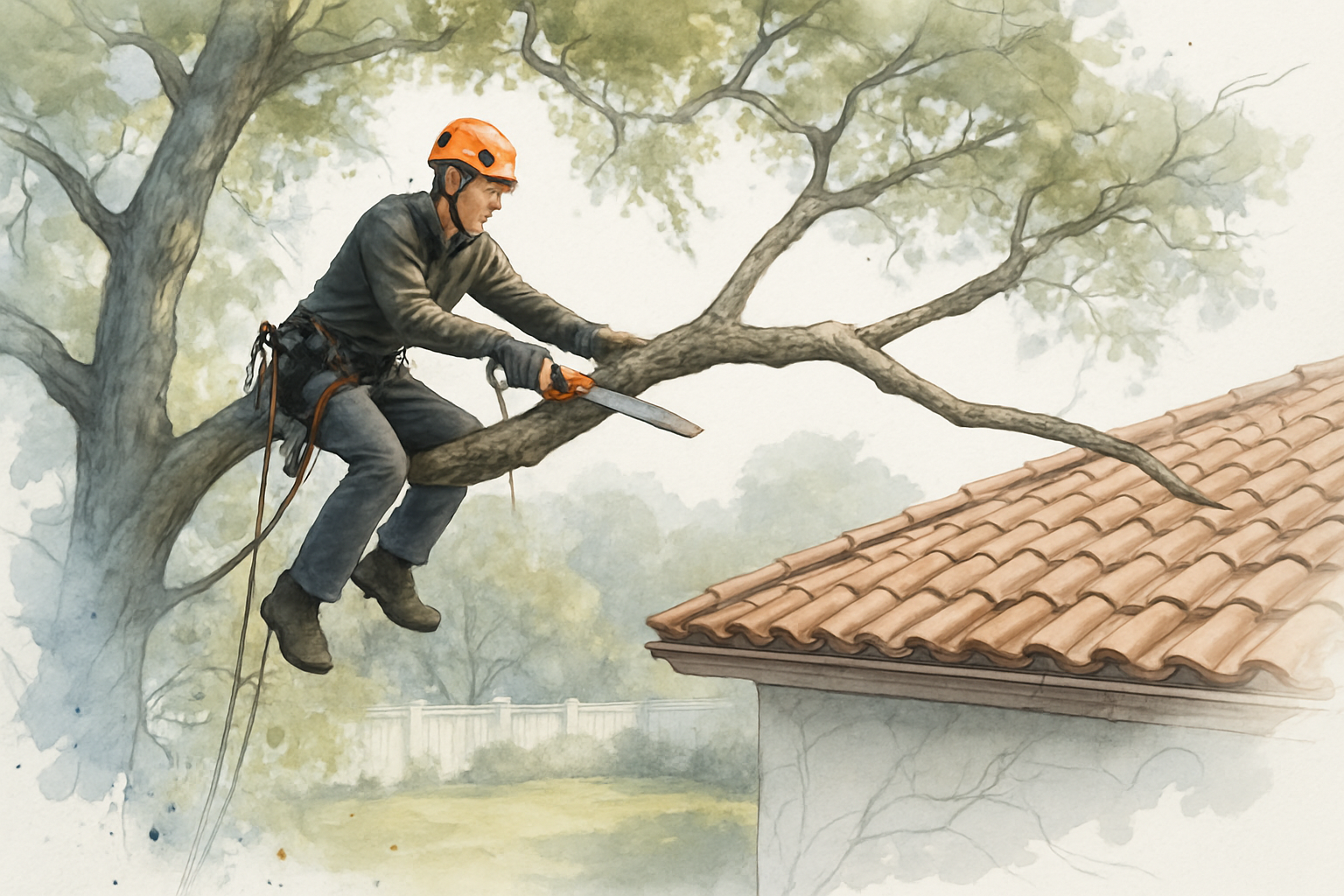
Here is the piece that catches almost everyone, including some crews. Insurers tend to send inspection letters in exactly the months when birds are nesting.
California Department of Fish and Wildlife biologists commonly define the nesting season as February 1 through August 15, as noted in this California municipal tree work guidance. Local bird groups point out that some species in central California nest into late August, and raptors and hummingbirds fall outside that typical window entirely.
When work genuinely cannot wait, a responsible crew does three things:
- Surveys the canopy for active nests before any cut is made, from up in the tree, not from the driveway
- Leaves any section with an active nest untouched until the young have fledged
- Sequences the rest of the work so the roofline gets cleared and the nest area gets finished later
Songbird nests are small and camouflaged well enough that you can stand under one for ten minutes and never see it. Palms are especially easy to get wrong. A quick look from the ground is not the same as an inspection from inside the canopy, and I have had crews find nests on the second pass that nobody spotted on the first.
Scope Matters More Than Season
This is the distinction that resolves most of these standoffs, and it almost never makes it into the insurance letter.
Targeted safety cuts are a small ask of a tree. Removing deadwood, taking out a broken limb, pulling branches back off a roofline, these can generally be done outside the ideal window on most species without much consequence.
Heavy structural work is a completely different level of stress. A large crown reduction, a one sided cut, or anything approaching topping asks the tree to recover during a season when it may not have the reserves to do it.
And insurance mandates have been driving a wave of over pruning nationally. Lion’s tailing, where the interior growth is stripped and all the weight ends up at the branch tips. One siding, where an entire half of the canopy comes off to satisfy a clearance number.
Both produce weak, fast growing shoots that are more likely to fail in the next winter storm. Pruning done to satisfy a risk letter can create the exact failure the carrier was worried about. That is why the standard on our jobs is safety first, without destroying the tree.
If you are trying to understand what drives the bid you receive, what goes into the price of tree trimming in San Jose breaks that down separately.
Which Work Can Move, and Which Should Wait
Here is roughly how I sort the request when a homeowner in Almaden Valley or Campbell forwards me an insurance letter.
| Type of Work | Timing Flexibility | What We Check First |
|---|---|---|
| Deadwood removal | Generally any month | Nest survey, wound size on oaks |
| Broken or hanging limb | Immediate, any month | Rigging path, drop zone, nearby structures |
| Roofline clearance cuts | Generally any month on most species | How much foliage is being lost, nest activity |
| Crown reduction (heavy) | Wait for the species window when possible | Species, tree health, storm season timing |
| One sided cut or topping | Not recommended in any season | Whether the goal can be met another way |
| Removal | Assess and permit before scheduling | Whether clearance solves the carrier’s issue instead |
The Order That Keeps Homeowners Out of Trouble
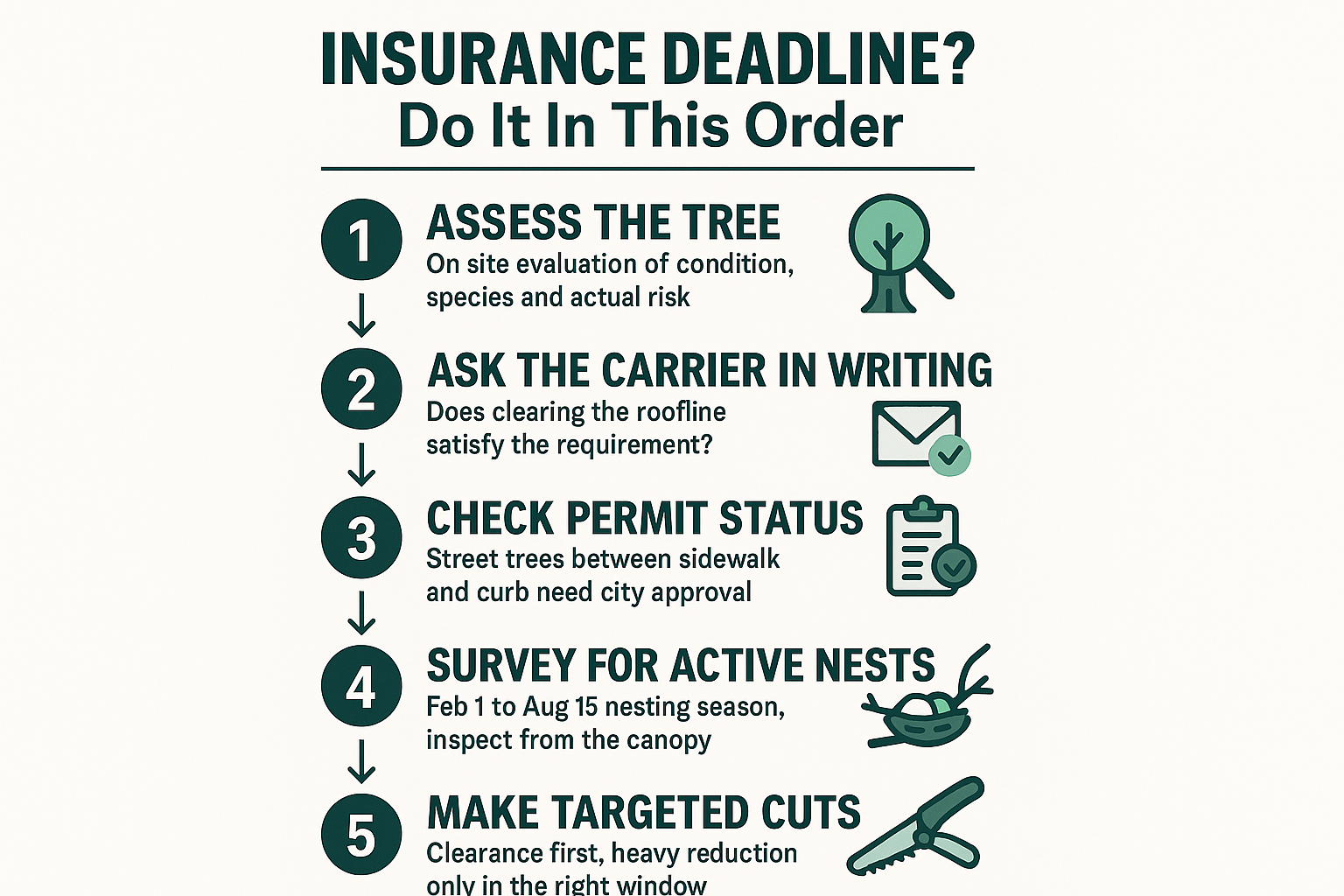
When there is a deadline involved, the sequence matters as much as the cutting. Doing it in this order protects the tree, the wildlife, and your wallet.
How to Handle the Carrier Before You Cut Anything
Most homeowners read the letter as an order to remove a tree. In my experience it usually is not.
Ask your agent in writing whether trimming to clear the roofline satisfies the requirement. Carriers often accept clearance when the underlying issue is overhang or roof contact, not the tree itself. Get that answer on paper before you agree to take down a mature tree you cannot replace.
In foothill neighborhoods like Saratoga and Los Gatos, the request may be driven by wildfire and ember modeling rather than the branch. That can mean clearance distances stricter than anything in city code, and it changes the conversation from pruning to defensible space.
Then there is the wrinkle that catches San Jose homeowners off guard. If the branch belongs to a tree in the park strip between the sidewalk and the street, the city requires a permit before you prune it. Unpermitted street tree work can carry penalties that run into the thousands of dollars per tree.
If you are not sure which category your tree falls into, who actually owns the tree in front of your house sorts that out, and what San Jose requires before a tree comes down covers the removal side.
Assessment, permit, then cutting. That order has saved more than a few of my clients a fine they never saw coming.
What an Arborist Assessment Adds to an Insurance File
There is one more thing worth knowing, because homeowners rarely find out it exists until they need it.
A written evaluation of the tree’s condition and the work performed is often exactly what a carrier wants on file. Not a receipt for trimming, but a documented statement of what was found and what was done about it.
Formal arborist reports and preservation plans are a distinct service, prepared from an on site evaluation rather than a template. They are the same kind of document cities ask for during permit review, and they carry weight with an underwriter for the same reason: someone qualified looked at the tree and wrote down what they saw. There is more on that in what a professional tree assessment actually covers.
Robert Apolinar is a Board-Certified Master Arborist, the highest ISA credential, and San Jose Tree Service & Landscaping has been BBB accredited since 2013 with a 4.96 star average across 70 Google reviews.
The part that matters most under deadline pressure is restraint, and a longtime customer said it better than I can: “They’re super knowledgeable and never push work that doesn’t need to be done.” – Kathryn P.
Frequently Asked Questions About Insurance Deadlines and Tree Trimming
My insurer gave me 30 days. Can the work really wait for the right season?
The clearance cuts usually do not need to wait. Taking branches back off a roof is a targeted cut that most species handle fine any month of the year. What should wait, when possible, is heavy reduction work. If your carrier is asking for a large reduction on an oak in the spring, that is worth a conversation with both the agent and an arborist before anyone climbs.
Will my insurance company accept trimming instead of removal?
Often, yes, when the issue is overhang or roof contact rather than the tree’s condition. Ask in writing and keep the response. In Saratoga and Los Gatos, wildfire modeling may drive a stricter clearance request, which is a different standard than a simple overhang concern.
What happens if there is a bird nest in the tree?
We leave that section alone until the young have fledged and sequence the rest of the work around it. Nesting season is commonly defined as February 1 through August 15, though some central California species nest later. It rarely stops a job. It just changes the order of operations.
The branch is over the sidewalk. Do I need a permit?
If the tree sits in the park strip between the sidewalk and the curb, San Jose treats it as a street tree and requires a permit before pruning. Unpermitted work on street trees can carry serious penalties. Check ownership before you schedule anything.
Can I just have the crew cut back the side facing the house?
You can, but I would push back on it. One sided cuts throw the canopy out of balance and trigger weak, fast growing shoots that are more failure prone in the next winter storm. There is almost always a way to get the clearance the carrier wants while keeping the tree structurally sound.
Working Through an Insurance Letter About Your Trees?
If you have a renewal deadline and a mature tree over the roof in San Jose, Willow Glen, Almaden Valley, or the surrounding cities, an on site look will tell you what the letter cannot: whether clearance solves it, whether a permit applies, and what the tree can safely handle this month. San Jose Tree Service & Landscaping can be reached at (408) 422-1313 or at sanjosetreemaintenance.com if you would like that assessment on the calendar. The goal is safety, health, and longevity, in that order.
