 Skip to content

Direct Answer: A stump left in the ground will slowly decay over years, attract wood-boring insects and fungal disease, and can send up unwanted sprouts — all of which may cause problems for nearby trees, structures, or your yard.
A tree comes down — maybe from a storm, maybe because it was dead, maybe because it was just in the wrong spot — and the stump stays behind. It’s not hurting anything right now, so it can wait. That’s a reasonable thought. But what actually happens to a stump over the next few years is something most homeowners don’t find out until there’s already a problem.
In the San Jose area, where mature-tree neighborhoods like Willow Glen and Almaden Valley have decades-old root systems winding under lawns and near foundations, a stump that looks harmless above ground is doing real work below it. The decay process, the pest activity, and the root behavior that follows a cut tree are all worth understanding before you decide to leave it.
This article covers what actually happens to a stump over time — the biological process, the risks that come with it, and the point at which leaving it becomes a decision you’ll regret.
The Decay Timeline: What’s Actually Happening Underground
When a tree is cut down, the stump doesn’t just sit there doing nothing. It starts a long, slow biological process that plays out over 5 to 20 years, depending on the species, the size, and the conditions around it.
For the first year or two, the stump holds its structure. The wood is still relatively hard, the roots are still intact, and depending on the species, the tree may attempt to push out new growth from the root collar or nearby lateral roots. Oaks and California bay laurel — both common in San Jose neighborhoods — are particularly aggressive resprouters.
By years three through five, moisture from soil and rainfall starts breaking down the outer wood. You’ll see:
- Surface cracking and darkening
- Soft, punky wood when you press on the edges
- Fungal growth or mushrooms appearing at the base
- Bark separating from the wood
The core of a large stump can take 10 to 15 years to fully decompose. A redwood or cedar stump may hold its structure even longer because those species have naturally rot-resistant heartwood. During all of this time, the decaying material is creating an ideal habitat for insects and disease organisms — and that’s where the real problems start.
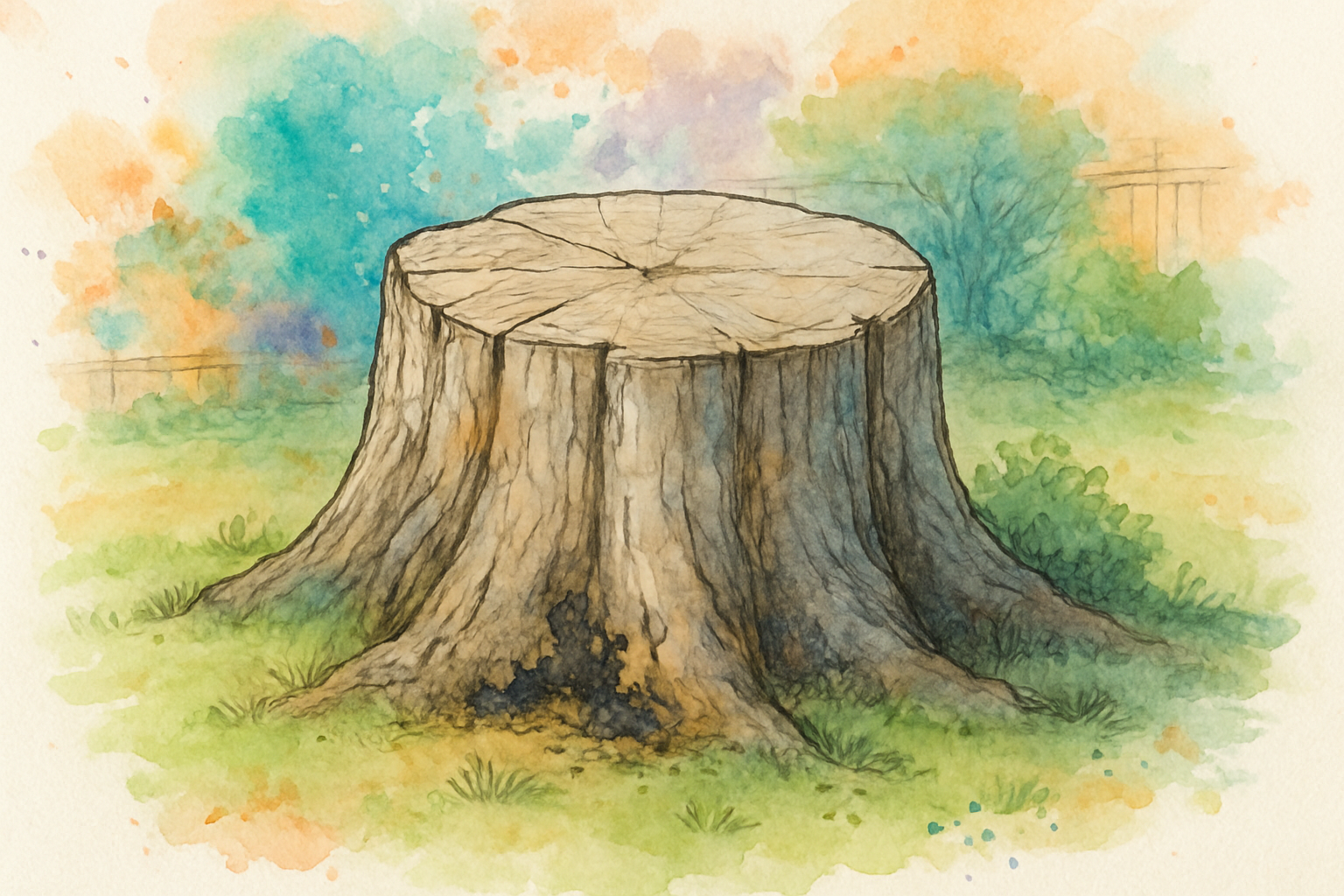
Pests and Fungal Disease: Who Moves In After the Tree Comes Down
A decaying stump is one of the most attractive environments for wood-boring insects in the region. Termites, carpenter ants, and wood-boring beetles all use rotting stumps as a nesting site and food source. Once established, these colonies don’t always stay in the stump.
In neighborhoods like Los Gatos and Saratoga, where homes often sit close to mature oak and redwood plantings, a termite colony that started in a backyard stump can migrate toward a home’s foundation or wooden fence line within a few seasons. That’s not a hypothetical — it’s a pattern that shows up in property inspections regularly.
Fungal disease is the other concern worth taking seriously. Several fungal pathogens that attack living trees travel through root-to-root contact underground. Armillaria (honey fungus) and Ganoderma are two of the more aggressive ones in the Bay Area. A stump infected with either can pass that infection through shared root zones to nearby healthy trees — sometimes before any above-ground symptoms appear.
If you have a tree within 20 to 30 feet of a stump showing fungal growth, it’s worth having someone assess the situation. The Tree Stump Removal Guide for San Jose Homeowners covers the options in more detail, but the first step is understanding whether disease is already present.
The Stump Decay Timeline at a Glance
Here’s how a stump typically changes from the day a tree is cut through full decomposition — and when each type of problem tends to emerge.

Root Regrowth and the Lawn Problems That Follow
One thing homeowners underestimate is how aggressively some trees try to come back. If the root system is still healthy after a cut, many species will send up sprouts — sometimes dozens of them — from the base of the stump or from lateral roots several feet away.
Chinaberry, mulberry, and tree-of-heaven (Ailanthus altissima) are some of the worst offenders in the San Jose area. These sprouts aren’t just cosmetically annoying. If left alone, they can become multi-stem shrubs within a single growing season, and the root system — which is already mature — can push them to significant size fast.
Even species that don’t resprout aggressively leave behind a decaying root network that causes its own issues:
- Soil voids form as large roots decompose underground, creating depressions and soft spots in the lawn
- Surface roots that were once supported by the living tree can shift, crack pavement, or create trip hazards
- Water retention in the decaying wood can affect drainage patterns in the surrounding soil
For homeowners planning to replant in the same area, this matters. Many species won’t thrive in a spot where a large root mass is still actively decomposing — the chemistry of the soil changes, and competition for nutrients from the decaying root system can affect new plants for several years.
Common Stump Outcomes by Tree Species in San Jose
Different tree species behave very differently after removal. Here’s what to expect from the most common trees in San Jose residential yards.
| Tree Species | Resprout Risk | Decay Speed | Key Concern |
|---|---|---|---|
| Coast Live Oak | Moderate | Slow (10–15 yrs) | Armillaria fungus can spread to nearby oaks via roots |
| California Bay Laurel | High | Moderate (7–12 yrs) | Aggressive resprouting; difficult to control without stump treatment |
| Mulberry | Very High | Moderate (6–10 yrs) | Will regrow repeatedly without grinding; fast-growing sprouts |
| Redwood | High | Very Slow (15–20+ yrs) | Rot-resistant wood; strong resprout rings common around base |
| Liquid Amber / Sweetgum | Low | Moderate (7–10 yrs) | Surface root lifting causes pavement and lawn damage as decay progresses |
| Eucalyptus | Very High | Slow (10–15 yrs) | Resprouts vigorously; fire risk in foothill areas like Saratoga without complete stump removal |
When Leaving It Alone Is Actually Fine — and When It’s Not
Not every stump needs to be ground out immediately. In some situations, leaving a stump to decay naturally is a reasonable choice. In others, it becomes a liability.
Leaving it is generally low-risk when:
- The stump is far from structures, fences, and living trees
- The species is not a known resprouter
- There’s no evidence of fungal disease at the time of removal
- You’re not planning to replant or hardscape in that area
Removing it becomes more urgent when:
- The stump is within 20 feet of your home’s foundation or a wooden fence
- You’re seeing mushrooms or conk-like fungal growths at the base
- The tree that was removed was diseased
- Sprouts are already appearing and you’re in a restricted water district (actively fighting regrowth wastes irrigation)
- You’re planning a landscape renovation or new planting nearby
If you’re weighing the decision and there’s a healthy tree nearby that you want to protect, it’s worth getting a proper assessment before assuming the stump is benign. Understanding when a tree problem requires an arborist — not just a trimmer is often the clearest way to get an honest answer about what’s happening underground.
Stump Grinding vs. Full Removal: A Quick Practical Breakdown
Most homeowners assume stump grinding and stump removal mean the same thing. They don’t.
Stump grinding uses a machine to chip the stump down 8 to 12 inches below grade. The root system stays in the ground and continues to decay on its own. This is the most common and cost-effective option, and it’s usually sufficient unless disease is a factor.
Full stump and root removal involves extracting the root ball — or as much of it as equipment can reach. This is more disruptive, more expensive, and typically only necessary when replanting in the exact same location or when the root system itself is diseased.
In the San Jose market, stump grinding typically runs $150 to $400 for a standard residential stump, depending on diameter and accessibility. A stump that’s close to a fence, irrigation lines, or hardscaping will cost more to grind because access is harder and care has to be taken not to damage surrounding features.
For anyone dealing with a stump near an irrigation system, it’s worth knowing that root intrusion is one of the more common causes of sprinkler problems that get expensive when you wait on them — decaying roots can collapse around lateral lines and cause slow leaks that go unnoticed for months.
Frequently Asked Questions About Leaving a Stump in the Ground
Will a stump eventually just go away on its own?
Yes, but it takes a long time — often 10 to 20 years for a large stump to fully decompose, and the process isn’t clean. You’ll deal with fungal growth, insect activity, soil voids, and potential resprouting long before it’s gone.
Can a stump really spread disease to my other trees?
It can. Fungal pathogens like Armillaria travel through root-to-root contact underground. If the tree that was removed was infected, and the stump sits near healthy trees, there’s a real risk of transmission — especially with oaks, which are susceptible and common throughout Almaden Valley and Willow Glen. A certified arborist can assess whether that risk is present before you decide anything.
How do I know if the stump on my property has a fungal problem?
The most visible signs are mushrooms or shelf-like growths (called conks) at the base of the stump or at soil level around the root zone. Dark staining on the wood, a honey-colored fungal mat under the bark, and a distinctly sweet or musty smell are also indicators. If you’re seeing any of these, it’s worth having someone take a look before the season changes.
My neighbor’s tree stump is close to my property line. Should I be worried?
It depends on the species and whether there are signs of disease. Root systems don’t respect property lines, and a stump with an active fungal infection on your neighbor’s side can affect your trees. It’s a conversation worth having — and if there’s a shared mature tree involved, a certified arborist assessment can document the situation clearly for both parties.
Can I plant something new where the old stump is?
You can, but timing matters. Planting directly over or adjacent to a decomposing stump can be tricky — the decaying root mass ties up nitrogen in the soil and may harbor disease. Grinding the stump first and waiting one growing season before replanting in the same spot gives new plants a much better start.
Is stump treatment with chemicals a good option?
Chemical stump treatments — typically potassium nitrate-based products — accelerate the natural decay process, but they still take 6 to 12 months to show real effect and require regular applications. They work best on small to medium stumps that aren’t near water features or irrigation lines. For stumps showing active disease, grinding is almost always the more reliable answer.
Not Sure What to Do With a Stump on Your Property?
If you’ve got a stump sitting in your yard — whether it’s been there a season or several years — and you’re not sure whether to act on it, San Jose Tree Service & Landscaping can take a look and give you a straight answer. We serve homeowners throughout San Jose, Los Gatos, Saratoga, Campbell, and surrounding communities. Reach us at (408) 422-1313 or visit sanjosetreemaintenance.com to learn more about what we do.
