 Skip to content

Direct Answer: A pre-storm tree risk inspection checks root flare, soil movement, crown balance and end weight, stem unions, upper deadwood, and past pruning damage, then documents the tree’s condition in writing.
The calls I get in January all sound the same. A big limb came down in the wind, or a tree that stood quietly for forty years is suddenly leaning over the driveway, and the homeowner wants to know why nobody saw it coming.
Usually somebody could have. Most of the structural problems that show up during a winter storm were visible months earlier, at the base of the tree, in the fork of two stems, or in the shape of the canopy.
This article walks through what a tree risk assessment before storm season actually covers, why the difference between a quick look and a written assessment matters more than most people think, and which trees in San Jose yards should be at the front of the line this fall.
Why This Fall Is the Window That Matters
As of mid-2026, El Nino conditions are in place. NOAA’s forecasters have flagged roughly a two-in-three chance of a very strong event during November through January, which you can track through the Climate Prediction Center’s ENSO diagnostic discussion.
I am not telling you that to make you nervous. I am telling you because the practical preparation window is now through early fall, before the ground gets soft.
Here is the mechanism that actually causes failures in Santa Clara County. Saturated soil reduces how well roots anchor a tree, and storm wind loads the canopy at the same time. Neither one alone usually brings down a healthy tree. Together they find every weak point.
Once the rains start, three things change at once:
- Access gets harder, especially on sloped lots and soft lawns where equipment can rut the ground
- Emergency rates apply instead of scheduled work
- The failure zone under the tree stops being a hypothetical and becomes a fence, a car, or a roof
If you want a longer read on how wet winters affect trees that were already struggling, we covered that in El Nino wet seasons hit struggling trees hardest.
What I Actually Look At During a Pre-Storm Inspection
A walk around the yard tells you almost nothing about structure. Here is what a real inspection covers, and roughly why each item is on the list.
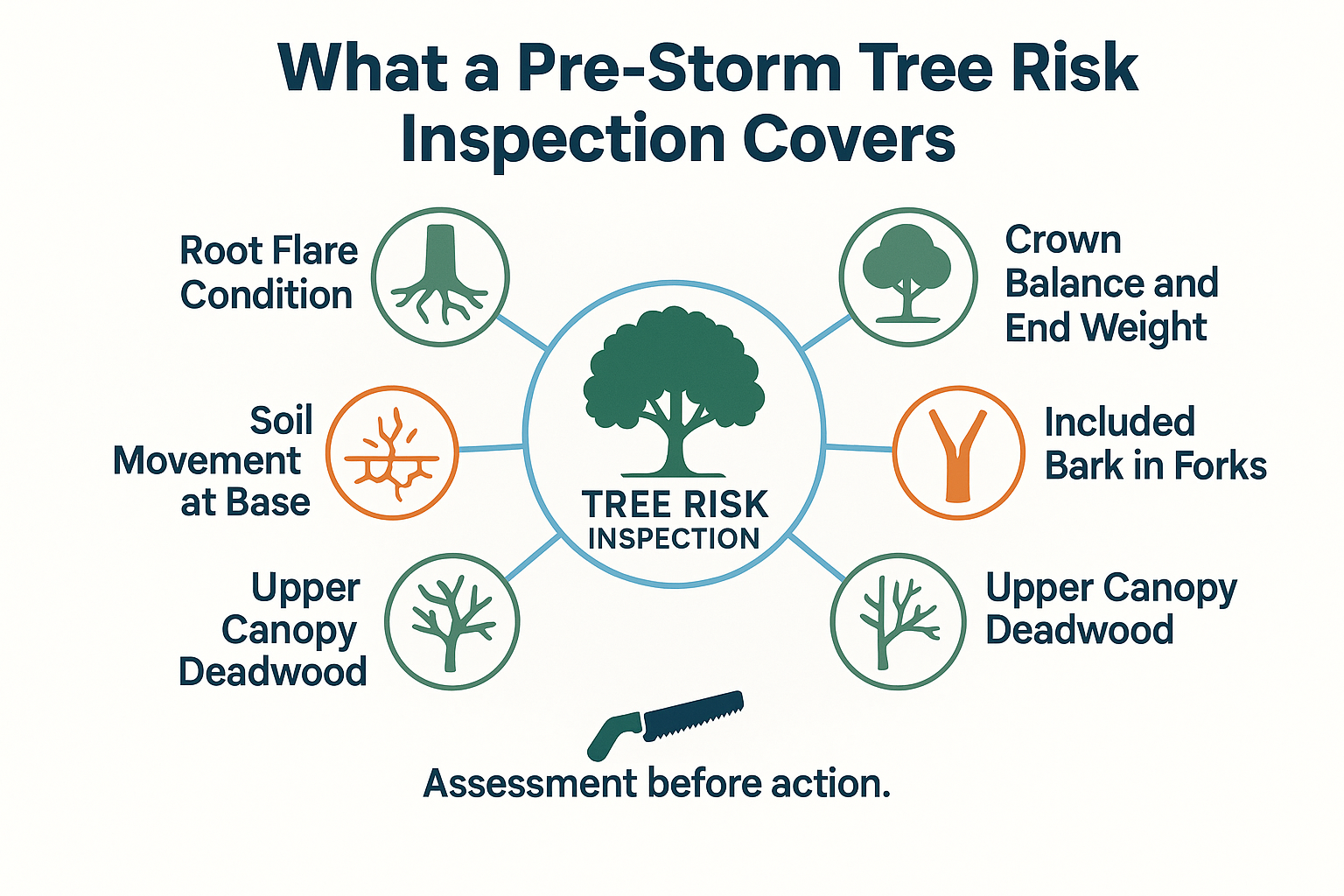
- Root flare condition. Where the trunk widens into the roots is where a huge share of serious decay hides. If that flare is buried under soil, mulch, or turf, I want to see what is underneath it.
- Soil movement at the base. Cracked, lifted, or mounded soil on one side of the trunk can mean the root plate is already shifting. That is one of the few signs I treat as urgent.
- Crown balance and end weight. A canopy that has grown heavy at the tips on one side is a lever. Wind acts on that lever.
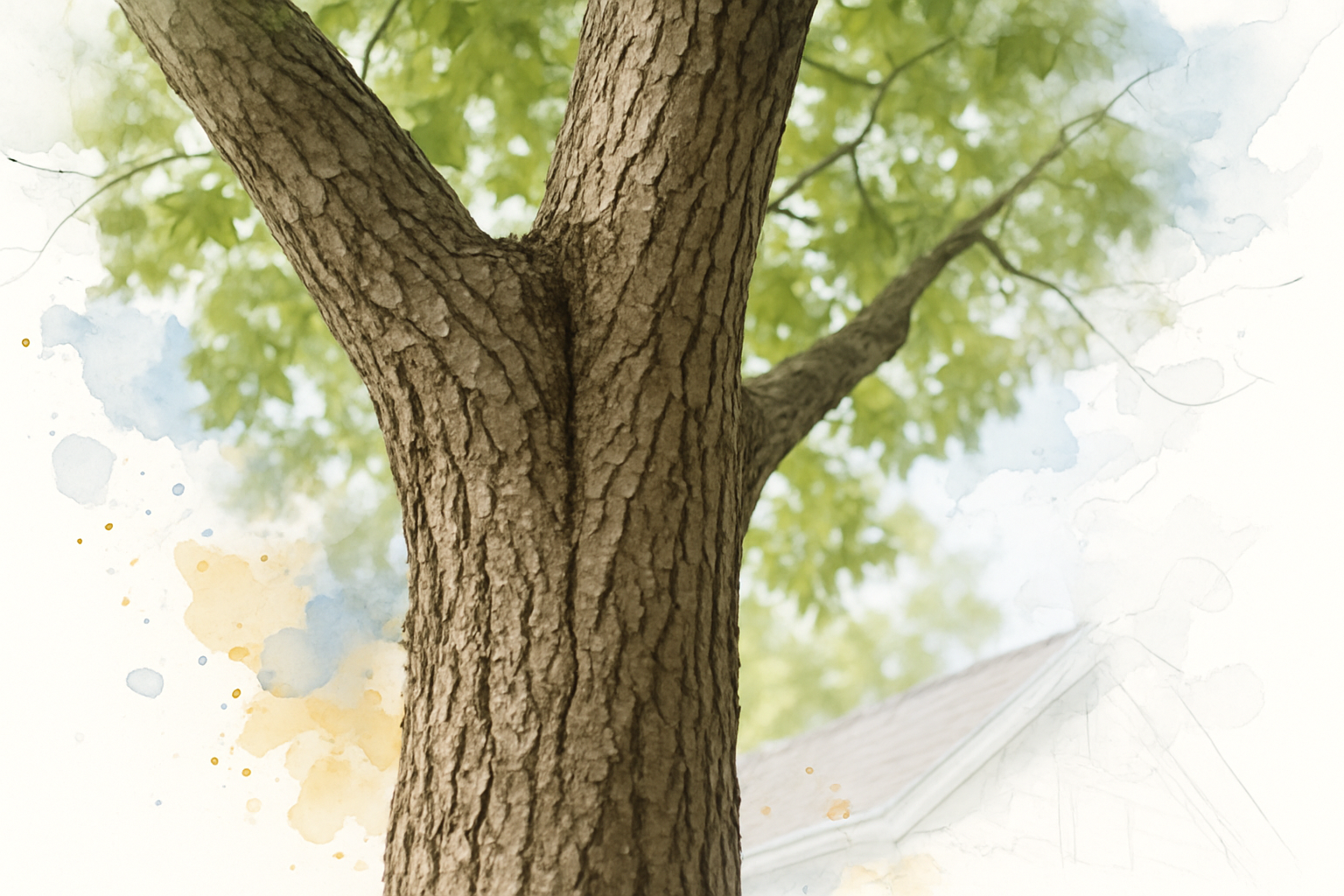
- Included bark in major forks. Two stems that grew together with bark pinched between them never formed a real structural union.
- Deadwood in the upper canopy. Not the obvious dead branch at eye level. The ones you cannot see from the patio.
- Prior pruning history. Old topping cuts, flush cuts, and lion-tailing all create weak regrowth that behaves badly under load.
In San Jose’s clay-heavy soils, root zone condition gets extra attention. Clay that pools water near the base during a wet winter starves roots of oxygen and drives decline that is completely invisible from the sidewalk but readable up close.
The Trees That Go to the Top of My List
Not every tree needs the same level of scrutiny. If I had one afternoon on a South Bay property before the rains, these are the ones I would spend it on.
Trees with co-dominant stems and included bark unions. These are the classic pre-storm failures in Willow Glen and Campbell yards. The union has been stable for twenty years, so the homeowner reasonably assumes it is fine. Then saturated soil and a loaded canopy change the math in one night.
Trees with prior storm damage. A limb that tore out three winters ago left a wound. What matters is how the tree responded to it, and whether decay moved into the trunk behind that wound.
Large trees over structures, driveways, or a neighbor’s property. The tree’s condition matters, but so does what sits underneath it. A struggling tree at the back fence line is a very different conversation than the same tree over a bedroom.
Hillside properties. Almaden Valley, Los Gatos, and Saratoga add slope instability to the picture. Wet conditions on a slope reduce anchorage in ways a flat lot does not, and a good assessment should say so specifically rather than treating every property the same.
If you have a tree that has started to tilt, that deserves its own look. We wrote about how to tell a harmless lean from a real problem in your tree is leaning, here is how to figure out if that is a problem.
The Six Things a Pre-Storm Inspection Checks
A quick reference for what separates a real structural inspection from a look around the yard.
A General Checkup vs. a Written Risk Assessment
Both have their place. The difference shows up when someone else needs proof of what you knew and when you knew it.
| What You Get | General Tree Checkup | Written Arborist Assessment |
|---|---|---|
| On-site look at the tree | Yes | Yes |
| Verbal recommendations | Yes | Yes |
| Dated written record of condition | No | Yes |
| Documented recommended actions | Rarely | Yes |
| Usable with an insurer or HOA | No | Typically yes |
| Supports a city permit application | No | Often required |
| Best for | Routine maintenance planning | Large trees over structures, disputes, insurance, permits |
Why the Written Part Matters More Than People Expect
Most homeowners do not think about documentation until they need it. Then it becomes the only thing that matters.
A written assessment from a certified arborist does three specific things. It records the tree’s condition on a specific date. It states what was recommended. And it establishes that the property owner acted on the information available to them.
That last part is the one that gets overlooked. If a large tree fails and damages a neighbor’s garage, the question that comes up is not just whether the tree was healthy. It is whether you knew, and what you did about it.
Several callers this past spring brought up insurance directly. One described a carrier pushing back over overhanging limbs. Written documentation of condition and completed work is a far stronger response than a verbal assurance from anyone.
HOAs and small commercial properties run into the same thing. When a board has to justify spending on tree work, or explain why a tree was left standing, a dated report from a credentialed arborist is the document that ends the argument. We go deeper on that credential difference in 6 things a board-certified arborist does that a tree crew doesn’t.
What This Kind of Inspection Costs and What Drives It
I get asked about price early in almost every conversation, so let me be straight about how it works instead of quoting a number that may not apply to your property.
A basic estimate for a defined job, like trimming a specific tree, is usually a different thing than a diagnostic consultation. The consultation is where an arborist is paid for judgment rather than labor, and in Santa Clara County that generally runs into the low hundreds of dollars depending on scope. A formal written report or preservation plan sits above that because it takes documentation time after the site visit.
What moves the number:
- How many trees are being assessed, and their size
- Whether internal decay testing is needed, such as percussion testing or a resistograph
- Whether you need a verbal recommendation or a written report that meets city standards
- Slope, access, and whether the root zone is buried or paved over
- Whether the report supports a permit application
Some companies, including ours, will do a free photo review as a first pass to tell you whether an on-site visit is even warranted. Photos cannot show root flare condition or internal decay, but they can often tell you whether something is urgent. Call (408) 422-1313 for current pricing on your situation rather than working off a number you read online.
And if you are weighing pruning this fall, timing matters as much as cost. We covered that in the right time to prune before an El Nino winter.
The Question Most People Are Actually Asking
Behind almost every one of these calls is one sentence. A homeowner said it plainly to us this spring: the tree might need to be removed, or it might just need treatment, and they just needed someone to tell them if it could be saved.
That is the whole point of a pre-storm inspection. It answers that question while you still have options.
Removal is a last resort, not a default. A lot of what looks alarming from the patio is treatable, and a lot of what looks fine has real structural trouble underneath. Proper assessment before action, every season, is how you tell the two apart.
Safety first, without destroying the tree. The goal is safety, health, and longevity, and you get more of all three when the decision is made in September than in January.
Frequently Asked Questions About Pre-Storm Tree Inspections
How often should a large tree over my house be inspected?
For a mature tree over a structure, once a year is reasonable, and ideally before the wet season. If the tree has a known defect, prior storm damage, or sits on a slope, more frequent looks make sense. Trees away from targets can go longer between inspections.
Can you tell what is wrong from photos instead of coming out?
Sometimes, and it is a fair first step. Photos are good for identifying obvious pest and disease symptoms, dieback patterns, and whether something looks urgent. What photos cannot show is root flare condition, soil movement, or internal decay, which are exactly the things that matter most before storm season.
Do I need to be home for the inspection?
For a straightforward estimate, usually not. For a diagnostic consultation I would rather you be there, because half the value is the conversation about what we are seeing and what your options are.
My tree looks fine. Is an inspection a waste of money?
Sometimes the answer is that the tree is in good shape and needs nothing, which is a legitimate result. The trees that fail in San Jose winters are frequently the ones that looked fine from the ground. Included bark unions and buried root flare decay do not announce themselves.
Will I need a permit to do the work the inspection recommends?
It depends on the tree and the city. San Jose regulates street trees and protected trees, and pruning can fall under those rules, not just removal. An arborist familiar with local requirements should flag this before any work starts rather than after.
Thinking About a Pre-Storm Look at Your Trees?
If you have a large tree over a roof, driveway, or shared fence line in San Jose, Los Gatos, Saratoga, or Campbell, the months before the rains are the easiest time to get clear answers about it. Our arborist-led assessments are available now through the fall, and a photo review is a reasonable first step if you are not sure whether a site visit is warranted. You can reach us at (408) 422-1313 or at sanjosetreemaintenance.com whenever you are ready to ask.
