
Direct Answer: In San Jose, a tree measuring 38 inches or more in trunk circumference at 4.5 feet above the ground is ordinance-size, and removing it on residential property generally requires a city permit.
Most homeowners who call me about a tree already know permits exist somewhere in the picture. What they cannot figure out is whether their tree is big enough to count.
That is a fair question, and the answer is more specific than people expect. San Jose does not judge a tree by how tall it looks or how old the neighbors say it is. The city uses a measurable trunk size, and once a tree crosses that line, the rules change.
I want to walk you through exactly where that line sits, how to measure your own tree in about five minutes, and what actually happens after you find out you are over the threshold. No scare tactics. Just the numbers and the process.
What Counts as an Ordinance-Size Tree in San Jose
Under San Jose Municipal Code Chapter 13.32, a tree becomes ordinance-size when its trunk measures 38 inches or more in circumference, taken at 4.5 feet above the ground.
That 38 inches of circumference works out to roughly 12 inches in diameter. Wrap a tape around the trunk at chest height, and if the number comes back at 38 or higher, the city has a say in what happens to that tree.
Here is why that surprises people: 12 inches of diameter is not a giant tree. It is a mid-size tree that plenty of yards in Willow Glen, Almaden Valley, and Cambrian already contain.
- A liquidambar planted when the house was built in the 1970s is almost certainly over the line
- A Chinese pistache that has been in the ground 15 to 20 years often is too
- A Coast Live Oak that looks modest from the street can clear the threshold easily
- Even a fruit tree, if it has been left to mature, can qualify
So the mental shortcut of “it’s not that big, I’m fine” is the exact assumption that gets people in trouble. Measure first. That is the whole point of reading up before a tree comes down.
How to Measure Your Own Tree in Five Minutes
You do not need an arborist to get a rough answer. You need a tape measure and a little care about where you put it.
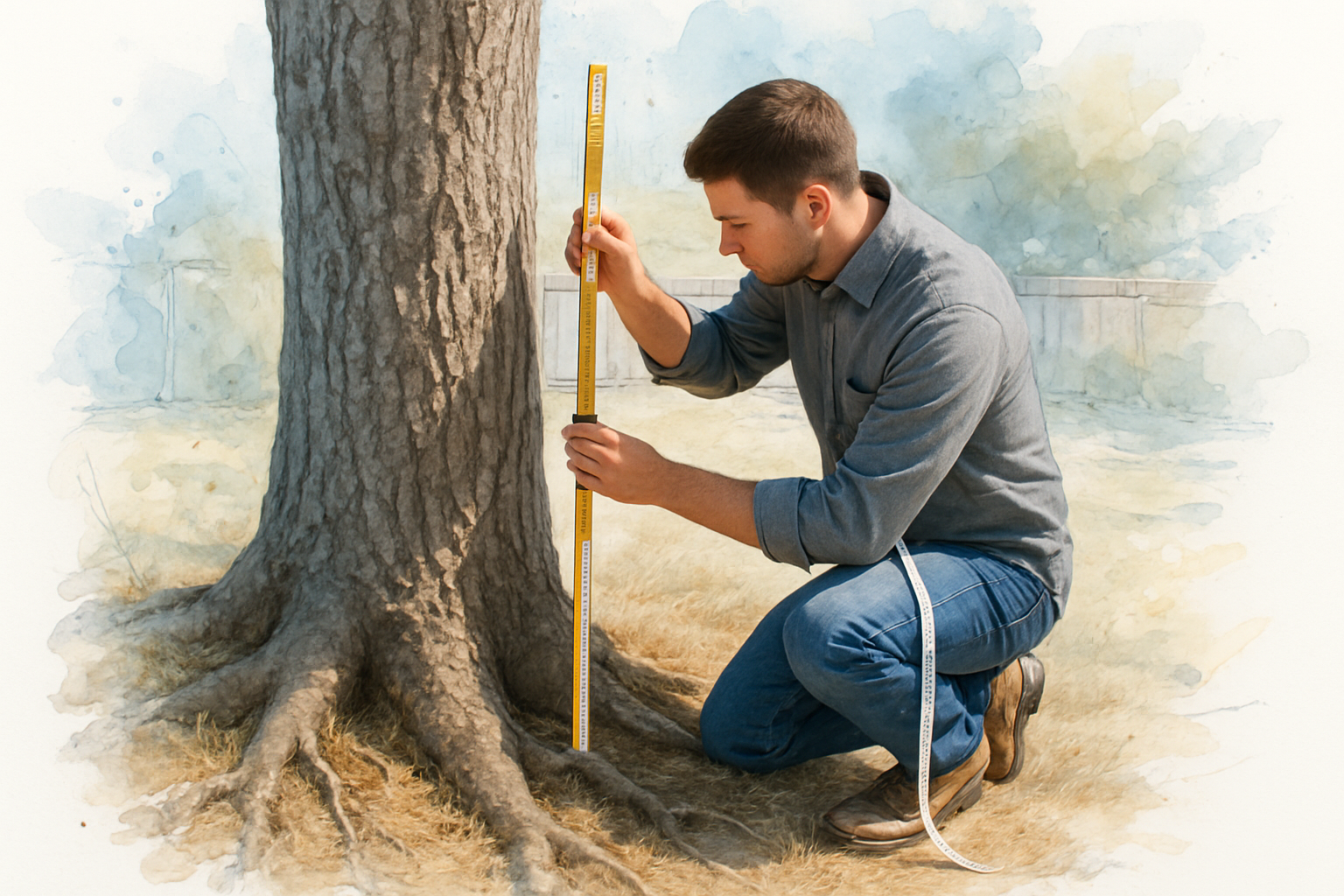
- Find 4.5 feet up the trunk. That is standard chest height for most adults. Mark it with a piece of tape or just hold your finger there.
- Wrap a flexible tape around the trunk at that mark, snug but not biting into the bark. Keep the tape level, not angled.
- If the tree is on a slope, measure 4.5 feet up from the ground on the uphill side. This is the standard arborists use, and it usually gives a smaller number than measuring from the downhill side.
- Avoid measuring over a burl, a graft union, or a swollen knot. If there is a bulge right at 4.5 feet, measure just below or above it and note that you did.
- Write down the number. 38 inches or more means ordinance-size.
No flexible tape? Wrap a string around the trunk, mark where it overlaps, then lay the string flat against a rigid tape.
Multi-trunk trees are the tricky case. A tree with three or four stems, each one skinny on its own, can still be a substantial tree with a single large root system. Depending on how the combined circumference is measured at that height, a multi-trunk tree may land squarely in ordinance-size territory even though no single stem looks big. If that is your situation, confirm it with the City Arborist’s office or have an arborist measure it before you plan any work.
Trunk Measurement Quick Reference
Use this to translate the number on your tape into what it likely means for your property. These are rounded conversions to give you a fast read, not a substitute for a formal measurement.
| Circumference at 4.5 ft | Approximate diameter | What it generally means |
|---|---|---|
| Under 30 inches | Under 9.5 inches | Below the threshold, but worth remeasuring every few years as it grows |
| 30 to 37 inches | 9.5 to 11.8 inches | Close to the line. Measure carefully and consider getting a second read |
| 38 inches | About 12 inches | Ordinance-size. Removal on residential property generally requires a permit |
| 50 to 80 inches | 16 to 25 inches | Clearly ordinance-size. An arborist report is commonly part of the application |
| Over 100 inches | Over 31 inches | Large mature specimen. Check the Heritage Tree Map before any work is planned |
Heritage Trees Are a Separate and Stricter Category
Ordinance-size is one set of rules. Heritage designation is another, and it is considerably more serious.
Under San Jose Municipal Code, it is illegal to prune or remove a heritage tree without first consulting the City Arborist and obtaining a permit. Note the word pruning. This is not only about removal.
The penalties reflect how seriously the city treats these trees. Fines for unpermitted work on a heritage tree start around $10,000 and can reach $30,000 per tree for repeat violations, according to the City of San Jose’s heritage tree information. Heritage status is granted by City Council designation, not by size alone.
The important practical point: you cannot tell by looking. A heritage tree does not have a plaque on it. The city maintains a Heritage Tree Map, and the only reliable ways to confirm status on a private property are to check that map or contact the City Arborist’s office directly.
I have had homeowners tell me a previous contractor waved off the question and said the tree was fine to cut. If that assurance turns out to be wrong, the property owner carries the exposure, not the crew that drove away. Verification takes one phone call or one map lookup. It is worth doing before anyone starts a saw.
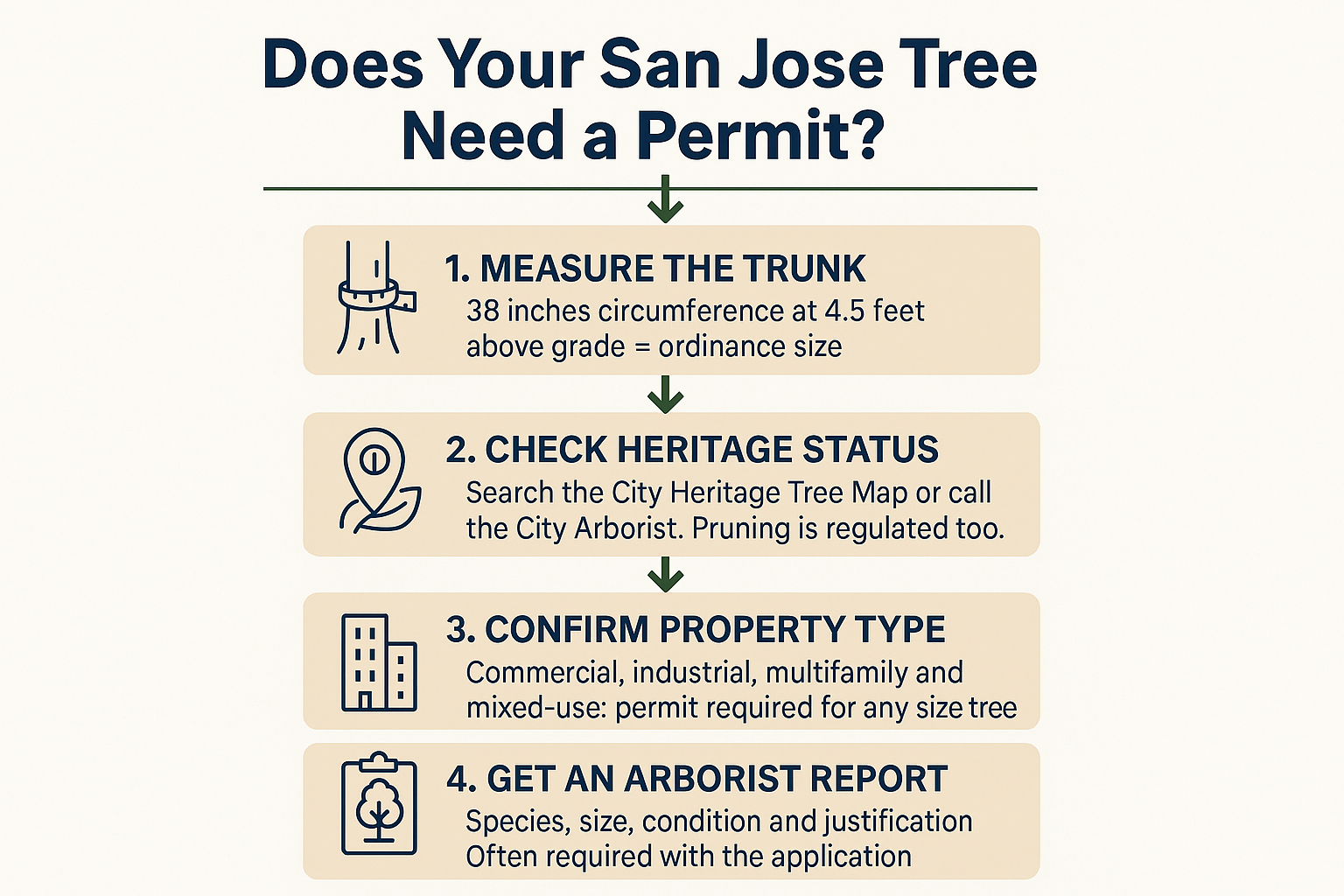
Does Your Tree Need a Permit? A Quick Decision Path
This walks through the four checks I run in my head when a homeowner asks whether their tree is regulated.
If You Manage a Commercial, Multifamily, or HOA Property, the Rule Is Different
This is the part that catches property managers off guard, and I get these calls regularly from HOA boards and small commercial owners around San Jose.
For commercial, industrial, multifamily, and mixed-use properties, the 38-inch threshold does not apply the same way. On those property types, any tree removal requires a permit regardless of the tree’s size.
So a small ornamental in a townhome complex courtyard is treated differently than the same tree in a single-family backyard. A board member reading the residential rules online can reach the wrong conclusion in good faith.
- Confirm your property’s zoning designation before assuming residential rules apply
- The City Planning Division can tell you which rules govern your specific parcel
- A certified arborist familiar with San Jose requirements can also confirm this during an assessment
If you manage multiple trees across a site, it is usually cheaper and faster to sort out the permit picture once, up front, than to handle it tree by tree as issues come up.
What the Permit Process Actually Looks Like
Once you know you are over the threshold, the process is more orderly than most people fear. Here is the sequence I walk homeowners through.
- Assessment on site. An arborist confirms the measurement, identifies the species, and evaluates condition. This is where a tree that “has seen better days” sometimes turns out to be treatable rather than removable.
- The arborist report. Many removal applications require a signed report from a certified arborist documenting the tree’s species, size, condition, and the specific justification for removal. Several homeowners have called me saying exactly this: they need someone who can write a report for the city.
- Application submittal. The report goes to the city with the permit application.
- Review and conditions. The city reviews the justification. Replacement planting is a common condition of approval.
For a genuine imminent hazard involving an ordinance-size tree, San Jose has an expedited over-the-counter pathway when a signed certified arborist report confirms the hazard. That means a legitimately dangerous tree does not have to wait weeks, provided the documentation is prepared correctly.
On cost, I will not quote you a number I cannot stand behind. Permit fees, report fees, and the removal itself all vary with tree size, access, and site complexity, and the report portion depends on how much diagnostic work the tree needs. Our office can give you a real figure once we know what we are looking at. If you want to understand what drives the numbers, what goes into the price of tree work in San Jose breaks it down.
And a reminder worth repeating: proper assessment before action. Removal is the last option on my list, not the first. Plenty of ordinance-size trees people call about are candidates for structural pruning, cabling, or a health treatment plan instead.
Frequently Asked Questions About Ordinance-Size Tree Permits in San Jose
Do I need a permit just to prune an ordinance-size tree, or only to remove it?
For most private residential ordinance-size trees, the permit requirement centers on removal. Heritage trees are the exception, since pruning a heritage tree without consulting the City Arborist and getting a permit is not allowed. Street trees in the park strip between the sidewalk and the curb also have their own pruning rules, which is covered in more detail in our piece on who actually owns the tree in front of your house.
What if the tree is already dead? Do I still need a permit?
Do not assume dead means exempt. Verify with the city or with an arborist before any cutting starts. A signed certified arborist report documenting the condition is typically what makes that determination straightforward.
My tree has four trunks that are each pretty small. Am I under the threshold?
Maybe not. A multi-trunk tree can meet the ordinance-size threshold based on how combined circumference is measured at 4.5 feet, even though no single stem looks large. Multi-trunk trees are exactly the case where I would confirm with the City Arborist’s office rather than guessing.
My insurance company is pushing me to cut back a tree over the roof. Does that change the permit rules?
Insurance pressure is a real motivator and I hear it often, but it does not override city requirements. The good news is that most insurance concerns about overhanging limbs are resolved with structural pruning or crown reduction, not removal, which is a much simpler path. Safety first, without destroying the tree.
A contractor told me my tree does not need a permit. Is that good enough?
Not on its own. The property owner carries the financial and legal exposure if that assessment is wrong. Ask them to show you the measurement and confirm the tree is not on the Heritage Tree Map, or verify it yourself with the City Arborist’s office.
How long does the permit take?
It depends on the tree, the justification, and how complete the application is when it goes in. A clean submittal with a well-documented arborist report moves faster than one the city has to send back for more information. For a confirmed imminent hazard, the expedited over-the-counter pathway exists specifically so urgent situations are not stuck in a queue.
Not Sure Where Your Tree Falls?
If you have measured your trunk and landed somewhere near 38 inches, or you simply want the heritage status confirmed before anything gets scheduled, our office can help you sort out which rules apply to your parcel. We handle arborist assessments and city reports for homeowners and HOAs across San Jose, Willow Glen, Almaden Valley, Los Gatos, Saratoga, and Campbell. Reach us at (408) 422-1313 or sanjosetreemaintenance.com whenever you are ready to talk it through.
