 Skip to content

Direct Answer: Before El Niño season, ask an arborist about structural soundness, signs of disease, overhanging branches, cabling needs, and what to watch for during storms.
El Niño years bring a particular kind of anxiety to homeowners in San Jose, Los Gatos, and Saratoga — especially those with mature trees close to the house. One soaking storm can turn a tree that looked fine all summer into a genuine emergency by morning.
The problem is most people wait until something breaks to call an arborist. By then, the options are limited and the costs are higher. A pre-season walkthrough — before the first major storm rolls through — is almost always the smarter move.
These five questions are the ones worth asking before El Niño season hits Silicon Valley. They don’t require any tree knowledge to ask. But the answers can tell you a lot about what’s coming and what, if anything, needs to happen now.
1. Is This Tree Structurally Sound Enough to Handle Heavy Rain and Wind?
This is the starting point for every pre-storm conversation. And the honest answer can only come from a hands-on inspection — not a glance from the sidewalk and definitely not a photo sent by text.
A proper structural assessment means getting close to the trunk, checking the root flare, looking for cracks in major limbs, and examining the canopy for branch attachments that have weakened over time. What a certified arborist actually covers in a professional tree assessment goes well beyond what most homeowners expect.
Things a structural check is looking for:
- Included bark in major branch unions (a weak attachment point that fails under load)
- Cracks or splits in the trunk or primary scaffold branches
- One-sided canopy weight that puts uneven stress on the root system
- Previous wound sites that may have hollowed out internally
- Root zone disturbance from past construction or irrigation trenching
In neighborhoods like Willow Glen and Almaden Valley, where mature sycamores and redwoods are common, structural problems often hide in plain sight for years — until a wet, windy January exposes them.
2. Does This Tree Have Any Disease or Decay That Wet Conditions Could Accelerate?
Prolonged moisture doesn’t just stress healthy trees — it actively accelerates problems that were already brewing quietly underground or inside the wood.
Fungal pathogens are the main concern. Armillaria root rot, Phytophthora, and several wood-decay fungi all thrive when soil stays saturated for extended periods. If any of these are already present in your tree, an El Niño winter can push a manageable issue into a structural emergency faster than most homeowners realize.
Catching disease early genuinely changes the outcome. A tree with early-stage root rot that gets diagnosed in October has options that the same tree in February — after three months of El Niño rain — may not.
Ask the arborist specifically about:
- Mushrooms or conks growing at the base of the trunk (classic decay indicator)
- Soft or discolored wood beneath bark at the root flare
- Sudden dieback in one section of the canopy
- Weeping sap or unusual bark staining anywhere on the trunk
For foothill communities like Saratoga and Los Gatos, where soils can shift dramatically between well-draining slopes and compacted valley clay, root disease is more common than most people expect. Understanding when a tree problem requires an arborist rather than just a trimmer is an important distinction before you make that first call.
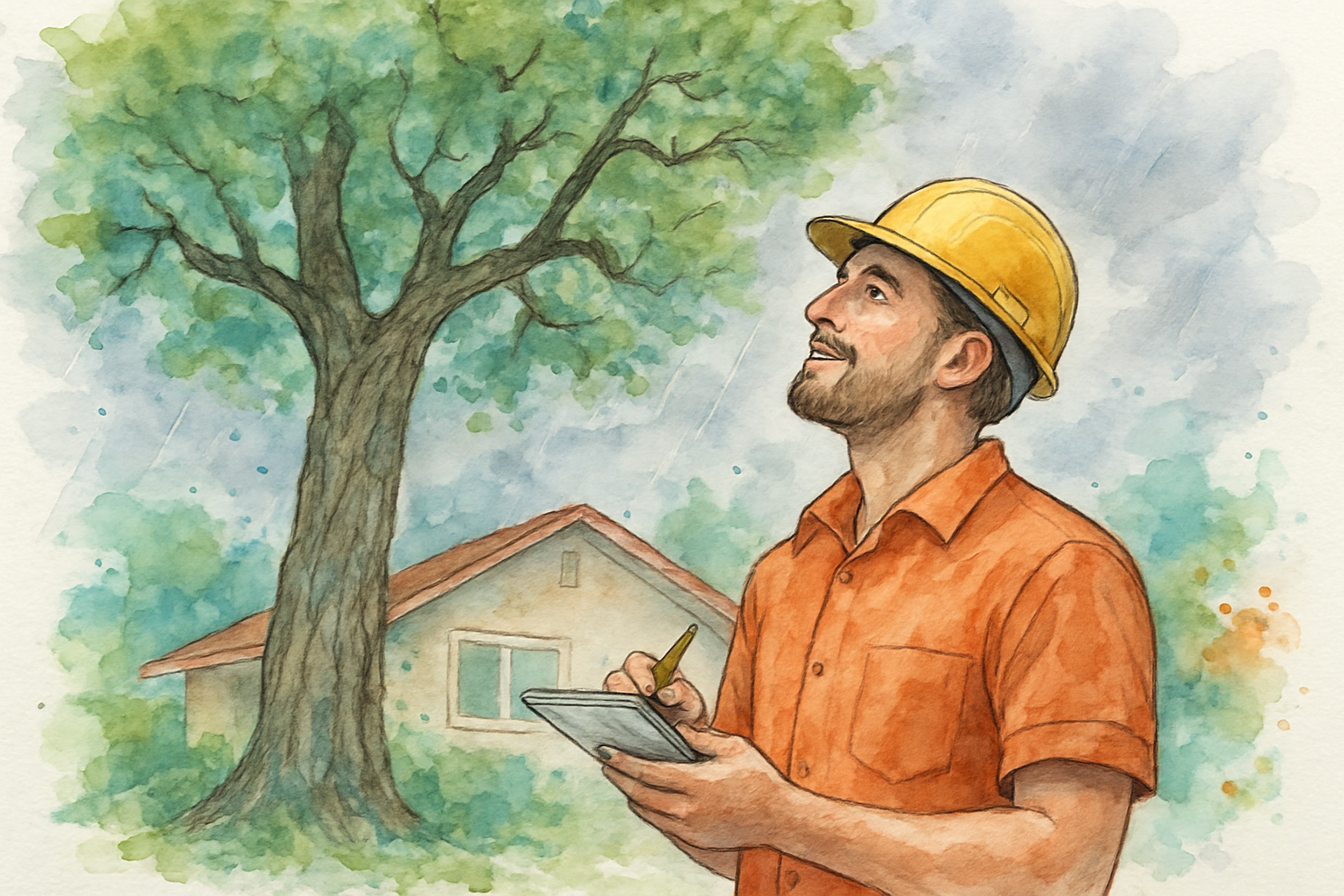
3. Are There Branches Over My Roof, Driveway, or Utility Lines That Should Be Pruned Now?
This one feels obvious, but it’s easy to underestimate how much a branch can move during a major storm — and how little clearance it actually needs to cause real damage.
Proactive crown management before storm season is one of the most cost-effective things a homeowner can do. A branch removed cleanly in October costs a fraction of what emergency cleanup costs in January — and that’s before you factor in any roof or vehicle damage.
But not all pruning is equal. There’s a significant difference between removing a genuinely hazardous limb and cutting branches that don’t need to come down. An arborist should be able to explain exactly which branches are a real risk and why — not just point at large limbs and recommend removal as a precaution.
The areas to pay particular attention to:
- Branches within 10 feet of the roofline — especially those with downward hang
- Deadwood in the upper canopy — dead branches fall first in wind events
- Limbs crossing utility lines — these often require coordination with PG&E depending on proximity
- Low-hanging branches over driveways — a soaked, heavy branch can drop with almost no warning
In Campbell and Santa Clara, where older neighborhoods have trees that grew up before anyone thought much about clearance, this issue comes up constantly.
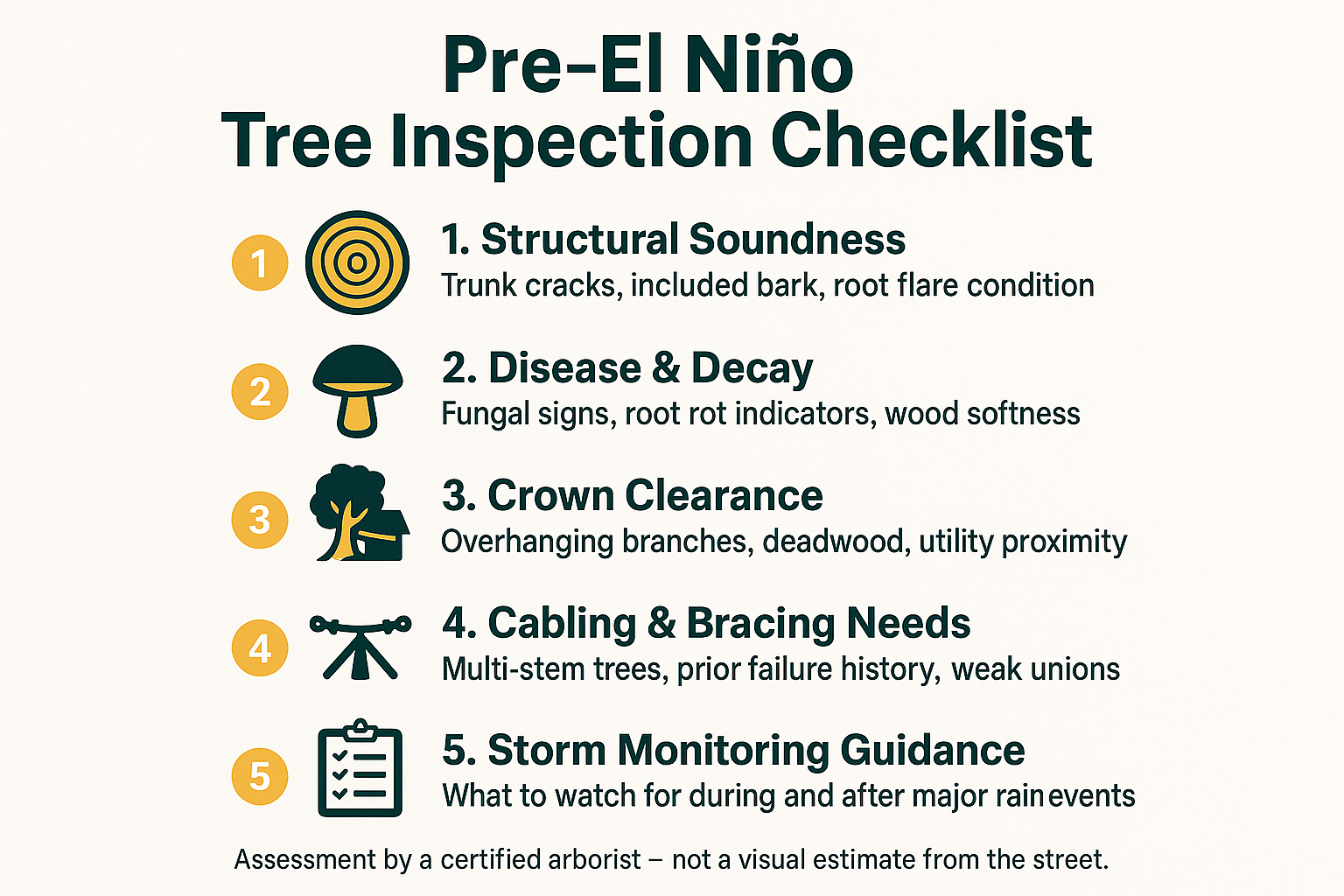
What a Pre-El Niño Tree Inspection Actually Covers
This breakdown shows the five main areas a qualified arborist checks during a pre-storm tree assessment — and what each one is looking for.
4. Should Any of My Trees Be Cabled or Braced Before Winter?
Most homeowners have never heard of cabling and bracing unless an arborist brought it up. But for the right tree in the right situation, it’s one of the most practical tools available for reducing storm risk without removing a tree.
Cabling installs a steel cable between two major limbs to limit how far apart they can spread under load. Bracing uses threaded rods to stabilize a split or weak union. Together, they can extend the life of a structurally compromised tree by years — sometimes decades — while keeping it safe.
The trees most likely to benefit are:
- Multi-stem trees (two or more trunks growing from the same base) — these are especially prone to splitting apart in high winds
- Trees with previous failure history — if a large limb already came down once, the rest of the canopy likely has the same structural pattern
- Large ornamental trees with sentimental or aesthetic value that a homeowner wants to preserve
Cabling is not a permanent fix for every tree, and it’s not the right call in every situation. But when an arborist recommends it, it usually means they see a tree worth saving — and a specific mechanical reason why the support would work. For more on what goes into that kind of professional evaluation, understanding what a certified arborist actually does helps put those recommendations in context.
Cabling vs. Removal: When Each Makes Sense
These aren’t rigid rules — they’re general indicators an arborist weighs when deciding whether support systems are appropriate or whether removal is the more responsible path.
| Situation | Cabling / Bracing Often Appropriate | Removal More Likely Warranted |
|---|---|---|
| Structural issue | Weak union, co-dominant stems, minor split | Severe internal decay, hollow trunk |
| Tree health | Otherwise healthy, good root system | Advanced disease, failing root system |
| Location | Away from high-traffic zones, clearance exists | Directly over occupied structure or utility lines |
| Failure history | One past limb failure, isolated incident | Multiple failures, recurring pattern |
| Homeowner goal | Preserve long-term with managed risk | Eliminate risk completely |
5. What Should I Watch for During and After a Major Storm?
A good arborist doesn’t just assess and leave. They should send you away with a clear picture of what to monitor — because how quickly you respond to post-storm changes can make a real difference in what happens next.
This isn’t about turning homeowners into amateur arborists. It’s about knowing the difference between surface-level cosmetic damage and early signs of a developing structural problem.
After a significant El Niño storm, pay attention to:
- Sudden lean in a tree that was previously upright — even a few degrees of new tilt is significant
- Soil heaving or cracking around the root zone — a sign the root system may be moving
- Freshly exposed wood where a limb has torn away, leaving an open wound
- Cracks or splits that weren’t visible before the storm
- Drooping or hanging branches that are still attached but clearly compromised
For anything that looks actively dangerous, the right move is to keep people away from the area and get a professional out quickly. The San Jose emergency tree services guide for dangerous trees after a storm walks through exactly what that process looks like and when to call.
Knowing what to look for lets you act early — before a warning sign becomes a failure.
Frequently Asked Questions About Pre-Storm Arborist Inspections
When is the best time to schedule a pre-El Niño tree inspection in San Jose?
October and early November are the ideal window. That gives enough lead time to schedule any recommended pruning, cabling, or other work before the first major storm typically arrives in late November or December. Waiting until the first storm warning usually means arborists are already booked out.
How much does a tree inspection cost in San Jose?
A basic visual assessment from a licensed arborist often runs $150 to $300 depending on the number of trees and property size. A formal written risk assessment — the kind needed for permits or insurance documentation — typically runs $300 to $600 or more. Many companies will apply the inspection fee toward any work you proceed with.
Can I just have a tree crew look at my trees instead of a certified arborist?
A general tree crew can spot obvious problems, but they’re not trained to evaluate internal decay, root system health, or structural risk the way a certified arborist is. For anything beyond routine trimming — especially before a wet winter — an arborist’s evaluation is worth the difference. Understanding what a certified arborist does that a standard crew doesn’t explains this distinction in plain terms.
What if the arborist recommends removing a tree I want to keep?
Ask them to walk you through the specific reasons. A good arborist explains what they’re seeing — not just what they’re recommending. If the concern is structural, ask whether cabling, bracing, or crown reduction might reduce the risk enough to preserve the tree. Removal should be the last option, not the first.
Do I need a permit to prune or remove a tree in San Jose before storm season?
It depends on the species, size, and location. San Jose’s Heritage Tree Ordinance protects certain trees from removal or major pruning without a city permit. An arborist familiar with local regulations — including those in Los Gatos and Saratoga, which have their own tree ordinances — should be able to tell you what’s required before any work begins.
My tree looks fine from the street. Do I really need an inspection?
Honestly, yes — if there’s any reason for concern. Internal decay, root problems, and included bark in branch unions are almost never visible from the street. Some of the most dangerous tree failures in Silicon Valley involve trees that looked completely healthy right up until they fell.
Ready to Get Your Trees Assessed Before the Rains Arrive?
San Jose Tree Service & Landscaping serves homeowners throughout San Jose, Los Gatos, Saratoga, Campbell, and surrounding South Bay communities. If you have trees you’re uncertain about heading into El Niño season, a pre-storm inspection is the most practical step you can take right now. Reach the team at (408) 422-1313 or visit sanjosetreemaintenance.com to learn more.
